Author: Samuel M. Goldwasser
For contact info, please see the Sci.Electronics.Repair FAQ Email Links Page.
Copyright © 1994-2022
Reproduction of this document in whole or in part is permitted if both of the
following conditions are satisfied:
1. This notice is included in its entirety at the beginning.
The power supplies for even the smallest microwave ovens operate at extremely
lethal voltage and current levels. Do not attempt to troubleshoot, repair, or
modify such equipment without understanding and following ALL of the relevant
safety guidelines for high voltage and/or line connected electrical and
electronic systems.
We will not be responsible for damage to equipment, your ego, county wide
power outages, spontaneously generated mini (or larger) black holes, planetary
disruptions, or personal injury or worse that may result from the use of this
material.
For a long time, there was controversy as to whether microwave ovens were
safe - in terms of microwave emissions and molecular damage to the food.
Whether these issues have been resolved or just brushed aside is not totally
clear. Nonetheless, the microwave oven has taken its place in virtually
every kitchen on the planet. Connoisseurs of fine dining will turn up
their collective noses at the thought of using a microwave oven for much
beyond boiling water - if that. However, it is difficult to deny the
convenience and cooking speed that is provided by this relatively simple
appliance.
Microwave ovens are extremely reliable devices. There is a good chance
that your oven will operate for 10 years or more without requiring repairs
of any kind - and at performance levels indistinguishable from when it
was first taken out of the box. Unlike other consumer electronics
where a new model is introduced every 20 minutes - some even have useful
improvements - the microwave oven has not changed substantially in the
last 20 years. Cooking is cooking. Touchpads are now nearly universal
because they are cheaper to manufacture than mechanical timers (and also
more convenient). However, an old microwave oven will heat foods just
as well as a brand new one.
This document provides maintenance and repair information applicable to
most of the microwave ovens in existence. It will enable you to quickly
determine the likely cause and estimate the cost of parts. You will be
able to make an informed decision as to whether a new oven is the better
alternative. With minor exceptions, specific manufacturers and models will
not be covered as there are so many variations that such a treatment would
require a huge and very detailed text. Rather, the most common problems
will be addressed and enough basic principles of operation will be provided
to enable you to narrow the problem down and likely determine a course of
action for repair. In many cases, you will be able to do what is required
for a fraction of the cost that would be charged by a repair center - or - be
able to revive something that would otherwise have gone into the dumpster
or continued in its present occupation as a door stop or foot rest.
Should you still not be able to find a solution, you will have learned a great
deal and be able to ask appropriate questions and supply relevant information
if you decide to post to sci.electronics.repair. In any case, you will have
the satisfaction of knowing you did as much as you could before taking it in
for professional repair. You will be able to decide if it is worth the cost
of a repair as well. With your new-found knowledge, you will have the upper
hand and will not easily be snowed by a dishonest or incompetent technician.
It is quite possible your problem is already covered at the Microtech site.
In that case, you can greatly simplify your troubleshooting or at least
confirm a diagnosis before ordering parts. My only reservation with respect
to tech tips databases in general - this has nothing to do with Microtech
in particular - is that symptoms can sometimes be deceiving and a solution
that works in one instance may not apply to your specific problem. Therefore,
an understanding of the hows and whys of the equipment along with some good
old fashioned testing is highly desirable to minimize the risk of replacing
parts that turn out not to be bad.
More detailed explanations are provided elsewhere in this document.
However, if you can do the repair yourself, the equation changes dramatically
as your parts costs will be 1/2 to 1/4 of what a professional will charge
and of course your time is free. ;-) The educational aspects may also be
appealing. You will learn a lot in the process. Many problems can be
solved quickly and inexpensively. Fixing an old microwave for the dorm
room may just make sense after all. But this critically depends on it
being done safely!
Complete service manuals are often available free on-line. For example this
one is for my ancient (38+ year old) Sharp R-5960:
SHARP
MICROWAVE OVEN MODEL R-5960 SERVICe GUIDE (English). (The manual pdf which
was a scanned hardcopy OCR'd and then translated from German, which is why some
of the words don't make sense. It was the only version I could find on-line.)
But the microwave generation sections of most modern microwaves are similar.
(The exceptions being the relatively rare inverter-based ovens.)
Make sure the outlet is in good condition in either case. Check that the
plug (or adapter) fits tightly and that there is no appreciable heating
of the outlet during use of the microwave oven. If there is, spread the
metal strips of each of the prongs apart if possible and/or replace the
outlet.
A grounded outlet is essential for safety. Microwave ovens are high
power devices and a separate circuit will eliminate nuisance fuse blowing
or circuit breaker tripping when multiple appliances are being used at
the same time. It will also minimize the possibility of Radio Frequency
Interference (RFI) between it and any electronic equipment which might be
on the same circuit. A GFCI is not needed as long as the outlet is properly
grounded and may result in nuisance tripping with some microwave ovens.
Inexpensice outlet testers are available at hardware stores, home centers,
and electrical parts distributors, to confirm that the outlet is properly
wired and grounded.
If it is too late and you have a recurring problem of cockroaches getting
inside the electronics bay, tell them to get lost and then put window screen
over the vents (or wherever they are entering). Such an open mesh should
not affect the cooling of the electronic components significantly. However,
the mesh will likely clog up more quickly than the original louvers so make
sure it is cleaned regularly. If possible, clean up whatever is attracting
the unwanted tenants (and anything they may have left behind including their
eggs!!). WARNING: See the section: SAFETY before going
inside.
CAUTION: Do not spray anything into the holes where the door latch is inserted
or anywhere around the touchpad as this can result in internal short circuits
and costly damage - or anywhere else inside, for that matter. If you do this
by accident, immediately unplug the oven and let it dry out for a day or two.
WARNING: This only applies to a *working* microwave oven! If there is no
heat, the magnetron may not be drawing any current from the HV power
supply and the HV capacitor can remain charged for a long time. In this
case, there is a very real risk of potentially lethal electrical shock even
after several minutes or more of being unplugged! See the section:
SAFETY if you will be troubleshooting a microwave oven.
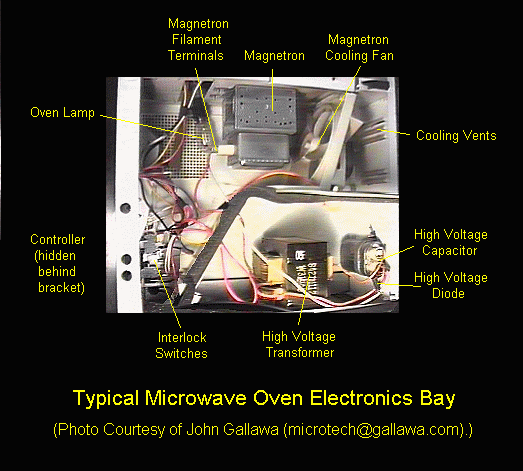
Please see Typical Microwave Oven Electronics Bay
for parts identification.
WARNING! WARNING! WARNING! WARNING! WARNING! WARNING! WARNING! WARNING!
Microwave ovens are probably the most dangerous of consumer appliances
to service. Very high voltages (up to 5000 V) at potentially very high
currents (AMPs) are present when operating - deadly combination. These
dangers do not go away even when unplugged as there is an energy storage
device - a high voltage capacitor - that can retain a dangerous charge
for a long time. If you have the slightest doubts about your knowledge
and abilities to deal with these hazards, replace the oven or have it
professionally repaired.
Careless troubleshooting of a microwave oven can not only can fry you from
high voltages at relatively high currents but can microwave irradiate you as
well. When you remove the metal cover of the microwave oven you expose
yourself to dangerous - potentially lethal - electrical connections. You
may also be exposed to potentially harmful levels of microwave emissions if
you run the oven with the cover off and there is damage or misalignment to
the waveguide to the oven chamber.
There is a high voltage capacitor in the microwave generator. Always ensure
that it is totally discharged before even thinking about touching or probing
anything in the high voltage power circuits. See the troubleshooting sections
later in this document.
To prevent the possibility of extremely dangerous electric shock, unplug
the oven from the AC outlet before removing the cover and do not plug it in
to operate it with the cover off if at all possible. If you must probe
live, remove the connections to the magnetron (see below) to prevent the
inadvertent generation of microwaves except when this is absolutely needed
during troubleshooting. Discharge the high voltage capacitor (with the oven
unplugged) and then use clip leads to make any connections before you plug
it in and apply power. Then after removing power and unplugging the oven
discharge the HV capacitor once again.
WARNING: Experienced technicians have been electrocuted deader than a brick
from even careful probing of the HV circuits of a powered microwave oven.
Therefore, I highly recommend avoiding any probing of the HV circuits - nearly
everything can be determined by inspection and component tests with the oven
unplugged.
The microwave oven circuitry is especially hazardous because the return for
the high voltage is the chassis - it is not isolated. In addition, the HV
may exceed 5000 V peak with a continuous current rating of over .25 AMP at
50/60 Hz - the continuous power rating of the HV transformer may exceed
1,500 W with short term availability of much greater power. Always observe
high voltage protocol.
There are two additionals non-electrical safety concerns that are
*probably* not present in consumer microwave ovens but still need
to be mentioned:
These guidelines are to protect you from potentially deadly electrical shock
hazards as well as the equipment from accidental damage.
Note that the danger to you is not only in your body providing a conducting
path, particularly through your heart. Any involuntary muscle contractions
caused by a shock, while perhaps harmless in themselves, may cause collateral
damage - there are many sharp edges inside this type of equipment as well as
other electrically live parts you may contact accidentally.
The purpose of this set of guidelines is not to frighten you but rather to
make you aware of the appropriate precautions. Repair of TVs, monitors,
microwave ovens, and other consumer and industrial equipment can be both
rewarding and economical. Just be sure that it is also safe!
For the microwave oven in particular, use a 25K to 100K resistor rated for
at least 5 kV and several watts with
a secure clip lead to the chassis. Mount the resistor on the end of a well
insulated stick. Touch each of the capacitor terminals to the non-grounded
end of the resistor for several seconds. Then, to be doubly sure that the
capacitor if fully discharged, short across its terminals with the blade of
a well insulated screwdriver. I also recommend leaving a clip lead shorting
across the capacitor terminals while working as added insurance. At most,
you will blow a fuse if you should forget to remove it when powering up the
microwave.
As noted, a GFCI (Ground Fault Circuit Interrupter) will NOT protect you
from the high voltage since the secondary of the HV transformer is
providing this current and any current drawn off of the secondary
to ground will not be detected by the GFCI. However, use of a GFCI is
desirable to minimize the risk of a shock from the line portions
of the circuitry if you don't have an isolation transformer.
An isolation transformer is even limited value as well since the chassis IS
the HV return and is a large very tempting place to touch, lean on, or brush
up against.
And, of course, none of these devices will protect fools from themselves!
Take extreme care whenever working with the cover off of a microwave oven.
There's little point to using an isolation transformer with a microwave
for testing the high voltage circuitry. It would have to be HUGE due to the
high power nature of a microwave oven and since the high voltage return is the
chassis which is grounded, it won't be terribly useful as noted above.
However, an isolation transformer can and should be used to test the primary
side circuitry if necessary including interlocks, motors, triac/relay, etc.
Disconnect the HV transformer to eliminate the possibility of high voltage
shock and to reduce the load.
Actually, the best policy is to NEVER EVER attempt to measure anything
in the HV section while the oven is powered - it's almost never needed in
any case. Failures are usually easily found by performing test with the
oven unplugged. If you insist on making live measurements, connect the
meter before power is applied and disconnect or move its probes only
after power is removed AND the HV cap has been discharged (even if the meter
catches fire or explodes!). Qualified service people have been electrocuted
using proper test equipment on microwave ovens!
If you get stuck, sleep on it. Sometimes, just letting the problem
bounce around in your head will lead to a different more successful
approach or solution. Don't work when you are really tired - it is both
dangerous (particularly with microwave ovens) and mostly non-productive
(or possibly destructive - very destructive).
If you need to remove the cover or other disassembly, make notes of which
screw went where - they may not all be identical. More notes is better
than less.
Pill bottles, film canisters, and plastic ice cube trays come in handy for
sorting and storing screws and other small parts after disassembly.
Select a work area which is well lighted and where dropped parts can
be located - not on a deep pile shag rug. Something like a large plastic
tray with a slight lip may come in handy as it prevents small parts from
rolling off of the work table. The best location will also be relatively
dust free and allow you to suspend your troubleshooting to eat or sleep or
think without having to pile everything into a cardboard box for storage.
A basic set of high quality hand tools will be all you need to work on a
microwave oven. These do not need to be really expensive but poor quality
tools are worse than useless and can cause damage. Stanley or Craftsman
are fine. Needed tools include a selection of Philips and straight blade
screwdrivers, needlenose pliers, wire cutters and wire strippers.
A medium power soldering iron and rosin core solder (never never use acid
core solder or the stuff for sweating copper pipes on electronic equipment)
will be needed if you should need to disconnect any soldered wires (on
purpose or by accident) or replace soldered components.
However, most of the power components in microwave ovens use solderless
connectors (lugs) and replacements usually come with these as well.
See the document: Troubleshooting and Repair of
Consumer Electronics Equipment for additional info on soldering and
rework techniques and other general information.
An assortment of solderless connectors (lugs and wirenuts) is handy when
repairing the internal wiring. A crimping tool will be needed as well but
the $4 variety is fine for occasional use.
Old dead microwaves can often be valuable source of hardware and sometimes
even components like interlock switches and magnetrons as these components
are often interchangeable. While not advocating being a pack rat, this
does have its advantages at times.
A DMM or VOM is necessary for checking of power supply voltages (NOT
the high voltage, however) and testing of interlock switches, fuses,
wiring, and most of the components of the microwave generator. This does
not need to be expensive but since you will be depending on its readings,
reliability is important. Even a relatively inexpensive DMM from Radio
Shack will be fine for most repair work. You will wonder how you ever
lived without one! Cost: $25-50.
Other useful pieces of 'test equipment':
There are special magnetron and microwave test instruments but unless you are
in the business, these are unnecessary extravagances.
The technique I recommend is to use a high wattage resistor of about 5 to
50 ohms/V of the working voltage of the capacitor. This will prevent the
arc-welding associated with screwdriver discharge but will have a short enough
time constant so that the capacitor will drop to a low voltage in at most a
few seconds (dependent of course on the RC time constant and its original
voltage).
The reason for specifying the resistor in this way is for voltage hold-off.
Common resistors only are rated for 200 to 500 V, but there may be as much
as 5 kV on the HV cap. You don't want the HV zapping across the terminals
of the resistor. Special high voltage resistors are available but they are
expensive and not readily available from common electronics distributors.
WARNING: DO NOT use a DMM for checking voltage on the capacitor unless you
have a proper high voltage probe. If your discharging did not work, you may
blow everything - including yourself.
A suitable discharge tool can be made as follows:
This discharge tool will keep you safely clear of the danger area. The
capacitor discharge indicator circuit described in the document:
Capacitor Testing, Safe Discharging and Other Related
Information can be built into the discharge tool if desired.
Again, always double check with a reliable high voltage meter or by shorting
with an insulated screwdriver!
Reasons to use a resistor and not a screwdriver to discharge capacitors:
Unplug the unit! Usually, the sheet metal cover over the top and sides
is easily removed after unscrewing 8-16 philips head or hex head sheet
metal screws. Most of these are on the back but a few may screw into the
sides. They are not usually all the same! At least one of these includes
a lockwasher to securely ground the cover to the case.
Note that on some ovens (I've heard that some Sharp models do this), there
may also be one screw that is slightly longer than the others to engage a
safety case interlock switch and prevent the oven from getting power if it
is not present or one of the shorter screws is used in its place.
So, with the cover removed, nothing is powered inside (which is a good
thing for safety!). But when the cover is
replaced with the screws in random locations, there's a high probability
that the oven no longer works at all. Kind of like Russian Roulette.
And, if it's then taken to a service center, they will know someone has
been inside. If less than entirely honest, they can make any sort of
claim they want as to what might have been damaged even if all you did
was remove and replace the cover without touching anything inside.
"The repair will be $195 because you blew out the touch panel by removing the
cover."
Therefore, it is essential to make note of any differences
in screw types so they can be put back in the same place. The cover will
then lift up and off. Note how fingers on the cover interlock with
the main cabinet - these are critical to ensure prevention of microwave
leakage after reassembly.
Please see Typical Microwave Oven Electronics Bay
for parts identification. Not all ovens are this wide open. If yours is a
compact unit, everything may be really squeezed together. :) Details will
vary depending on manufacturer and model but most of the major components will
look fairly similar to those depicted in the photo. Note that for this model,
the oven lamp is actually inside the electronics bay right next to the high
voltage on the magnetron filament - light bulb changing here is really best
left to a professional if you would otherwise not go inside!
Discharge the high voltage capacitor as described in the section:
Safe discharging of the high voltage capacitor
before even thinking about touching anything.
A schematic showing all of the power generation components is usually
glued to the inside of the cover. How much of the controller is included
varies but is usually minimal.
Fortunately, all the parts in a microwave can be easily replaced and most of
the parts for the microwave generator are readily available from places
like MCM Electronics, Dalbani, and Premium Parts.
Reassemble in reverse order. Take particular care to avoid pinching any
wires when reinstalling the cover. Fortunately, the inside of a microwave
is wide open and this is not difficult. Make sure ALL of the metal fingers
around the front edge engage properly with the front panel lip. This is
critical to avoid microwave emissions should the waveguide or magnetron
become physically damaged in any way. Confirm that the screws you removed
go back in the proper locations, particularly the one that grounds the
cover to the chassis.
A typical microwave oven uses between 500 and 1000 W of microwave energy
at 2.45 GHz to heat the food. This heating is caused mainly by the vibration
of the water molecules. Thus plastic, glass, or even paper containers will
heat only through conduction from the hot food. There is little transfer of
energy directly to these materials. This also means that the food does not
need to be a conductor of electricity (try heating a cup of distilled water)
and that electromagnetic induction (used elsewhere for high frequency
non-contact heating) is not involved.
What is significant about 2.45 GHz? Not that much. Water molecules are not
resonant at this frequency. A wide range of frequencies will work to heat
water efficiently. 2.45 GHz was probably chosen for a number of other reasons
including not interfering with existing EM spectrum assignments and convenience
in implementation. In addition, the wavelength (about 5 inches) results in
reasonable penetration of the microwave energy into the food. The 3 dB (half
power) point is about 1 inch for liquid water - half the power is absorbed in
the outer 1 inch of depth, another 1/4 of the power in the next inch, and so
forth.
From: Barry L. Ornitz (ornitz@tricon.net).)
Water has numerous resonances over the entire spectra range, but the lowest
frequency resonance is the rotational resonance is around 24 GHz. Other
resonances occur in the millimeter wave range through the infrared.
For references, check books on microwave spectroscopy by Townes and Gordy."
Since the oven chamber cavity is a good reflector of microwaves, nearly all
the energy generated by the oven is available to heat the food and heating
speed is thus only dependent on the available power and how much food is being
cooked. Ignoring losses through convection, the time to heat food is roughly
proportional to its weight. Thus two cups of water will take around twice as
long to bring to a boil as one.
Heating is not (as popularly assumed) from the inside out. The penetration
depth of the microwave energy is a few cm so that the outside is cooked faster
than the inside. However, unlike a conventional oven, the microwave energy
does penetrate these few cm rather than being totally applied to the exterior
of the food. The misconception may arise when sampling something like
a pie filling just out of the microwave (or conventional oven for that
matter). Since the pie can only cool from the outside, the interior filling
will appear to be much hotter than the crust and will remain that way for a
long time.
One very real effect that may occur with liquids is superheating. It is
possible to heat a pure liquid like water to above its boiling point
if there are no centers for bubbles to form such as dust specks or container
imperfections. Such a superheated liquid may boil suddenly and violently
upon removal from the oven with dangerous consequences. This can take place
in a microwave since the heating is relatively uniform throughout the liquid.
With a stovetop, heating is via conduction from the burner or coil and there
will be ample opportunity for small bubbles to form on the bottom long before
the entire volume has reached the boiling point.
Most metal objects should be excluded from a microwave oven as any sharp
edges (areas of high electric field gradient) may create sparking
or arcing which at the very least is a fire hazard. Microwave safe metal
shelves will have nicely rounded corners.
A microwave oven should never be operated without anything inside as the
microwave generator then has no load - all the energy bounces around
inside an a great deal is reflected back to the source. This may cause
expensive damage to the magnetron and other components.
There *is* a wire mesh embedded in the glass panel. Since the holes
in the mesh are much much smaller than the wavelength of the 2.45 GHz
microwaves (about 5 inches or 12.5 cm), it is essentially opaque to
microwaves and essentially all the energy is reflected back into the
oven cavity.
(From: Filip (I'll buy a vowel) Gieszczykiewicz (filipg@repairfaq.org).)
Greetings. Did you ever see a "mesh" satellite disk up close? You will
note that it looks much like it's made out of simple wire mesh that
you can get in a hardware store (in the USA, it's called "chicken fence"
:-). The reason this works is that the wave that the dish picks up
is longer than the hole in the mesh. Consider bouncing a tennis
ball on the "wire mesh" in the microwave - it WOULD work because
the ball is bigger than the holes. The wave in the microwave is
about 2.5cm "long" ... as long as the holes are smaller than that
(actually, you want them as small as possible - without affecting the
"watching the food" - to minimize any stray and harmonic waves
from escaping... like bouncing tennis and golf and ping-pong balls and
marbles off the mesh - you want to catch all the possible sizes - yet
still be able to see through it) they will not let anything out of the
oven.
BTW, it's not really "glass" but rather a 'sandwich' of glass, from
the outside, wire mesh (usually a sheet of metal which is either stamped
or drilled with a hole pattern - like a color TV CRT mask!), and followed
by a sheet of glass or plastic to make sure that food splatters and
vapor condensation are easy to clean - imagine scraping the mesh!
A schematic diagram of the microwave generating circuitry and portions of
the controller is usually glued to the inside of the cover.
The controller is what times the cooking by turning the microwave energy
on and off. Power level is determined by the ratio of on time to off time
in a 10-30 second cycle.
The microwave generator takes AC line power. steps it up to a high voltage,
and applies this to a special type of vacuum tube called a magnetron - little
changed from its invention during World War II (for Radar).
Power level in most microwave ovens is set by pulse width control of the
microwave generator usually with a cycle that lasts 10-30 seconds. For
example, HIGH will be continuous on, MEDIUM may be 10 seconds on, 10
seconds off, and LOW may be 5 seconds on, 15 seconds off. The power
ratios are not quite linear as there is a 1 to 3 second warmup period
after microwave power is switched on.
However, some models use finer control, even to the point of a continuous
range of power. These are typically "inverter" models which use a more
sophisticated type of power supply than the simple high voltage transformer,
capacitor, rectifier, system described below. However, there have been
some back in the 1970s that did this with a 1 second or so pulse width
modulated cycle, fast enough to have the same effect as continuous control
for all practical purposes.
The operating voltages for the controller usually are derived from a stepdown
transformer. The controller activates the microwave generating circuitry
using either a relay or triac.
Since these sensors are exposed to the food or its vapors, failures of the
sensor probes themselves are common.
An oven that shuts off after a few minutes of operation could have a cooling
problem, a defective overtemperature thermostat, a bad magnetron, or is being
operated from very high AC line voltage increasing power to the oven.
One interesting note: Since 30 to 50 percent of the power goes out the vents
in the back as heat, a microwave oven is really only more efficient than
conventional means such as a stovetop or gas or electric oven for heating
small quantities of anything. With a normal oven or stovetop, wasted energy
goes into heating the pot or oven, the air, and so on. However, this is
relatively independent of the quantity of food and may be considered to be a
fixed overhead. Therefore, there is a crossover point beyond which it is more
efficient to use conventional heat than high tech microwaves.
The most common microwave generator consists of the following:
You cannot miss this as it is the largest and heaviest component visible
once the cover is removed. There will be a pair of quick-connect terminals
for the AC input, a pair of leads for the Magnetron filament. and a single
connection for the HV output. The HV return will be fastened directly to
the transformer frame and thus the chassis.
These transformers are designed with as little copper as possible. The
primary for 115 VAC is typically only 120 turns of thick wire - thus about 1
turn per volt input and output (this is about 1/4th as many turns as in a
"normal" power transformer. (It's usually possible to count the primary
turns by examining how it is wound - no disassembly required!) So there
would be about 3 turns for the magnetron filament and 2080 turns for the
high voltage winding for the transformer mentioned above. The reason they
can get away with so few turns is that it operates fully loaded about 90
percent of the time but is still on the hairy edge of core saturation.
The HV components are actually matched to the HV transformer characteristics.
Performance will suffer if the uF value of a replacement HV capacitor is not
close to that of the original.
There is also generally a "magnetic shunt" in the core of the transformer.
This provides some current limiting, possibly to compensate for various
magnetron load conditions. However, it's not enough to provide any reduction
in the likelihood of electrocution should you come in contact with the
HV winding!
When salvaging parts from dead microwave ovens, save the HV components
(transformer, capacitor, and diode) as a group (assuming all are still
good). Then, if a repair is needed to another oven it may be better to
replace all 3 both because this eliminates uncertainty if more than 1
part failed or is marginal, and they will have been designed to have
the best compatibility.
The transformer goes by several names, depending on where you are. Variable
reluctance, leakage flux, stray flux, etc. It is exactly the same
construction and operating principle as a neon transformer, some kinds of HID
light ballasts and some series streetlight constant current transformers.
The core is an almost standard "E" core (or "H" core if you prefer) with one
exception. The center leg has an air gap. The windings are on the end legs
of the "E" instead of the center leg.
There are two magnetic paths around the core for the field set up by the
primary to travel. Around the periphery and across the secondary and around
the center leg and across the air gap. The field that travels along the center
leg does not cross the secondary and induces no voltage.
With no load applied, the bulk of the field travels the peripheral, very much
lower reluctance solid iron path, inducing full secondary voltage proportional
to the turns ratio. As current flows in the secondary, counter-MMF raises the
reluctance of the peripheral path so that some of the flux travels through the
center leg. With less flux traveling around the periphery and cutting across
the secondary, the secondary voltage drops as the current remains about the
same. At the limit, if the secondary is shorted, the peripheral path has so
much reluctance that most of the flux travels the center leg and across the
air gap. The same current as before flows through the secondary but at zero
volts.
When the dimensions of the core and gap are set up correctly, the transformer
behaves as an almost perfect constant current device. That is, the secondary
voltage varies as necessary to keep the same current flowing through a varying
load. Just what the doctor ordered to keep the magnetron happy.
The secondary current can be increased by opening up the air gap. This raises
the reluctance of that path and forces more field through the secondary leg.
Closing the gap has the opposite effect.
The center leg is often called the magnetic shunt and frequently it is a
separate piece of laminated iron stuck between the coils and TIG welded in
place. It is a common trick for Tesla Coilers to open up a neon transformer
and either knock out the shunt entirely or grind it down to open the air gap.
This modification causes the transformer to output much more current than it
is designed for - for a little while, at least :-) The same thing works with
microwave oven transformers (MOT).
This design in a microwave oven is a vital part of keeping the magnetron anode
current within spec. The magnetron is electrically a diode. A diode that
isn't emission-limited would draw destructive current if not externally
limited. With this design, the filament can be heated good and hot for long
life and not have the tube run away. The design also is vital for protecting
the magnetron from potentially damaging conditions such as operating the oven
empty, arcing, etc.
It's popular to use several MOTs to build an arc welder. This works quite
well specifically because these transformers are constant-current devices -
exactly the characteristic stick welding needs. If they were conventional
transformers, the first time the rod touched the work and shorted the
secondary, fault current would flow and the breaker would trip or blue smoke
would leak out.
Along similar lines, one can cut off the high voltage secondary and replace it
with a suitable number of turns of heavy wire, connect a bridge rectifier and
have a nice constant current battery charger. Select the turns carefully and
it'll do the bulk/absorption stages of the smart 3 stage charging algorithm.
The story goes that shortly after the War, a researcher at the Raytheon
Corporation, Dr. Percy Spencer, was standing near one of the high power radar
units and noticed that a candy bar in his shirt pocket had softened. In the
typical 'I have to know why this happened' mentality of a true scientist, he
decided to investigate further. The Amana Radarange and the entire future
microwave oven industry were the result.
Here are two descriptions of magnetron construction. The first is what you
will likely find if you go to a library and read about radar. (Some really old
microwave ovens may use the classic design as well.) This is followed by my
autopsy of a dead magnetron of the type that is probably in the microwave oven
in your kitchen. (Items (1) to (6) in the following sections apply to each
type while items (7) to (9) apply to both types.)
For more detailed information with some nice diagrams, see the articles at the
Microtech Web Site. Topics include basic microwave theory as well as a
complete discussion of microwave oven magnetron construction and principles of
operation.
The wavelength of the microwave energy is approximately 7.94 times the
diameter of the cavities. (For the frequency of 2.45 GHz (12.4 cm) used
in a microwave oven this would result in a cavity diameter of approximately
.62" (15.7 mm).
The item numbers are referenced to the diagram in the section:
Cross section diagram of typical magnetron.
Also see this photo of the Typical Magnetron Anode and
Resonant Structure. This is a view looking up through the anode cylinder
from the filament end of the tube. See the text below for parts names and
dimensions.
Note: this coating is the only material contained in the microwave oven
magnetron that might be at all hazardous. Beryllium, a toxic metal, may
be used in the form of a ceramic of beryllium oxide (BeO) in large radar
magnetrons due to its excellent heat conductivity. But should not be
present in modern domestic microwave ovens. However, see the section:
SAFETY.
The filament gets its power via a pair of high current RF chokes - a dozen
or so turns of heavy wire on a ferrite core - to prevent microwave leakage
back into the filament circuit and electronics bay of the oven. Typical
filament power is 3.3 VAC at 10 A.
The cathode is supplied with a pulsating negative voltage with a peak value
of up to 5,000 V.
Steel plates (which probably help to shape the magnetic field, see below)
and thin steel covers (to which the filament and antenna insulators are
sealed) are welded to the ends of the cylinder.
The filament leads/supports enter through a cylindrical ceramic insulator
sealed to the bottom cover and then pass through a hole in the bottom end
plate.
Surrounding this space are the .062" (1.5 mm) thick edges of the 10 vanes
with gaps of approximately .04" (1 mm) between them.
Copper shorting rings at both ends near the center join alternating vanes.
Thus, all the even numbered vanes are shorted to each other and all the odd
numbered vanes are shorted to each other. Of course, all the rings are
also all shorted at the outside where they are joined to the inner wall
of the cylinder.
This structure results in multiple resonant cavities which behave like
sets of very high quality low loss L-C tuned circuits with a sharp peak
at 2.45 GHz. At this high frequency, individual inductors and capacitors
are not used. The inductance and capacitance are provided by the precise
configuration and spacing of the copper vanes, shorting rings, and anode
cylinder.
The anode and magnetron case are at ground potential and connected to the
chassis.
The typical circuit is shown below. This is the sort of diagram you are
likely to find pasted inside the metal cover. Only the power circuits
are likely included (not the controller unless it is a simple motor driven
timer) but since most problems will be in the microwave generator, this
schematic may be all you need.
The easiest way to analyze the half wave doubler operation is with the
magnetron (temporarily) removed from the circuit. Then, it becomes a simple
half wave rectifier/filter so far as the voltage acrtoss the capacitor is
concerned - which will be approximately V(peak) = V(RMS) * 1.414 where V(RMS)
is the output of the high voltage transformer. The voltage across the HV
rectifier will then be: V(peak) + V where V is the waveform out of the
transformer. The magnetron load, being across the HV diode, reduces the peak
value of this somewhat - where most of its conduction takes place.
Note that there is a difference in the labels on the filament connections of
the magnetron. Functionally, it probably doesn't matter which way they are
connected. However, the typical schematic (as above) shows FA going to
the node attached to the Anode of the HV diode, while F goes to the lone
Filament terminal on the HV transformer.
WARNING: What this implies is that if the magnetron is not present or is not
drawing power for some reason - like an open filament - up to V(peak) will
still be present across the capacitor when power is removed. At the end of
normal operation, some of this will likely be discharged immediately but will
not likely go below about 2,000 V due to the load since the magnetron does not
conduct at low voltages.
Other types of power supplies have been used in a few models - including high
frequency inverters - but it is hard to beat the simplicity, low cost, and
reliability of the half wave doubler configuration. See the section:
High frequency inverter type HV power supplies.
There is also usually a bleeder resistor as part of the capacitor, not shown.
HOWEVER: DO NOT ASSUME THAT THIS IS SUFFICIENT TO DISCHARGE THE CAPACITOR -
ALWAYS DO THIS IF YOU NEED TO TOUCH ANYTHING IN THE MICROWAVE GENERATOR AFTER
THE OVEN HAS BEEN POWERED. The bleeder may be defective and open as this does
not effect operation of oven and/or the time constant may be long - minutes.
Some ovens may not have a bleeder at all.
In addition, there will likely be an over-temperature thermostat - thermal
protector - somewhere in the primary circuit, often bolted to the magnetron
case. There may also be a thermal fuse or other protector physically
elsewhere but in series with the primary to the high voltage transformer.
Other parts of the switched primary circuit include the oven interlock
switches, cooling fan, turntable motor (if any), oven light, etc.
Interestingly, another interlock is set up to directly short the power line
if it is activated in an incorrect sequence. The interlocks are designed
so that if the door is correctly aligned, they will sequence correctly.
Otherwise, a short will be put across the power line causing the fuse
to blow forcing the oven to be serviced. This makes it more difficult for
an ignorant consumer to just bypass the door interlocks should they fail or
to run the oven with an open door as a room heater - and protects the
manufacturer from lawsuits. (That interlock may be known as a "dummy switch"
for obvious reasons and is often not even mentioned in the schematic/parts
manifest.) Of course, should that switch ever actually be used, not only will
the fuse blow, but the switch contacts will likely be damaged by the high
initial current! This also means it probably wouldn't be a bad idea to
replace the interlock switch which might have been affected if your oven
fails with a blown fuse due to a door problem.
Failed door interlocks account for the majority of microwave oven problems -
perhaps as high as 75 percent. This is not surprising considering that two
of the three switches carry the full oven current - any deterioration of the
contacts results in increased resistance leading to their heating and further
deterioration. And, opening the door to interrupt a cook cycle may result in
arcing at the contacts, so that should be avoided as it will definitely
shorten the life of the series switche(s). If the sequence upon opening
the door turns off the controller first, then there should be no arcing,
but how to know? ;-) Use the STOP buttom!
Complete meltdowns are not unusual! Random shutdowns during COOK
as well as occasional or frequent unresponsive buttons after the
door is closed are another symptom of a bad switch. If any defective
door switches are found, it is probably a good idea to replace all of them as
long as the oven is already apart.
The typical door switches and their function:
Note that if the Door Sensing switch should malfunction, peculiar behavior
may occur (like the fan or turntable operating at the wrong time) but should
never result in microwaves being generated with the door open.
Replacement switches are readily available from appliance parts
distributors and even Amazon. Many if not most microwave ovens
use the same type of switch, so the exact part is not required
as long it fits. A complete set will probably be under $10 and
certainly not much more.
While this chart lists many problems, it is does not cover everything that can
go wrong. However, it can be a starting point for guiding your thinking in
the proper direction. Even if not listed here, your particular problem may
still be dealt with elsewhere in this document.
The interlock switches, being electromechanical can fail to complete the
primary circuit on an oven which appears to operate normally with no blown
fuses but no heat as well. Faulty interlocks or a misaligned door may result
in the fuse blowing as described above due to the incorrect sequencing of the
door interlock switches. Failed interlocks are considered to be the most
common problems with microwave ovens, perhaps as high as 75% of all failures.
See the section: Testing and replacing of interlock
switches.
No adjustments should ever be required for a microwave oven and there are no
screws to turn so don't look for any!
First, unplug the microwave oven for a couple of minutes. Sometimes, the
microcontroller will get into a whacko mode for some unknown reason - perhaps
a power surge - and simply needs to be reset. The problem may never reoccur.
Note: when working on controller related problems, unplug the connection
to the microwave generator (HV transformer primary) from the power relay
or triac - it is often a separate connector. This will prevent any possible
accidental generation of microwave energy as well as eliminating the high
voltage (but not the AC line) shock hazard during servicing.
If this does not help, there is likely a problem with the controller circuitry
or its power and you will have to get inside the oven.
Clean the circuit board and connectors thoroughly with water and then isopropyl
alcohol. Dry completely. Inspect the circuit traces for corrosion or other
damage. If there are any actual breaks, these will have be be jumpered with
fine wire and then soldered. Hopefully, no electronic components were affected
though there is always a slight possibility of other problems.
If you find the fuse blown or circuit breaker tripped, unplug everything from
the circuit to which the microwave is connected (keep in mind that other
outlets may be fed from the same circuit). Replace the fuse or reset the
circuit breaker. If the same thing happens again, you have a problem with
the outlet or other wiring on the same branch circuit. If plugging in the
microwave causes the fuse to blow or circuit breaker to trip immediately,
there is a short circuit in the power cord or elsewhere.
The microwave oven may be powered from a GFCI outlet or downstream of one and
the GFCI may have tripped. (Removing a broken oven lamp has been known to
happen.) The GFCI outlet may not be in an obvious location but first check
the countertop outlets. The tripped GFCI could be in the garage or almost
anywhere else! Pushing the RESET button may be all that's needed.
Next, try to set the clock. With some ovens the screen will be totally blank
following a power outage - there may be nothing wrong with it. Furthermore,
some ovens will not allow you perform any cooking related actions until the
clock is set to a valid time.
Assuming these are not your problems, a fuse has probably blown although
a dead controller is a possibility.
If the main fuse is upstream of the controller, then any short circuit
in the microwave generator will also disable the controller and display.
If this is the case, then putting in a new fuse will enable the
touchpad/display to function but may blow again as soon as a cook cycle
is initiated if there is an actual fault in the microwave circuits.
Therefore, try a new fuse. If this blows immediately, there may be a
short very near the line cord, in the controller, or a defective triac
(if your oven uses a triac). Or, even a shorted oven lamp - remove and
inspect the light bulb and socket.
If it does not blow, initiate a cook cycle (with a cup of water inside). If
the oven now works, the fuse may simply have been tired of living. This is
common.
If the fuse still blows immediately, confirm that the controller is
operational by unplugging the microwave generator, power relay, and/or
triac from the controller. If a new fuse does not now blow when a cook
cycle is initiated - and it appears to operate normally - then one of
the components in the microwave generator is defective (shorted). See
the section: Microwave generator problems.
Some models have a thermal fuse as well and this may have failed for no
reason or a cooling fan may not be working and the oven overheated (in
which case it probably would have died while you were cooking something
for an important guest - assuming you would use a microwave oven for such
a thing!).
Other possible causes: bad controller power supply or bad controller chip.
Of course, any number of other pre-existing or induced problems can result
in the oven playing dead after it has been "repaired". :
If the controller power supply is working and there is still no sign of life
(dead display and no response to buttons) the microcontroller chip or some
other part may be bad. It could be a simple part like a capacitor or diode,
but they would all need to be tested. At this point, a schematic of the
controller board will be needed - often impossible to get - and replacement
controller or even just the main chip may be nearly as expensive as a complete
new oven.
Also see the section: Some of the keys on the touchpad do
not function or perform the wrong action.
For microwaves to actually be generated with the door still open would require
the failure of all 3 interlock switches. The only way this could really
happen would be for the 'fingers' from the door that engage the interlocks to
break off inside the oven keeping the interlocks engaged. In this case, the
controller would think the door was always closed.
Where no such damage is evident, a failure of this type is extremely unlikely
since power to the microwave generator passes through 2 of the 3 interlock
switches. If both of these failed in the closed position, the third switch
would have blown the fuse the last time the door was opened.
Another more benign possibility is that one or more fans are running as a
result of either a defective sensor or normal operation to maintain air flow
until all parts have cooled off.
First, unplug the oven for a couple of minutes to try to reset the controller.
If this doesn't help, put a cup of water into the oven and let it run for a
minute to check for heating. (You could also note the normal sound change or
slight dimming of lights that accompanies operation of the magnetron.)
Much more must be enabled to actually power the magnetron so this might point
more to the controller as being faulty but not always.
Also see the section: Whacked out controller or incorrect
operation.
Try pulling the plug for a minute or two - for some reason the display portion
of the controller may have been sent out to lunch by a power surge or alpha
particle. It woudn't be the first time.
Check for bad connections between the display panel and the power supply
and solder joints on the controller board.
With everything else operational, a bad microcontroller chip is not that
likely but is still a possibility. If the oven was physically abused,
the display panel may have fractured though it would take quite a bit
of violence. In this case, more serious damage to the door seals may
have resulted as well which would be a definite hazard.
First, try unplugging the oven for a couple of minutes - perhaps the controller
is just confused due to a power surge, lightning strike or the EMP from a
nearby nuclear detonation because it wanted attention.
If you recently cleaned the oven, some liquid may have accidentally gotten
inside the touchpad or even the controller circuitry (though this is less
likely). See the section: Some of the keys on the
touchpad do not function or perform the wrong action.
If the oven seems to have a mind of its own - running a cycle you didn't
think you programmed, are you sure a previous cook cycle was not interrupted
and forgotten? Try to recreate the problem using a cup of water as a load.
Assuming this does not apply, it sounds like a controller problem - possibly
in its power supply. First check the controller PCB for obvious problems
like burnt components and bad solder connections. Look for bulging or leaking
electrolytic capacitors. Check for AC across them - there should be little or
none. (But make sure your multimeter has an internal capacitor to block DC,
else it will not read AC correctly.) Bad electrolytic capacitors resulting
in a large amount of ripple on one or more DC power supplies
are particularly likely if there is a flickering display
or chattering relay. There have been reports of bad capacitors in late
model GE ovens but of course GE will want to sell you a $200+ controller
board, not a 50 cent cap so don't expect this advice should you call them!
but could also be the controller chip. My guess is that
unless you were to find some simple bad connections or an obvious problem
with the controller's power supply, the cost to repair would be very high
as the custom parts are likely only available from the manufacturer.
The controller's program may be corrupted (unlikely) but we have no real way
of diagnosing this except by exclusion of all other possibilities. Depending
on the model, some or all operations - even setting the clock - may be
conditional on the door interlocks being closed, so these should be checked.
Some ovens will not allow any actions to be performed if the door has been
closed for more than a few minutes - open and close the door to reset.
A controller failure does little to predict the reliability of the rest
of the oven. The microwave generator circuits could last a long time
or fail tomorrow. The output of the magnetron tube may decrease slightly
with use but there is no particular reason to expect it to fail any time
soon. This and the other parts are easily replaceable.
However, unless this oven has a lot of fancy features, you can buy a
replacement (depending on size) for $100-200 so it is probably not worth
fixing unless it is something relatively simple and inexpensive.
The filter capacitor(s) in the controller's power supply may be dried
up or faulty. Check with a capacitor meter or substitute known good ones.
Prod the logic board to see if the problem comes and goes. Reseat the
flex cable connector to the touchpad.
For mechanical timers, the timing motor could be defective or require
lubrication. The contacts could be dirty or worn. There may be bad
connections or loose lugs.
The primary relay may have dirty or burnt contacts resulting in erratic
operation. If the oven uses a HV relay for power control, this may be
defective.
If the times and power levels appear on the display reliably but then become
scrambled when entering the cook cycle or the oven behaves strangely in some
other way when entering the cook cycle, there are several possibilies:
I only service Amana's, but have serviced lot's of them over the years. I've
only found a few that leaked with my expensive leak detector. The most
memorable was the one with the leak that was due to the copper gasket that's
between the magnetron tube and the cavity. I just reformed the gasket and
reseated the magnetron and that fixed the leak.
The symptom was that the Touch Pad timer lights and indicators would change
while the unit was cooking. I thought I had a timer problem. I took it apart
and checked for loose solder joints and even cleaned the glass touch pad
contacts.
For some reason that I don't remember now, I checked for radiation with the
cover off the unit and found it extremely high.
It turned out that the radiation was affecting the controller.
From the outside, with the cover on, the unit didn't leak.
Long ago, I tried one of the cheapie detectors because one of my parts supply
houses suggested it, and it detected leaks on everything. After that I
shelled out the bucks and bought a real detector.
(From: Matthew Sekulic (goatboy@telusplanet.net).)
I have had a similar experience with a Sanyo, similar symptoms, but with the
leakage from the spot welded waveguide inside the unit. Our calibration meter
showed a two watt leakage, with none escaping the outer case when attached.
(My worst case of actual external leakage was from a misaligned door at
.75 watts with the probe's styrofoam spacer placed against the door, of course
dropping off to near zero a few inches away. My clue in was a spark between
the waveguide and the case, when I was messing with the Controller PCB.)
Look carefully for any visible signs of damage or spills. The touchpads
often use pressure sensitive resistive elements which are supposed to be
sealed. However, any damage or just old age may permit spilled liquid
to enter and short the sensors. A week or so of drying may cure these
problems. If there is actual visible damage, it may be necessary to
replace the touchpad unit, usually only available from the original
manufacturer. Also, check the snap type connector where the touchpad
flex-cable plugs into the controller board. Reseating this cable may cur
a some keys dead problem.
Some people have reported at least temporary improvement by simple peeling
the touch pad off of the front panel and flexing it back and forth a few
times. Presumably, this dislodges some bit of contamination. I am skeptical
as this could just be a side effect of a bad connection elsewhere.
With a little bit of effort (or perhaps a lot of effort), the internal
circuitry of the touchpad can be determined. This may require peeling it
off of the front panel). Then, use resistors to jumper the proper contacts
on the flex cable connector to simulate key presses. This should permit
the functions to be verified before a new touchpad is ordered.
Caution: unplug the microwave generator from the controller when doing
this sort of experiment!
If the problem was the result of a spill into the touchpad, replacement will
probably be needed.
However, if you have nothing to lose, and would dump it otherwise, remove the
touchpad entirely and wash it in clean water in an effort to clear out any
contamination, then do the same using high purity alcohol to drive out the
water, and then dry it out thoroughly. This is a long shot but might work.
If there is an alternate way of activating the cook cycle, try it. For
example, Sharp Carousel IIs have a 'Minute Plus' button which will cook
for one minute on HIGH. Use this to confirm the basic controller logic and
interlock circuitry. If it works, then the problem may indeed be a faulty
START button. If it is also ignored, then there may be a bad interlock
or some other problem with the controller.
Check for bad interlocks or interlocks that are not being properly activated.
Next confirm if possible that the START touch pad button is not itself faulty.
If you can locate the matrix connections for this button, the resistance should
go down dramatically (similar to the other buttons). See the section:
Some of the keys on the touchpad do not function or
perform the wrong action. The START button does, after all, sees quite
a lot of action!
Assuming it is not the touch pad, it sounds like the controller is either not
sensing the start command or refusing to cooperate for some reason - perhaps
it thinks an interlock is open. Otherwise, the timer would start counting.
Testing the relay or triac control signal will likely show that it is not
there. Check that there are no missing power supply voltages for the
controller and bad connection.
Most of these are easy to diagnose and the required parts are readily
available at reasonable prices.
Some models may have a separate high voltage fuse. If this is blown, there
will be no heating but no other symptoms. However, high voltage fuses are
somewhat rare on domestic ovens.
A number of failures can result in the fuse NOT blowing but still no heat:
A shorted HV diode, magnetron, or certain parts of the HV wiring would
probably result in a loud hum from the HV transformer but will likely not
blow the main fuse. (However, the HV fuse - not present on most domestic
ovens - might blow.)
Depending on design, a number of other component failures could result in
no heat as well including a defective relay or triac, interlock switch(s),
and controller.
(From: Bonita Lee Geniac (bgen@wdl.net).)
When the timer counts down but nothing else works, 99% of the time the lower
door switch is bad or else the door is not closing fully and the latch hooks
are not depressing the upper and lower switches. There is also a slight
possibility that the relay or triac on the control board is not closing but
those usually do not result in these particular symptoms. Most of the
microswitches used in recent production microwaves are very poor quality
and the silicone lubrication used by some of the manufacturers migrates
into the switch contact area and makes the switch fail even faster than
it should.
The cause is almost certainly related to either the door interlock switches
or the door itself. Marginal door alignment, broken 'fingers' which operate
the switches, dislocated parts in the interlock mechanism, or a defective
interlock switch may result in either consistent or erratic behavior of this
type.
On some ovens, this can happen at any time regardless of the control panel
settings or whether the oven is in the cook cycle or not. On others, it can
only happen when interrupting the cook cycle by opening the door or when
initiating the cook cycle from the front panel (if the switches are in the
wrong state).
The rational for this basic design - some form of which is used in virtually
all microwave ovens - is that a defect in the interlock switches or door
alignment, which might result in dangerous microwave radiation leakage, will
produce a hard permanent failure. This will prevent the oven from being used
until it is inspected and repaired.
See the section: Testing and replacing of interlock
switches.
Note that a short on the load side of the HV capacitor will likely result
in the actual wattage drawn from the power line being
much lower than under normal conditions. Although
there will be a high current flowing in the HV transformer secondary
through the HV capacitor (which is what causes the hum or buz), the
real power consumed will be reduced since the
current and voltage will be out of phase (due to the series capacitor)
and the power factor will be low.
A reading on an AC line wattmeter of 300 W compared to the normal 1,200 to
1,500 W would be reasonable.
The following procedure will quickly identify the most likely component if
the problem is not food/spills/carbon related:
(Usually a loud hum that doesn't result in a blown main fuse is caused by a
short in the HV diode, magnetron, or wiring on the load side of the HV
capacitor. The other items listed below would likely blow the main fuse but
possibly not always.)
(Portions from: Tony (tonyb@ramhb.co.nz).)
First, completely clean below, above, inside, and whatever of the cover
material is remaining. All traces of carbon and burnt on food must be
removed. In particular, you need to clean inside the waveguide above the
inside top of the oven as well.
Then run the oven (with the waveguide cover removed, if necessary) to verify
that there are no other problems (there probably are none).
Sometimes, you need to remove the outside metal cover in order to remove the
waveguide cover. There may be little plastic pins or snaps which tend to get
gummed up with burnt food and may be difficult to pry off from inside the
oven. If you do need to remove the metal cover, jot down the locations of
each of the screws (they are not always all alike) and stay away from
everything but the waveguide cover itself (especially the high voltage
components!).
That waveguide cover is not essential to the operation of the oven but it
does prevent food from entering the waveguide and getting trapped there.
The following can cause the fuse to blow (in approximate order of likelihood):
Note that a shorted magnetron or shorted HV diode - which you would think
should blow the fuse - probably will not do so because current will be limited
by the impedance of the HV capacitor (assuming it is not shorted as well).
However, there will likely be a loud hum from the HV transformer as it strains
under the excess load. Such a sound in conjunction with no heat is a likely
symptom of a shorted magnetron or HV diode. If your oven has a separate
high voltage fuse - somewhat rare in domestic ovens - it may certainly blow
due to a fault in any of the HV components.
Fuses also die of old age. The types of fuses used in microwave ovens are
subjected to a heavy load and you may find that all that is needed is to
replace the fuse with one with equivalent ratings. (but check for shorts
first). There could be an intermittent problem as well which will only show
up at some random time in the future. A poorly timed power surge (as opposed
to the well timed variety) could also weaken the fuse element resulting in
eventual failure.
The fuses used in microwave ovens are usually ceramic 1-1/4" x 1/4" 15 or
20 A 250 V fast blow type. Replace with exactly the same type and rating.
Another possible cause of a blown fuse is a partially bad triac. Some ovens
use a triac rather than a relay to control the main power to the high voltage
transformer. One type of failure of a triac is for it to be totally shorted
causing the oven to come on whenever the door is closed. Alternatively, the
gate may be defective preventing the triac from ever turning on. A third, and
most interesting possibility, is that one half of the triac is bad - shorted
or open, or doesn't turn on or turn off reliably. Recall that a triac is in
effect a pair of SCRs in parallel in opposite directions. If one side is
defective, the main fuse will blow due to transformer core saturation since
the triac will act as a rectifier and transformers really do not like DC.
See the chapter: "Testing and Replacement of Components" for more information
on this and similar problems.
Exactly how a bad relay could result in these symptoms unless it was actually
arcing and shorting is unclear. However, there is anecdotal evidence to
suggest that inspecting the relay contacts and cleaning them if necessary may
cure it in some cases.
The following description applies directly to some GE and Hotpoint models.
Modify it accordingly for your oven. Depending on model, the triac may
be located on the control board or mounted directly on the chassis.
(From: John Gallawa (john@microtechfactoryservice.com).)
I have seen exactly this problem; and I've seen it baffle many a repair shop.
It is likely that the triac on the 'Power Control Board' is breaking down.
This is a fairly common problem in GE and Hotpoint models that use this board.
You can usually confirm the problem by setting the oven to a lower power level,
say "medium," and heat a cup of water. You will probably hear a 'thump!' each
time the magnetron cycles on. This is an indication of a weakened triac.
Replace the triac (Q1) with either of the following: ECG 56010, or SK 10265.
Finally, replace the line fuse, install the outer cover, and test the oven
for proper operation.
The only other alternative is to replace the board. The cost used to be pretty
reasonable, but now it's gotten expensive - probably about $80.00.
The triac is probably located beneath a red plastic guard on the power control
board. Its designation is usually Q1.
(From: John Montalbano (jrmont@iquest.net).)
The microwave oven in my General Electric JHP65G002AD cooking center
blew its 15 AMP fuse each time the timing cycle expired. Replacing the
triac GE Part number WB27X5085 ($65.00 from GE) with a new NTE56014
($13.00) solved the problem.
(From: Les Bartel lbartel@veribest.com).)
I had the exact same symptoms on my GE microwave. I replaced the triac with a
$3 15 amp off-the-shelf triac and it has been working for several years since.
See the chapter: "Testing and Replacement of Components" for more information
on triac testing though replacement is probably the only sure test.
When the oven always seems to be stuck at high power, it is likely to be
due to one of two possible causes - a faulty relay or Triac, or controller.
The relay or triac may have failed in the on state. This will probably
show up with ohmmeter tests (with the oven unplugged!) but not always.
Replacements should be readily available. If the problem is is the
controller, it will be more difficult to diagnose as schematics for the
controller are usually not readily available. However, it could be something
simple like a bad connection or dirty connector.
First, are you sure the problem is real? Perhaps you are just a little
less patient than you used to be. Perform a water heating test or try
to pop a bag of popcorn using you usual time setting. See the section:
Testing the oven - the water heating test.
Testing on HIGH will eliminate this possibility. Make sure the magnetron is
powered continuously and it is not cycling. You can often tell by listening
for the relay clicks and/or by observing the oven light/other lights dimming
as the magnetron kicks in. 50% power should result in approximately equal
on and off times.
Inspect and clean and tighten (if necessary) all connections in the microwave
generator including the magnetron filament, HV transformer, HV Diode, HV
capacitor, and thermal protector. Be sure to unplug the unit first and
discharge the HV capacitor before touching anything!
Something may have loosened up with age and use.
If the noise is caused be simple vibrations, no damage is likely to result.
However, if the main cooling fan is on its way out and it stops or gets stuck,
parts will overheat quite quickly at which point the oven will shut down
(hopefully) and there could be damage to the magnetron or other components.
Therefore, at least identifying the cause is probably a good idea.
The solution may be as simple as tightening a screw or weging a shim
between two pieces of vibrating sheet metal.
You would think that something like replacing a light bulb would be
trivial and self evident. Unfortunately, not always so with microwave
ovens. Light bulbs may be typically located in any of 3 places:
These are typically not your usual vanilla flavored appliance bulbs either.
Bad connections are also possible but not that likely.
When any of these do not operate properly, the most likely causes are:
I would NOT recommend making the repair in any manner that compromises
the shielding properties of the door. (I have visions of someone using
1/2" stove bolts through the door and handle which would definitely be a
bad idea). Anything that penetrates the door seal is a potential hazard -
likely a very small one but it is not worth the risk.
Therefore, I would recommend staying with repairs that can be made totally
externally unless there is no possibility of a change to the integrity of
the door. For example, replacing the screws with similar sized screws that
gripped better or using filler to reconstruct or strengthen the threaded
holes would be acceptable.
Plastic is generally tough to glue where a strong bond is needed and where
the joint is subject to abuse. However, depending on the type of plastic,
one or more of the following may work: semiflexible adhesive like windshield
sealer, plastic cement (the kind that fuses the plastic, not model cement),
Duco cement, PVC (pipe) cement, or even superglue (though it seems not all
brands are equally effective). Make sure the surfaces to be glued are
perfectly clean (remove any residual library paste if you tried that!) and
provide a means of clamping the pieces until the bond sets up (adhesive
tape and/or rubber bands may be all you need). Consider providing some
reinforcements around the joint (i.e., plastic splints or sisters depending
on your profession) for added durability.
Replacement door handles and/or entire doors may be available from the
manufacturer of the oven. Replacements for a few Panasonic models are
even stocked by MCM Electronics (and no doubt other places as well).
(From: John Gallawa (john@microtechfactoryservice.com).)
Here are the door disassembly instructions from the Amana service manual.
Many others are similar:
WARNING: A microwave leakage test must be performed any time a door is
removed, replaced, disassembled, or adjusted for any reason.
So you were throwing roasts at the oven again, huh? :-)
If the metal screen/mesh is behind and separate from the glass, there is no
danger. In this case, the function of the glass is mostly cosmetic and a
small crack should not be a problem.
However, if the screen is inside the glass and now broken as well, there
could be microwave leakage. Even if it is not actually broken at this
time, future failure is possible. Therefore, the glass panel or entire
door should be replaced.
Also, any break large enough to allow something to touch the metal screen
is a hazard because during cooking, there could be shock hazard due to
microwaves inducing current in the screen. And, poking something metallic
through the screen would make is susceptible to microwave pickup as well.
However, damage to the inner plastic is probably not a cause for concern
as that is only there to keep the screen and inside of the door glass clean.
If this happens in the vicinity of the mica waveguide cover, it may be
damaged as well. In addition, sometimes splatters may find their way
above the waveguide cover and cause problems above the roof of the oven
chamber in the waveguide.
Needless to say, clean up spills and food explosions as soon as possible.
Not only will it be easier, the chance of future expensive problems will
be minimized.
To prevent arcing and sparking, the interior needs to be smooth. Sharp
edges and hard carbon in particular creates places where electric field
gradients can become great enough to cause problems. Thus the warning
not to use any metal utensils in a microwave.
Once damage occurs - paint blisters and peels, or totally hardened impossible
to remove carbon deposits - more drastic action is called for:
Special microwave oven cavity paint is available but any common gloss enamel
will work just as well (and costs about 1/10th as much). Unplug the oven
as paint solvent is generally flammable. Use touch-up paint
with a small brush (recommended) or spray paint (be careful to mask off
all but the immediate area). Allow at least 24 hours to dry with the
microwave oven door OPEN so all the solvent has evaporatedf. The typical
color is beige, almond, or some other form of off-white - just match it
to your oven (if you care). While I have never heard of problems caused
by these non-approved paints, it's always a good idea to test first in
an inconspicuous location to be sure there are no surprises when power is
applied. Test by putting a cup of water in as a load and running for a
minute or so on HIGH. The area where the new paint has been applied
should not be any warmer than other areas. Of course, there should be no
smoke or six foot flames. :) But the odor from petro-chemical solvent-based
paints may linger for some time and could be quite objectionable in the
vicinity of food. Once the paint is dry to the touch, a blow-dryer on low
heat (NOT a heat gun!) applied to the newly painted areas may be used to
speed this along. Running the oven on the lowest setting should help as
well, as the fan will circulate air throughout. Make sure there is a
water or other load in the oven when doing this! Also, putting a container
of used coffee grounds in the oven overnight for several nights should help
clear the odor.
As noted, damaged paint is often a symptom of other problems, most likely
due to debris causing hot spots. If around the waveguide cover, there
may be gummed up food trapped under the cover. If it occurred along the
turntable track, the turntable wheels themselves may be full of carbonized
food causing heating and/or arcing as they rotate on the bottom paint.
Any of this will destroy the new paint if not thoroughly cleaned first.
Alternatives to mica which can stand the elevated temperatures in a microwave
oven may also be acceptable. Possible choices include plastic or fiberglass
laminate but not all materials will allow microwaves to pass without some
heating - check it out. Heat a cup of water and the candidate material on
high for a couple of minutes. If the material doesn't heat up, it should be
fine. Of course, it must also not have any metal coating (don't use a piece
of one of those 'browning disks' :-). Mica is also non-flammable which is
may not be the case with other materials.
Microwave oven cavity paint, waveguide cover mica sheets, and even some
replacement doors are available from the parts suppliers listed at the
end of this document. For most ovens, parts like doors will need to
be obtained direct from the manufacturer, however.
Also see the section:
A problem with a sensor, controller, or wiring, may result in incorrect
operation (never getting past 'preheat' or not terminating a cook cycle) or
in a display of 'EEEE', 'FFFF', ERROR, or something similar:
(From: Wilton Itamoto (witam40231@aol.com).)
When problems develop with these automatic features, the sensor and the probe
cable are the primary suspects. However, it is possible that the electronic
circuitry could also be affected by a damaged or defective probe unit.
The best test of the probe unit is to substitute a known good one. Of course,
this is generally not convenient.
If the resistor test determines that the controller is responding, than a
bad probe unit is likely.
If the probe checks out or substituting a known good one makes no difference
in behavior, look for corrosion or other deterioration of the socket in the
oven chamber as well as bad connections. Faulty circuitry in the controller
is also possible.
Please see Typical Microwave Oven Electronics Bay
for parts identification.
You can skip the heavy math below and jump right to the final result
if you like. However, for those who are interested:
Therefore, in one minute, a 1 kW microwave oven will raise the temperature
of 1 cup of water by:
To account for estimated losses due to conduction, convection, and imperfect
power transfer, I suggest using temperature rises of 57 DegC and 135 DegF.
Therefore, a very simple test is to place a measured cup of water in the
microwave from the tap and measure its temperature before and after heating
for exactly 1 minute on HIGH. Scale the expected temperature rise by the
ratio of the microwave (not AC line) power of your oven compared to a 1 kW
unit.
Or, from a Litton microwave handbook:
Use a plastic container rather than a glass one to minimize the needed
energy loss to raise its temperature by conduction from the hot water.
There will be some losses due to convection but this should not be that
significant for these short tests. For the ultimate in accuracy (as these
things go), put the water in a styrofoam cup, invert another styrofoam cup
over it, and poke your thermometer through it.
(Note: if the water is boiling when it comes out - at 100 DegC or 212 DegF,
then the test is invalid - use colder water or a shorter time.)
The intermediate power levels can be tested as well. The heating effect of
a microwave oven is nearly linear. Thus, a cup of water should take nearly
roughly twice as long to heat a specific number of degrees on 50% power or
3.3 times as long on 30% power as on full power. However, for low power
tests, increasing the time to 2 minutes with 2 cups of water will result
in more accurate measurements due to the long period pulse width power
control use by microwave ovens which may have a cycle of up to 30 seconds.
Any significant discrepancy between your measurements and the specified
microwave power levels - say more than 10 % on HIGH - may indicate a problem.
(Due to conduction and convection losses as well as the time required to
heat the filament of the magnetron for each on-cycle, the accuracies of
the intermediate power level measurements may be slightly lower).
See the section: Oven heats but power seems low or
erratic.
Replace with switches having a precisely identical fit and equal or better
electrical specifications (terminal configuration, current rating). When
removing the old switch make a note as to where each wire goes. Check
the embossed marking on the old switch - don't depend on location as your
replacement might just have a different arrangement. Make sure the new
switch aligns correctly with the actuating mechanism and then check for
correct electrical operation with an ohmmeter before applying power.
Even slamming the door really hard has been known to knock an interlock
switch out of position, resulting in breaker tripping at the electrical
service panel whenever the microwave oven door was closed. (Another reason
to stay calm after accidentally nuking that bagel for 5 minutes on HIGH!)
So if there was some kind of "event" after which the microwave failed,
check the interlock mechanism first - a switch may just need to be popped
back into place.
You may be temped to break out your Radio Shack DMM and start poking away
inside a live microwave oven. DON'T! This isn't like a CD player! Most of
the time, no measurements of any kind on the oven while it is operating will
be needed to identify and correct the problem. However, where this is not the
case, here are some guidelines to a long life:
WARNING: ALWAYS pull the plug and discharge the HV capacitor BEFORE doing
anything inside! Never be tempted to make any changes of any kind while
the oven is on - not even if your meter is being consumed by 5 foot flames!
First, pull the plug and discharge the HV capacitor!
WARNING: The high voltage components inside a microwave oven are at a
NEGATIVE potential with respect to the chassis. DO NOT be tempted to
interchange the probe and ground wire if you are using a high voltage
probe on a meter with a POSITIVE input (e.g., for testing CRT HV) and no
polarity switch! The ground cable doesn't have anywhere near the required
insulation. Get the proper equipment!
One thing you can do relatively safely is to connect a Variac directly to
the primary of the HV transformer. With this set at a MAXIMUM of 10
percent, the voltage on the filament terminals of the magnetron should read
from -150 to -250 V with respect to the chassis. A scope can also be used
if it has a proper 10:1 probe as long as you aren't tempted to turn up the
Variac any higher! The scope waveform should be close to a sinusoid with
its positive tips at 0 V. Such reduced voltage tests won't identify
problems that only occur at full voltage, however.
(From: Michael Caplan (cy173@freenet.carleton.ca).)
A properly conducting magnetron will load down the HV power supply. If the
magnetron is non-conducting, the voltage remains high.
The power supply will produce 3,500 to 4,000 volts DC, or more, open circuit
(as when the oven is first turned on and the magnetron filament/cathode is not
fully heated). With full conduction by the magnetron, the HV drops to between
1,800 and 2,100 V. Weak magnetrons conduct somewhat, but the HV remains
well above the 2,100 V. (The voltages vary with design and model, but the
magnitude of the change is the key.)
I check the HV using my 30 kV HV probe with a DMM, measuring between the
magnetron filament connectors (either one) or at another equivalent point, and
case ground. (Again, depends on the circuit, but I think this is a common
configuration.) The HV at the magnetron filament is negative to ground.
Assuming the oven passes the above test for interlocks and door alignment, the
triac (if used) may be defective. There could also be a wire shorting to the
chassis. However, the most likely problems are in the microwave generator.
An ohmmeter can be safely used to quickly determine if the capacitor, HV diode,
or magnetron are a dead short (as well as for an open magnetron filament).
Use an ohmmeter to test the diode and capacitor. While connected in circuit,
the resistance in at least one direction should be several M ohms. (Try it in
both directions, use the higher reading). Test the magnetron from the filament
to chassis - it should be high in at least one direction. Test the filament
for continuity - the resistance of a good filament is close to 0 (less than 1
ohm).
Where the capacitor and diode are combined into one unit, it should be possible
to test each component individually. In some cases, it may also be possible
to replace only the one that is found to be defective or make up a substitute
HV cap/diode assembly from individual components if the combined unit is
excessively expensive or no longer available.
These may be considered to fail/no conclusion tests - they can definitively
identify parts that are bad but will not guarantee that they are good. Parts
may test ok with no voltage applied but then fail once operated in-circuit.
Connections may open up when they heat up. The magnetron may short out when
full voltage is applied.
Don't overlook the wiring as no heat or erratic operation can result from
simple bad connections!
An alternative way of determining if the problem is in the control circuits
(triac, relay, wiring) or microwave generator (HV transformer, HV capacitor,
HV diode, magnetron, wiring, etc.) is to connect the HV transformer primary
directly to a line cord and plug. Tape the removed wire lugs to prevent
shorts.
Plug the transformer cord into a switched outlet strip which includes a fuse
or circuit breaker.
Put a cup of water into the oven cavity to act as a load.
More complete information on testing and replacing the individual components
is provided in the next few sections.
The HV diode can fail shorted (most likely) or open. It is not likely for
there to be anything in between as so much heat would result that the diode
would not remain that way for long.
The resistance measured across the leads of the HV diode should be greater
than 10 M ohm in at least one direction when disconnected from the circuit.
However, the HV diode is composed of multiple silicon diodes in series to
get the voltage rating. Its forward voltage drop will therefore be too great
(6 V or more) for a DMM to produce a definitive answer as to whether it
actually works as a rectifier.
The HV diode can be tested with a DC power supply (even a wall adapter of
at least 12 or 15 V output), series resistor (to limit current), and your
multimeter. This will determine proper behavior, at least at low voltages.
The following is the schematic of a simple HV diode tester:
Or, assume for now that the diode is good if it is not shorted - which is
likely.
Although a shorted HV diode is usually an isolated event, it is possible for
failures elsewhere to have caused the diode to blow. Possible causes include
a shorted HV cap, arcing between windings in the HV transformer, and possibly
even a defective magnetron or damaged waveguide. These may only occur with
full voltage so unless there is obvious physical damage (e.g., charring
between the HV transformer windings or hole burned in the waveguide), it may
be necessary to eliminate the other components one by one.
Most HV diodes have press fit (Fast-On) or ring lugs so replacement is very
straightforward. Discharge the high voltage capacitor. Make sure you get
the polarity correct if your replacement can be installed either way. Putting
the diode in backwards will result in positive instead of negative high
voltage and, needless to say, no heat, but no other symptoms either.
Note: the lugs on your new HV diode may just be crimped onto the wire leads
and not welded or soldered. If this is the case, take care not to stress them
excessively which might result in bad connections now or in the future. It
may be a good idea to solder the lugs to the wires as well (though this may be
overkill).
Where the diode is part of the capacitor assembly, it may be possible to
just replace the diode leaving the old one unconnected (at one end) as long
as the original diode isn't tied to ground inside the case. This will
probably be much much cheaper than replacing the entire assembly.
HV diodes rated at .5 A are adequate for most domestic microwave ovens. For
example, the largest of these will have a nameplate rating of around 1,800 W
power line input and a HV transformer secondary of 2,500 VAC. While there are
some losses in the HV transformer, and some power is used by the magnetron
filament, controller, motors, and light, this still leaves, perhaps, 1,600 W
into the HV generator. However, due to the design of the half wave doubler
circuit, not all the power flows through the HV diode (as would be the case
with a regular power supply. Thus, even though calculations using Ohms law
(I = P/V = 1,600/2,500 or .64 A) would suggest that .5 A is not enough, closer
to 1/2 of the total current actually flows through the HV diode.
To be doubly sure that your new HV diode is happy, run the oven on full power
(high) for 10 minutes with two quarts of water as a load (or a roast). Unplug
the oven (while your spouse prepares the veggies), quickly DISCHARGE THE HV
CAPACITOR, and then check the HV diode for overheating. It might be warm but
should not be too hot to touch. Unless you have the largest oven on earth,
this test is probably not needed.
(The following assumes no internal rectifier or other circuitry except of
a bleeder resistor. Adjust procedures accordingly if your oven is different.)
The resistance measured across the terminals of the high voltage capacitor
should be very high - several M ohms for bleeder resistor. If it is less
than 1 M ohms, the capacitor is definitely shorted. Yes, if you measure
0.00 ohms across the terminals (and they are not bussed together on the
case), then the capacitor is positively, without a shadow of a doubt, bad!
A high resistance does not prove that the capacitor is actually functional,
just not shorted with no voltage across it. If you have a capacitance meter,
check it for proper value (should be printed on the case). Even this does
not prove that it will not short when full voltage is applied. Substitution
is the only sure test beyond this.
Make a diagram of the precise wiring as multiple connections are often made to
the capacitor terminals. The capacitor is usually mounted with a clamp which
is easily loosened. Sometimes, the capacitor is jammed into a location that
requires moving some other components to extract it.
Replace in reverse order. Tighten the clamp securely but not so much as to
distort the case.
Where the capacitor assembly also includes the HV diode, it is possible to
just replace the capacitor if space permits leaving the old one unconnected
(at one end). However, the cost of a generic replacement diode is small
(around $3) so replacing both at the same time is usually best. However,
you don't need to use the exact combined part - which may be very expensive
or difficult to obtain. Just make sure the ratings of the capacitor and
diode are correct (use a generic replacement microwave oven HV diode and a
microwave HV capacitor with a uF rating within 10% or so of the old one and
at least equal working voltage).
I consider these sorts of failures somewhat unlikely as the HV diode and
capacitor do not generally fail half-way!
There is no totally definitive way to determine if a magnetron is good without
actually powering it under operating conditions but the following tests will
catch most problems:
While measuring resistance from filament chassis, gently tap the magnetron
to determine if there is an intermittent short. However, such problems may
only show up once the filament heats up and parts expand.
It may be possible to determine if the magnetron filament is actually
working by connecting just the filament connections to a low voltage
high current supply on a Variac (e.g., a microwave oven transformer but just
the filament connections). Most ceramic insulators are translucent and should
show a glow with a working filament. The one at the antenna may be visible
if the magnetron is removed from the oven or with a dental mirror looking
into the waveguide. WARNING: Make sure you ONLY have the filament connected!
I tried powering the filaments of a few magnetrons. On those that had
white or pink ceramic insulators between the antenna cap and body of
the magnetron, the glow was very bright. Even on one with a dark
red insulator, the glow could be seen with the lights out.
(This part is only visible with the magnetron removed from the oven). If
a problem elsewhere has been corrected, the damaged antenna cover can be
pulled off and replaced from a magnetron that died of other causes - try
your local appliance repair shop. (The shape doesn't matter as long as
it fits tightly - there are several diameters, however.) Your magnetron
may still be good.
Note: Since the antenna is attached directly to one of the vanes which is
part of the anode assembly, it will test as a dead short to the case on your
multimeter using DC and is normal. At 2.45 GHz, this won't be the case! :)
Most common magnetron failure modes:
Here is a list of typical magnetron failure modes. The percentage of each type
of failure varies. Currently, internal shorts and loose filament connectors
are probably at the top of the list. An internal plate-cathode short may only
manifest itself under the stress of high voltage during operation.
Symptoms: No heat, loud hum when entering cook cycle, possible blown HV
fuse (but will not likely blow the main fuse).
In ovens equipped with fuses that monitor the high voltage system, such
as some commercial Sharp models and most commercial and domestic Amana
models, the high voltage fuse would probably blow. But, rarely will a
shorted magnetron cause the main line fuse to blow. (I suppose the
transformer absorbs most of the current surge.) In fact, with reference
to the other symptoms below, there are almost no failures where the
magnetron causes the line fuse to blow.
Symptoms: No heat or erratic heat.
The slip-on connectors can loosen, overheat, build up resistance and
eventually loose contact. If the the magnetron terminal(s) have not been
burned too severely, the connection(s) can usually be repaired. We prefer
cleaning up the terminal, then soldering the filament wires directly to
the terminal.
Note: when discharging HV capacitor, since there is no load, it may end
up being charged to a much higher voltage than is normal. Be prepared
for a larger spark if you use a screwdriver to discharge it!
Symptoms: No heat.
See note about HV capacitor in (2) above.
Symptoms: No heat, loud buzz due to arcing when entering cook cycle,
possible blown HV fuse.
See comments about fuses in (1) above.
Symptoms: No heat, loud hum once it occurs.
See comments about fuses in (1) above.
Symptoms: Reduced cooking power.
Symptoms: (a) Reduced or no cooking power, (b) RF interference. However,
some food products (with high water content) may cook normally, whereas
the result with other foods is very unsatisfactory. RF interference is
possible but usually only occurs if there is actual structural damage to
either the magnetron, its RF gasket or waveguide flange, or its RF
(feed-through) capacitors.
Same as (7a) above.
Symptoms: Microwave leakage into electronics bay, erratic control panel
behavior. It can be very frustrating because the symptoms disappear when
the oven's outer cover is removed. With the cover in place, the escaping
RF energy is confined, and eventually builds up around the control panel
circuitry causing unusual symptoms.
Symptoms: Arcing, burning smell from magnetron, loud hum, no heat.
Symptoms: Reduced or no cooking power, magnetron overheating, occasional
'snapping' sound.
Both original and generic replacement magnetrons are available. Going direct
to the oven manufacturer will guarantee a compatible magnetron but is by far
the most expensive option. For a typical oven, one without the gold-plated
trim :-), such a replacement may be more than half the cost of a similar
new oven. In some cases (like Sears), you may need to convince their service
department that you are qualified to be poking around inside one of *their*
appliances before they will consider selling one to you (too many lawyers).
In some cases, original magnetrons may also be available from parts suppliers
like MCM Electronics - at somewhat less rediculous prices. They will be
identified as 'original' or 'genuine' along with the manufacturer and their
part number.
Generic replacement magnetrons are available for the majority of microwave
ovens. These will almost certainly be much less expensive than original
parts. Essentially, there is only one type 'tube' (at least for any similar
power range). The differences are mostly mechanical - which side the filament
connections are on, the location of screw holes and whether they are tapped,
and so forth. Sometimes, it's possible to make the wrong style fit but
this should be avoided, especially if it requires forcible changes to the
magnetron structure. However, quality may
vary. In some cases, the generic variety may actually be better than the
original. See the section: Comments on replacement
magnetron quality for some recommendations.
However, it turns out that eBay can be an excellent source of genuine
"new" magnetrons. These may be removed from cosmeticly damaged or
otherwise un-saleable ovens. It is often possible to find the
exact original make and model with a simple search. The cost is likely
to be as low or lower than for a generic replacement from a repair parts
distributor. Of course, as with anything else on eBay, checkout the
reputation of the seller via the Feedback rating and associated comments.
In my experience, mags purchased from after-market suppliers may or may
not be OEM parts (there are not that many manufacturers of magnetrons in
the world). Here's the interesting thing, though: In many cases, these
after-market tubes are actually higher in quality than the original
tube, as in the case of the OEM Sanyo magnetrons, which tend to fail
prematurely. Of course, the opposite can also be true, depending on the
after-market supplier. Some manufacturers, such as Toshiba and Hitachi,
produce both high and low end magnetrons. They sell these under a
variety of specialty names, as well as under manufacturer brand names. I
have seen the low-end tubes in many brand-new microwave ovens.
When buying magnetrons from other than the manufacturer, I have found it
best to go to a supplier who specializes in microwave oven parts (i.e.
AMI, Global Micro-parts, QB products). These sales people are usually
more knowledgeable about the magnetrons they sell, and they can help you
with proper choice and application.
When you receive the replacement, compare it with the original. It is critical
that the replacement magnetron be mechanically identical: this means that the
mounting configuration (studs or holes and their location), waveguide seating
surface, and the orientation of the filament connections and cooling fins are
the same. The studs may be removable so that the same assembly can be used
with or without them. The cooling fins are particularly important as there
must be adequate airflow from the fan for removal of the substantial waste
heat - up to half of the input power to the magnetron ends up as heat. The
shape of the antenna terminal - cone, bull nose, or square - doesn't matter.
Magnetron replacement is generally straightforward but other assemblies like
the cooling fan may need to be removed to gain access. Make careful notes
of both the wiring and mechanical relationships. Usually, the magnetron is
fastened to the waveguide with 4 nuts on studs. When removing it from its
mounting, do not lose the RF gasket - a metal mesh ring which seals the
connection against microwave leakage. Reuse it unless your replacement
magnetron comes with a new one. Transfer any thermal protector to the new
unit. Replace other components in reverse order and then reattach the
filament and HV wires.
Although the magnetron is a vacuum tube, there is probably no glass in yours
(unless it is quite old) so it isn't really very fragile. However, a sharp
blow or fall (during shipping as well if not properly packed) could shatter
the filament. Do keep it (the magnets) away from your diskettes unless you
want them bulk erased!
As for the old one, see the section: The magnets in dead
magnetrons. :-)
The typical schematic is shown below:
It may be possible to repair a filament winding which is shorted to the
core (the only likely place) as it is only 2 or 3 turns of heavy wire.
However, it must be insulated for 5,000 V, may get quite hot with normal
use, and similar fire resistant materials must be used for the repair as
were present original. However, if the filament winding is adjacent to
the HV winding (in the same channel), the arcing may have been taking
place to the HV winding rather than the core. Therefore, you need to make
sure that it hasn't been damaged as well.
Testing the high voltage transformer more fully is difficult without fancy
equipment. Only major short circuits can be identified in the transformer
with an ohmmeter since the nominal resistance of the windings is unknown.
However, open windings (not very likely) can be located and other faults
can be identified by the process of elimination.
Note: in the discussion below, it is assumed that the fuse is blowing due to
a possible short in the HV transformer. Alternatively, there may be a loud
hum as the HV transformer struggles due to a fault in the HV transformer or
a shorted HV diode, magnetron, or a short in the HV wiring. Also note that
depending on the severity of the fault, the fuse may not actually blow (at
least not immediately) but there will likely be a loud hum when the HV
transformer is powered.
Unplug the oven, discharge the HV capacitor.
WARNING: Up to 3,000 VAC on HV terminal - AND possibly other windings if there
is a short in the transformer somewhere. Use a 3 prong cord with H and N
connected to the primary and G firmly screwed to the transformer core/mounting
structure. Or, just remove the 3 secondary connections and power it through
the existing wiring using the normal oven controls. The meter's clamp needs
to go around H or N but not both. Stand well clear when you apply power!
Use of a Variac is recommended but not essential. However, here are the input
current readings at various input voltages for the HV transformer from a
typical mid-size microwave oven:
No, these readings do not indicate a problem. Microwave oven transformers are
designed with as little copper as possible. And, yes, the non-linear increase
in current indicates that the core is saturating with no load.
If your readings are similar to these, the transformer is likely good.
Shorted turns would result in much higher current at all input voltages.
Replacement of a HV transformer is straightforward but other assemblies may be
using the transformer bolts for their mounting and/or may block your way.
Label the wires before pulling off the Fast-Ons if there is any doubt as to
where they go.
If the replacement transformer is not mechanically identical, you may need
to use some creativity in anchoring it and any structures that are attached
to its frame. However, the transformer must be secure - don't just sit it
in place.
Try not to drop either the old or new transformer on your foot!
Inspect the wiring - especially between the magnetron, HV transformer, and
other components of the high voltage circuits for signs of arcing and excessive
heating or burning. Arcing may be the result of the wire scraping against a
sharp sheet metal edge due to poor placement and or vibration. A bit of
electrical tape may be all that is needed.
Since the magnetron filament in particular uses high current, any resistance
at the press (Fast-On) connections will result in heating, weakening of the
lug, more heating, and eventual failure or erratic operation. Try to pull off
each of the lugs. They should not be loose - you should have to work at
removing them. However, note that some lugs are of the locking variety and
require that you push a little tab to release them.
Check for loose, burnt, or deteriorated lugs in the filament circuit (not just
the magnetron). If you find evidence of this:
These approaches will work as long as there is enough metal remaining for a
solid connection and may permit you to salvage a magnetron or HV transformer
that would otherwise need to be replaced.
Also check for bad solder connections between the terminals on the high voltage
transformer and the enameled wire used for its windings. If you find anything
suspect, scrape away the enamel and surface corrosion and resolder with a high
wattage soldering iron or soldering gun.
At room temperature, both types should read as a dead short with an ohmmeter
(disconnect one terminal as there may be low resistance components or wiring
which may confuse your readings). If the resistance is more than a small
fraction of an ohm, the device is bad. Replacements are somewhat readily
available. You must match both the temperature and current ratings.
If you suspect a bad thermal protector in the HV transformer primary, clip a
100 W light bulb or AC voltmeter across it and operate the oven. If the
thermal protector is functioning properly, there should never be any voltage
across it unless there is actual overheating. If the bulb lights up or
the meter indicates approximately line voltage - and there is no sign of
overheating - the thermal protector is defective and will need to be replaced.
An overheating condition would generally be obvious as the mounting surface
on which the thermal protector is located would be scorching hot when it
tripped - too hot to touch (but discharge the HV capacitor first - a burn from
the heat will be nothing compared to the potential shock!).
Replacement of a thermal protector is very straightforward as it is almost
always screwed in place with push-on lug terminals. The new thermal fuse will
probably come with lugs attached.
Nearly all triac failures will be shorts. Thus, measuring across the
MT1 and MT2 terminals of the triac (the power connections) should read
as a high resistance with a multimeter. A few ohms means a bad triac.
As noted above, triacs can fail in other - possibly peculiar ways - so
substitution or bypassing may be necessary to rule out all possibilities.
Replacement is very straightforward - just don't get the wires mixed up.
If the relay is totally inoperative, test for voltage to the coil. If the
voltage is correct, the relay may have an open coil. If the voltage is low
or zero, the coil may be shorted or the driving circuit may be defective.
If the relay makes a normal switching sound but does not correctly control
its output connections, the contacts may be corroded, dirty, worn, welded
closed, binding, or there may be other mechanical problems.
Remove the relay from the circuit (if possible) and measure the coil
resistance. Compare your reading with the marked or specified value
and/or compare with a known working relay of the same type. An open
coil is obviously defective but sometimes the break is right at the
terminal connections and can be repaired easily. If you can gain access
by removing the cover, a visual examination will confirm this. If the
resistance is too low, some of the windings are probably shorted. This
will result in overheating as well as no or erratic operation. Replacement
will be required.
The resistance of closed contacts on a relay that is in good condition
should be very low - probably below the measurable limits on a typical
multimeter - a few milliohms. If you measure significant or erratic
resistance for the closed contacts as the relay is switched or if very
gentle tapping results in erratic resistance changes, the contacts are
probably dirty, corroded, or worn. If you can get at the contacts, the
use of contact cleaner first and a piece of paper pulled back and forth
through the closed contacts may help. Superfine sandpaper may be used as
a last resort but this is only a short term fix. The relay will most likely
need to be replaced if as in this case the contacts are switching any
substantial power.
I own an Amana Commercial Radarange RC22LW. The specs
are: 4 kW input power, 2.2 kW output power, 3 magnetrons each on its own HV
transformer, etc., and a roughly $3,000 price tag.
The oven cavity is 15" deep x 13" wide x 9" tall. Most of the comments I
hear about it are from people who are scared of the fact that the light,
blower, etc. all turn on as soon as the door is opened/closed or the stop
button is pressed and shuts off about 30 seconds after the door is left open
or shut without pressing any buttons. They are used to consumer level
models where the fan and light are only on while cooking.
It operates on a standard 230 VAC 20 A circuit and everything inside
including the cavity light bulb are 230 V as there is no neutral conductor
in the cord. It has 2 magnetrons firing down from the top of the cavity
and 1 firing up from under the ceramic floor. It is wired so that the top
2 fire on the positive alternation of the AC cycle and the bottom 1 on
negative. It has auto-sensing for incoming line voltage and frequency
including 208 and 230 VAC terminals on the HV transformers and a small
buck/boost transformer to boost the voltage to the antenna motors, cooling
blower, and cavity light to 230 when connected to a 208 supply. The timer
compensates for the filament preheat time using a current transformer on
one of the main supply wires to sense when the magnetrons are actually
producing output power (i.e., it waits ~2 seconds before starting to count
down and 50% power is ~7 seconds on 5 seconds off). It has 2 thermal
cutouts on each magnetron, 1 high voltage in the primary for that
transformer, and 1 low voltage that causes the cook cycle to stop and the
display to read "HOT" when unplugged/tripped. The 3 low voltage cutouts
are simply wired in series. There is also a thermal fuse in the air
exhaust duct and a 30 amp line fuse.
How I acquired it is that my mom worked at a Hardees (Carl's Jr. in the
western USA) restaurant and they gave me 2 of them because they had died. I
discovered that one had the magnetron antennas burned from underloading and
the other had the door interlock switch contacts welded from opening the
door while operating, so I combined them into a working unit.
I used the information here for testing output power via the temperature
rise of water and came up with a value of 1.9 kW so I will be investigating
that next but otherwise it works great and I love stainless steel appliances.
I still love to impress people by popping a bag of popcorn in 72 to 75
seconds.
You can find complete diagrams and parts lists at:
Maytag Services
On-Line Parts Store. Just enter the the RC22LW model
number and then click the radio button for the P1198611M manufacturing
number.
If you work on microwave ovens, such a meter is a *must* for personal safety
reasons as well as minimizing the risk of liability after returning them to
your customers.
These should be available wherever you buy quality test instruments. They
are usually made by the same companies that manufacture other service
equipment. Prices and capabilities vary widely. MCM Electronics sells an
inexpensive unit suitable for quick checks on a go/no-go basis for $6.99
and an FDA approved unit (including calibration), for $388.
Note: you should also perform an electrical leakage test to assure that all
case parts are securely connected to the Ground of the AC plug.
I found an old manual for a Narda 8100B Electromagnetic Leakage Monitor. (I
used to work for a manufacturer of Microwave ovens.) While I don't personally
recall ever having damaged a probe while checking for leakage, I do know that
it is possible to do so and did happen on rare occasions.
The Narda manual states that their probes use an antenna/thermocouples design.
Holaday (sp?) makes another line of detectors and those may use a thermistor
array.
I have confirmed that by removing the styrofoam cone from the end of a Holaday
uW leakage detector's probe and then bringing its tip near a heat source (40W
bulb) caused the meter to have a significant deflection. Thus, the cones are
not only used as spacers. They prevent radiant heat sources from affecting
the meter reading, as well.
The Holaday probes that I used had 8 diodes in the tip that formed an array.
Newer designs (Holaday) claim to be more or less immune to damage resulting
from placing them into high energy fields. I do know that the older Narda
equipment was prone to such damage.
There is a section in the Narda manual that details how to select the proper
probe to measure "unknown" leakage levels. In a nutshell, one should start
with the highest power rated probe and work toward the lowest power rated
probe (three listed in all). The goal is to have a meter deflection of more
than 10% of it's scale while not going off scale for sake of accuracy. While
it didn't specifically mention damage to the probes, there were overtones
throughout the text that implied such (watch needle, listen for alarm, stop
and replace probe, etc...).
The three probes were listed as (high/low range for each):
As you no doubt know, with a hole cut in the oven (in reference to those who
want to modify one - see the section: Microwave ovens for
non-standard applications --- sam), the density can easily reach several
times these numbers, especially on the newer 1,000 watt plus models. Damage
would occur where one intentionally held the lower power rated probe in the
strong field until the thermocouple (or thermistor?) overheated.
WARNING: These are no substitute for a properly calibrated commercial unit!
(From: Leon Heller (leon@lfheller.demon.co.uk).)
A very simple design I saw somewhere (Electronics World, probably) consisted
of a half-wave dipole with a Shottky diode detector between the two elements.
I think one measured the voltage across the diode via a resistor and capacitor
smoothing arrangement using a 50 uA meter. You can buy these detectors quite
cheaply.
(From: Ren Tescher (ren@rap.ucar.edu).)
I saw an article about it in Modern Electronics in the early eighties. It is
simply a Schottky Barrier Diode (SBD) and an LED wired together. The leads of
the SBD are left intact and straight and act as a 1/4 wavelength dipole.
Here's the circuit:
I then taped/glued it 1 1/2 and perpendicular from the end of a popsicle stick
(this gives it a 'standoff' distance).
Put a large container of water (>=2 cups) in the microwave and run it on HIGH
for 2 minutes. While it is running, slowly sweep the tester around the door
seal, hinges and door latch. You may have to dim the lights to see if the LED
lights up.
Any leaking uwaves will be picked up by the dipole 'antenna', the SBD will
rectify the waves, and when sufficient rectified voltage has built up, the LED
will light up.
I built 10 of these at home and then compared them to the commercial tester we
had at work. The commercial tester had three ranges and the most sensitive
range was divided into 3 color bands, red, yellow, green. The home-built
testers all 'fired' at some point in the 'yellow' range. I attribute the
variances within the yellow (caution) range to individual characteristics of
the diodes - they all came from the bargain bin at Radio shacks....
A solid glow would indicate excessive leakage, especially if the tester still
glows if it is pulled beyond the 1-1/2 inch standoff distance to 3 inches.
Typically the LED just flickers, around the hinge/latch areas. (US law allows
increased leakage as the oven ages).
You may notice that no radiation leaks through the viewing window, contrary to
the old wives tale of not looking through the window while it's cooking. (The
screen really is a very good microwave shield --- sam).
Small leaks may be remedied by adjusting or cleaning the door and hinges
and/or by distance (square law= doubling the distance quarters the power).
Large leaks - trash the oven.
(From: James P. Meyer (jimbob@acpub.duke.edu).)
Get a small neon bulb. The NE-2 size is a good one. Use some resistors to
make a voltage divider for 115 VAC to feed the bulb. Adjust the voltage
across the bulb so that it's just barely glowing. Make the divider network
resistance large enough to limit the current through the bulb to just a couple
of mA. Put the bulb on the end of a line cord and plug. INSULATE everything
completely.
Adding this onto a neon circuit tester is one option and will provide an
insulated housing as well.
Plug the whole thing into an AC outlet. Wave the bulb around the door gaskets
and if it gets brighter when the oven is turned on, then you have located a
leak. The bulb detector can be very sensitive. You may even be able to use
it to find wires behind drywall in your house.
As long as there is no serious damage to the door (a 6 inch hole would quality
as serious damage) and the door fits square, it should be properly sealed. As
long as the waveguide is tightly mounted and undamaged, there should be no
leakage from there. Make sure the metal cover has all its fingers engaged
around the front (though with a properly installed magnetron, there should be
minimal microwave leakage into the electronics bay).
An inexpensive leakage tester - around $8 - will not be as sensitive or
accurate as the $500 variety by may provide some peace of mind. However, as
noted below, they may indicate dangerous leakage even when your oven is within
acceptable limits.
The most important considerations are the door and door seal.
(From Barry Collins (bcollins@mindspring.com).)
Those inexpensive hand held meters (from Radio Shack, etc..) can give very
inaccurate readings. While they definitely serve a purpose, they have caused a
more than a few people to unnecessarily fear microwave ovens over the years.
Also, I just changed jobs from working for a company that made gas ranges. CO
detectors caused similar panic among users of the appliances. I'd highly
recommend anyone with gas heat or appliances to purchase a quality CO
detector, but not one of those inexpensive type that go off whenever there is
a thermal inversion of smog a city.
A microwave oven is not likely to be more than 60% efficient - possibly as low
as 50 percent or even less. While the magnetron tube itself may have an
efficiency rating of 75%, there are losses in the high voltage transformer,
cooling fans, and turntable motor (if used). The light bulb and controller
also use small amounts of power. These all add up to a significant overhead.
In addition, the waveform applied to the magnetron by the half wave doubler
circuit is not ideal for maximum efficiency.
However, you are not heating the surrounding countryside as the microwaves only
affects what you are cooking and not the container or oven cavity itself and
you are more likely to only load the amount of food you expect to be eating.
For a single cup of tea, the microwave oven may use 1/10th the energy of a
typical electric cooktop element to bring it to a boil!
Therefore, it makes sense to use a microwave oven for small short tasks where
the losses of an electric or gas oven or cooktop would dominate. However,
gastronomic preferences aside, a conventional oven is better suited for that
20 pound turkey - even if you could distort its anatomy enough to fit the
typical mid-size microwave!
Microwave oven design is a black art. What one hopes for is to deliver all
the power from the magnetron into the food and not have a high SWR reflect
back into the magnetron and burn it out. Size, shape, placement of food items
affect the SWR. The microwaves are designed for the most part to work
optimally with an average load. Models equipped with turn-table models
compensate for this by breaking up the SWR as the food revolves. My oven has
a stirrer fan design and has been working for going on 18 years now without
the first hint of a problem (maybe a little less power). I personally know
that it had one of the lowest SWRs available at the time. Not to mention it
has an older design, non-cost reduced, cooler running, more efficient
magnetron (that cost $13.00 instead of $9.45). The thing that I found
disturbing about microwave oven design was the trends to go with hotter an
hotter insulation classes on the components used in them. The original
transformers were class H while the newer ones are now class N. This was all
done in the name of cost reduction to remain competitive. The windings AWG
got smaller and the temperature rise went up accordingly. The magnetrons were
cost reduced in a similar fashion. Size was reduced and the number of fins
were reduced. Their temperature went up while their efficiency went down.
But then the cost went from $300 to $149 while life went from 10 years-plus to
5 years or less and they became disposable items. That's one area, I'd
almost hesitate to hope the Government would have mandated an efficiency.
Having absolutely nothing in the oven chamber or just metal is the potentially
more likely damaging situation for the magnetron as you are dumping several
hundred W to over a kW of power into a reflective cavity with no load. In the
worst case, you could end up with a meltdown inside the waveguide requiring
replacement of various expensive components including the magnetron.
Older microwave ovens with used glass magnetrons were perhaps more susceptible
to these disasters (all modern overs use magnetrons with ceramic construction
but I really don't know how much this matters) but it's still a good idea to
avoid running a microwave empty. They don't need preheating! :)
Mainly, you need exposed water or food to absorb the microwaves. Otherwise,
they just reflect around the oven and get back to the magnetron tube. This
may be bad for the tube, and in an unpredictable manner.
It is even not too good to run a microwave empty. The walls of the main
cooking chamber are metal.
In the event the microwave runs empty OK, adding metal objects change the
microwave reflection pattern and might possibly unfavorably change things.
If you have exposed food or water, the tube should not mind some stray metal
too much. If the added metal does not interfere with microwaves mainly
getting from the tube to the target food or water and being absorbed, the
magnetron should be OK.
Even if the tube does not mind, there is another concern. Metal objects close
to other metal objects or to the walls of the cooking chamber may arc to these.
Any arcing is generally not a good thing. If you add metal objects in a manner
safe for the tube, try to keep these at lease a half inch (a bit over a cm.)
from the walls to avoid arcing. Safe distances are uncertain and are usually
less if the metal objects are small and a large amount of food or water is
exposed.
If any metal object has major contact with a microwave absorbing food target
and such target is still heavily exposed, you should be OK. Examples would
be wrapping foil around the wingtips of a whole chicken or whole turkey, or
a bottle of liquid (on its side) with a metal lid with liquid contacting much
of the lid. This is usually OK. Just avoid unrelated problems due to major
temperature change of anything in contact with a non-heat-rated glass
container.
A plain glass bottle if ice-cold stuff might possibly break from thermal shock
when heated, but any metal lid on a bottle largely full of microwave-absorbing
stuff should not present a problem especially if the bottle is on its side so
that stuff is contacting or very nearly contacting much of the lid.
Start by cleaning the interior of the oven thoroughly with mild detergent and
water. You may have to do this several times to get all of the sticky film
left behind. If this doesn't help enough, smoke may have gotten into the
waveguide above the oven chamber. If possible, remove the waveguide cover and
clean it and as best as possible the accessible part of the waveguide.
However, the odor may persist since the smoke can penetrate to places you
cannot access for cleaning. With a combination convection and microwave oven
especially, there are many passages where the air would normally circulate in
convection mode which will be coated even if the oven was used in microwave
mode. However, I would expect that the smell will decrease and eventually go
away. Most likely, nothing in the oven has actually sustained any damage.
Some have suggested boiling a cup of lemon scented water or vinegar to help
speed things along. It won't hurt - maybe even help. :) Also, putting a
container of used coffee grounds in the oven overnight for several nights
should help clear the odor.
A dedicated circuit is desirable since microwave ovens are significant users
of power. Only about 50 to 60% of the electricity used by a microwave oven
actually gets turned into microwaves. The rest is wasted as heat. Therefore,
a 700 W oven will actually use up to 1400 W of power - nearly an entire 15 Amp
circuit. Convection ovens have heating elements which are similar energy hogs.
At least, do not put your refrigerator on the same circuit!
A GFCI is not needed with a properly grounded microwave oven as any such fault
will blow a fuse or trip a circuit breaker. In most cases, it will not hurt
to have a GFCI as well. However, with some combinations of oven design and
your particular wiring, due to the highly inductive nature of the high voltage
transformer, nuisance tripping of the GFCI may occur when you attempt to cook
anything - or at random times. However, this usually does not indicate any
problem. Plug the oven into a properly grounded circuit not on a GFCI.
(A convection/microwave can get quite hot and have ventilation in other
places. In this case I would suggest contacting the manufacturer of the
oven for specific requirements.)
There are special (likely highly overpriced) models available for this type of
mounting.
To use a normal microwave, my recommendation would be to build a shelf rather
than a totally sealed, enclosed, conformal cabinet. It can have sides and a
top as long as you leave a couple of inches all around. This will result in
a microwave oven that is much more easily serviced should the need arise and
replaced in the future with a model that is not quite identical.
Just make sure it is securely supported - the microwave weighs quite a bit and
must endure a fair amount of abuse from heavy casseroles and the inevitable
door yanking/slamming!
Note that one of the advantages of buying a microwave oven designed for
under cabinet or wall mounting is that it may provide convenient access for
servicing from the front - not having to remove the entire unit to check
or change a fuse! For example, some GE units have a hinged front panel -
remove a couple of screws and most of the internal components can be accessed
for service. This would not be possible where a countertop oven is used in
a permanent installation.
(From: Roy Smith (roy@popmail.med.nyu.edu).)
I've installed a GE over-the-range microwave. It really was quite
straight-forward. There is a backplate which you attach to the wall with
whatever combination of lag bolts, screws, expansion bolts, etc you can
get to work (i.e. wherever you can find studs, etc). It comes with a
template to make this easy. The rear-bottom edge of the oven then clips
onto the backplate to form a kind of hinge, and you pivot the oven up into
place. There are two long bolts that run the depth of the oven near the
top which you use to complete the attachment of the oven to the
backplate. You then bolt it into the cabinet above it for additional
security.
Furthermore, for microwave ovens in particular, line frequency may make a
difference. Due to the way the high voltage power supply works in a microwave
oven, the HV capacitor is in series with the magnetron and thus its impedance,
which depends on line frequency, affects output power.
High voltage transformer core saturation may also be a problem. Even with no
load, these may run hot even at the correct line frequency of 60 Hz. So going
to 50 Hz would make it worse - perhaps terminally - though this is not likely.
The digital clock and timer will likely run slow or fast if the line frequency
changes as they usually use the power line for reference. Of course, this may
partially make up for your change in output power! :-)
Some microwave ovens have a self-test feature. This self-test is usually
accessed by pressing a couple of keys on the touch pad. You can usually test
things like keys, switches controller etc. Check the manual for any
self-test info. Some microwaves have this information tucked in a pocket
or hidden somewhere behind panels.
A typical circuit (from a Sharp microwave oven) uses full wave rectified
but mostly unfiltered pulsating DC as the power to a large ferrite inverter
transformer which sort of looks like a flyback on steroids. See
High Voltage Inverter Power Supply from Sharp
Microwave Oven. This means that the microwave output is pulsing
at both 60 Hz and the frequency of the inverter!
The chopper transistor is marked: Mitsubishi, QM50HJ-H, 01AA2. It is a LARGE
NPN Darlington transistor on a LARGE heatsink. :-) Others may use LARGE
IGBTs or MOSFETs.
Note the similarity between the normal half wave doubler circuit and this
output configuration! Base drive to the chopper transistor is provided
by some relatively complex control circuitry using two additional sets of
windings on the inverter transformer (not shown) for feedback and other
functions in addition to current monitoring via the 'Sense' resistor in the
transformer return.
It is not known whether power levels in the oven from which this
particular inverter unit came were set by the normal long cycle pulse
width modulation or by control over a much shorter time scale, or by
pulse width modulation of the high frequency power. However, the
blurb for the current line of Panasonic Genius(tm) inverter microwave
ovens does boast about providing actual power continuously at each
setting though I've heard it may only be down to a 1/10th, but that's
close enough. Panasonic has a several models like this. I don't know
what other manufacturers (including Sharp) still do. I acquired the
Sharp unit in the late 1990s.
Compared to the simplicity of the common half wave doubler, it isn't at all
surprising why these never caught on (what is diagramed above includes perhaps
1/10th the actual number of components in a typical inverter module, which
can be seen in the photo). Except for obvious problems like a tired fuse,
component level troubleshooting and repair would be too time consuming.
Furthermore, as with a switchmode power supply (which is what these really
are) there could be multiple faults which would result in immediate failure
or long term reliability problems if all bad parts were not located.
Schematics are not likely available either. And, a replacement module
would likely cost as much as a new oven!
This may simply be a situation where a high tech solution might not have been
the best approach. The high frequency inverter approach would not seem
to provide any important benefits in terms of functionality or efficiency
yet created many more possible opportunities for failure. The principle
advantages claimed by the manufacturer are more even cooking and less
overcooking of edges. The microwave distribution mechanism is at least
as important in this regard. Another major advantage - reduced weight -
is somewhat irrelevant in a microwave oven. Perhaps, this was yet another
situation where the Marketing department needed something new and improved!
But if it was a "must have", other companies certainly aren't jumping on
the bandwagon. Possibly more have jumped off. :)
(From: John De Armond.)
Don't try to operate an inverter-based oven from a cheap generator with a
less than perfect sine output. That's another excuse for the blue smoke
to leak out.
In my case I wasn't about to spend that kind of money to repair an oven that
barely cost that much, especially since I used it in my restaurant always on
high. Therefore I yanked out all those fancy electronics and installed the
transformer/diode/cap assembly from another old oven. I drilled a hole
through that nice touch pad and installed an Intermatic spring-wound timer
from Home Depot.
Viola, good as new and bullet-proof against nasty power.
Some may feel there is nothing of interest inside a microwave oven. I would
counter that anything unfamiliar can be of immense educational value to
children of all ages. With appropriate supervision, an investigation of
the inside of a deceased microwave oven can be very interesting.
However, before you cannibalize your old oven, consider that many of the parts
are interchangeable and may be useful should your *new* oven ever need repair!
For the hobbiest, there are, in fact, some useful devices inside:
DOUBLE WARNING: Do not even think about powering the magnetron once you have
removed any parts or altered anything mechanical in the oven. Dangerous
microwave leakage is possible.
If disassembling the magnetron (or if it does this on its own for some
reason), see the comments below.
(From: Wayne Love.)
I am a microwave engineer
and manufacture high power magnetron (up to 10 kilowatts at 2.450 GHz and
up to 100 kilowatts at 915 MHz.) Just some info. The filament in a 2.450
GHz magnetron is generally made of thoriated (about 2% thorium) tungsten.
The thorium is slightly radioactive but the tungsten is generally not
poisonous. The lead-in to the vacuum envelope are generally molybdenum and
also relatively inert. If the vacuum tube is compromised with the filament
at temperature (around 950 °C), tungsten oxide (yellowish/white coating)
can also form. Generally this is not harmful but smart to avoid anyway.
(From: Sam.)
Hmmmm 100 kW. I guess I shouldn't run one of those exposed on a work
bench. ;-)
(From: Wayne.)
The 915 MHz (actually 898 MHz in the UK and parts of the old eastern block
countries) 100 kilowatt magnetrons are about 4 feet tall and weight a couple
of hundred pounds and that is just the vacuum diode. Add a couple of hundred
more pounds for electromagnet and electronic lead terminals and I am pretty
sure it might crush your work bench. :) They are used primarily for large
industrial processing.
Having said that, these magnets can be used to demonstrate many fascinating
principles of magnetism. Have fun but be careful.
Also see the section: Magnetron construction - modern
microwave oven.
The output will control a 10-15 A AC load using its built in relay or triac
(though these may be mounted separately in the oven). Note that power on a
microwave oven is regulated by slow pulse width modulation - order of a 30
second cycle if this matters. If it uses a triac, the triac is NOT phase
angle controlled - just switched on or off.
Just cycling faster (without any other modifications is not the answer). One
problem is that the filament of the magnetron is turned on and off as well.
This would result in a very non-linear relationship between on-time and power
as the cycle became shorter and shorter.
It should be possible to put a Variac (variable autotransformer) on the input
to the high voltage transformer - between the controller and HV primary. (For
safety, DON'T attach it externally, DON'T bypass or disable any door
interlocks, and make sure the cooling fan is always powered from the full line
voltage.) The power to the filament will still be affected but there will be
a range over which continuous control will be possible. My guess is that this
would be between 60 and 80 percent and full voltage from the Variac will
result in 0 to 100 percent of cooking power (the magnetron is a non-linear
device - there is a threshold voltage below which no output is generated).
However, there will be a lag as the filament heats and cools.
Where manual control is all that is needed, this approach may be the adequate.
If the filament were put on its own transformer (with appropriate insulation
ratings), then instantaneous control of power should be possible using a Variac
on the HV transformer primary or a phase control scheme using a triac - a high
power light dimmer or motor speed control might even work. Alternatively, a
triac or solid state relay can be turned on and off at the peaks of the AC
(to minimize inrush) similar to the pulse width modulation that is normally
used for the oven - but at a much higher frequency. This could easily be
computer controlled with feedback from a temperature sensor.
In any case, you want everything else - including cooling fans - to be on the
full line voltage not affected by any power control scheme or timer.
(From: Dave Marulli (marulli@rdcs.kodak.com).)
We bought a Sharp unit with the Interactive Display feature.
There is a list of common items that you might Defrost, Cook, or Reheat.
You pick one of those tasks, choose a number from the list, enter the
'quantity', hit start and it picks the time and power level. There is
even an 'on-line' help feature. A typical session goes like this:
Unit turns on and starts cooking. If the little word HELP lights
up, you press the HELP button and it gives you little hints like,
DO NOT COVER, or CUT IN HALF, etc.
For things like CompuDefrost, you tell it what you are defrosting,
how many pounds, and hit start. It will turn on for a while, then
beep at you and tell you to break the pieces apart, cover the edges,
etc. You do as you are told, close the door hit start and it continues
until it's time for you to do some thing else.
Same idea for CompuReHeat: Tell it how many slices of pizza or bowls
of pasta you want to reheat, and it sets itself up and takes off.
It even has the obligatory POPCORN button!
Another neat feature is that you can hold the start button on without
setting any time and it will stay on for as long as you hold the button.
This is great for melting cheese, softening butter or chocolate, etc.
But, does it run Lotus??? :-) --- sam.
(From: Steve Dropkin (sdropkin@isd.net).)
The one we bought has an LCD screen that's maybe three inches square, takes
you step-by-step through anything the oven can do, and includes 600 recipes
(!). While that sounds like overkill, the attraction for me was that the
menu-driven interface actually seemed simpler and more inviting than the
ovens with timing buttons and 24 others marked "popcorn," "baked potato,"
"hot dog," "frozen dinner," "beverage," "sandwich," "waffles," etc. They
looked just way too busy. (Same argument I have against a lot of mainstream
HiFi equipment these days. I just want to listen to the music, not
reengineer the sound source ...)
(From: Andrew Webber (webbers@magma.ca).)
Our microwave has a button for popcorn. As far as I can tell, all it does is
automatically set 5 minutes. The manual says to monitor the popcorn anyway
since it varies based on bag size, etc. So on principal I choose 5 minutes on
high and stop it at 1:45 (why not set for 3:15? because the one time I tried it
the popcorn was burnt!). I can choose 5 minutes with two presses (QUICK, 5)
and popcorn with two presses (POPCORN, START).
But that popcorn button sure is a good selling point! :)
Special kilns that will fit inside a microwave oven are apparently available
to achieve really high temperatures. They consist of a ceramic (expanded
alumina or something similar) insulating cylinder lined with a microwave
susceptor - possibly a ferrite material. Temperatures exceeding 1000 degrees
C (yellow-white heat) are possible after a few minutes on high.
See for example Microwave
Melting of Metals.
If any modifications are made to the oven that would compromise the integrity
of the door seals or provide other places where microwave radiation could
escape, then special tests MUST be done to assure the safety of the users
of the equipment. The following is one such case in point:
Geez!!! You guys are out of your collective mind. Sorry, having said that
I feel much better. :-(
My first recommendation (though this is too weak a term) would to not do this.
My second (and up to N where N is a very large number) recommendation would
be not to do this.
However, if you insist, use a good conductive sheet metal such as copper or
aluminum to reduce the size of the opening as close to the material as
possible. The wood stock will tend to reduce leakage while it is in place
but the opening will leak like crazy when there is nothing in the hole. The
sheet metal must be in electrical contact with the mesh in the door and the
metal back. The smaller the opening, the less will be the leakage. Also,
make sure there is always a load in the oven (a cup of water, for example) to
keep the magnetron happy.
Next, borrow an accurate microwave leakage detector. A large appliance repair
shop or electronics store may rent you one if you are persistent enough. Use
this to identify the safe limits front and back. Label these and don't go
closer while the oven is in operation. The operators may have to remain
further away or some additional shields may needed if these distances are not
satisfactory. The leakage detector or microwave field strength meter should
come with information on acceptable power limits. It is something like 2 mW
per square cm a foot or so from the oven - check it out. However, there is
no assurance that even this limit is safe.
CAUTION (In addition to the loony nature of this entire project!): Since the
leakage you encounter may be orders of magnitude greater than what is typical
of even a misaligned microwave oven, start with the probe at a distance of a
few feet and slowly move it closer while watching the meter or readout. Don't
set it next the opening as you hit START! This will prevent the possibility
of damage to the expensive leakage tester (which could be costly) and exposure
risk to you as well.
The only known confirmed danger from microwave radiation is from internal
heating effects. The eye is particularly sensitive to this and it doesn't
take much of an increase in temperature to denature the tissue of the central
nervous system (i.e., scramble your brain). The human body does not have an
adequate warning system since nerve endings sensitive to heat are somewhat
sparse. Thus, while the dangers may be overstated, it doesn't make sense to
take chances.
What is wrong with radiant heat???
(From Barry Collins (bcollins@mindspring.com).)
You did the right thing to discourage people from breaching the integrity of a
microwave oven, because there are so many factors involved that one has to
assume personal (or property) injury (or damage) may result from such actions.
I personally don't feel uncomfortable with what the person was doing, provided
they had taken reasonable precautions (too numerous to list). Power does fall
off with the square of the distance and microwaves, barring any reflective
surface, are very directional by nature. Just don't stand in front of the
source. (I met one of the Japanese engineers who had unintentionally placed
his head in a test oven that was working. He reported warmth, but no lasting
damage, aside from the resulting joke.) Field density and exposure time is a
large factor. One tends to remove one's hand when one senses heat. I think
the story goes that this was how the heating affect was originally discovered.
The number one precaution I've always held near and dear to me is to protect
one's eyes. The Narda manual has multiple warning in it about this. The
aqueous membranes of the eyes are perfect absorption material for stray
microwaves. This can happen much faster than with fleshy parts of the body
and don't heal anywhere near the way a flesh injury does. It is this that you
might want to point out in your FAQ's.
Everything depends on "Air Flow". If the stirrer does not turn, you will
always get a "Hot! spot" on the left bottom of the door. In addition the
stirrer bearing will sometimes arc and may melt at the spots where it arcs.
If your blower is running up to speed, remove the cover and replace the foam
gasket material. This forces air over the stirrer when the cover is replaced.
If stirrer still does not turn, remove the grease shield and check the stirrer
for burns that are causing it to stick. If this is ok or you correct it and
stirrer still does not turn, then replace the grease shield with a later model
that looks almost the same as the original, but has one small modification
which you will see when you compare the two.
Never let one go out of the shop unless the stirrer is turning. It will soon
be back unless all they do is heat coffee. Next time it may be a cavity or
magnetron overload that has opened due to the stirrer not turning.
It's good work on a quality product. I wish I had a hundred restaurant
customers using them. The older Amana's power stays near 1,500 watts forever.
Retail customers are junking them because of $100 - to $125 repair bills.
What a waste!
Did the kids at Radio Shack even understand the question??? :)
Your request is certainly a bit unusual. My feeling is that it should be
fine. The problem would more likely be the magnetic field from the large
transformer in the microwave oven causing interference on your monitor
(wiggling, jiggling, shimmering, etc. due to its effect on the electron beams
in the CRT). There should be no significant microwave leakage from the oven,
especially the rear. Keep in mind that there is a computer of sorts inside
the microwave controlling it!
However, you will need separate grounded electrical circuits for the microwave
and computer equipment if you intend to ever use them at the same time.
Unlike most other types of consumer electronic equipment, a service manual
is rarely required. A sufficiently detailed schematic is nearly always
pasted to the inside of the cover and includes all power components,
interlocks, fuses, protectors, and wiring. This is entirely sufficient
to deal with any problems in the microwave generator. No adjustments or
alignment should even be required so detailed procedures for these are not
needed.
However, when tackling electronic faults in the controller, a service manual
with schematics will prove essential. Whether these are available depends
on the manufacturer. For legal reasons, some manufacturers are reluctant
to sell service information or replacement parts for microwave ovens. They
are concerned with litigation should an unqualified person be injured or
killed.
This may be available at your public library (621.83 or 683.83 if your
library is numbered that way) or from a technical bookstore.
Parts suppliers like MCM Electronics can provide these components to fit
the vast majority of microwave ovens.
Touchpads and controller parts like the microprocessor chip are usually only
available from the manufacturer of the oven. Prices are high - a touchpad
may cost $30 or more.
Sensors and other manufacturer specific parts will be expensive.
While the HV transformers are fairly standard, they are not readily available
from the common replacement parts sources. However, they do not fail that
often, either.
Here is one place that seems to stock some: AMI Parts, Eagle Grove, IA. Voice
phone: 1-800-522-1264. However, they won't be cheap - expect to pay $50 or
more!!! In addition, MCM Electronics now lists at least one Goldstar model
replacement.
With the prices of microwave ovens dropping almost as fast as PCs, a few year
old oven may not be worth fixing if the problem is a bad magnetron or touchpad.
However, except for a slight decrease in power output as the oven is used over
the years and the magnetron ages, there is little to go bad or deteriorate.
Therefore, you can expect a repaired oven to behave just about like new.
For safety related items, the answer is generally NO - an exact replacement
part is needed to maintain the specifications within acceptable limits with
respect to line isolation, radiation emission, and to minimize fire hazards.
For microwave ovens such parts include the power fuses, interlock switches,
and anything else that could potentially lead to microwave radiation leakage -
like a magnetron which did not fit the waveguide properly.
Fortunately, while an exact match may be required, it doesn't have to
be from the original manufacturer - most parts are interchangeable.
Thus the organs from that carcass may be able to provide renewed vitality
to your ailing microwave.
Here are some guidelines:
First, the voltage rating must be at least equat to that of the original.
It can be higher but never never lower or you will probably be replacing
it again in the very near future.
Now for the uF rating:
Unlike a conventional power supply filter capacitor, the capacitor in a
microwave is in a voltage doubler and effectively in series with the
load (magnetron). Therefore, its value **does** have an impact on output
power. A larger capacitor will slightly increase the output power - as
well as heat dissipation in the magnetron. Too small a capacitor and
the doubler will not produce full output.
As an example, the impedance of a 1 uF capacitor at 60 Hz is about 2.5 K ohms.
The cap is in effect in series with the magnetron. A 1 kW magnetron running
on just over 3 kV RMS is about 10 K ohms. These are really really rough
calculations.
Thus the power difference is not a straight percent for percent change - I
estimate that it is about a 1:4 change - increase the capacitor's uF rating
by 10 percent and the power and magnetron heat dissipation will go up by 2.5%
(assuming the relationship is linear right around the nominal value). I have
not confirmed this, however.
Therefore, I would say that using a capacitor with up to a 10-15% difference
(either way) in uF rating is probably acceptable but a closer match is better.
However, places like Digikey, Allied, and Newark do not have the specialized
parts like magnetrons, HV capacitors and diodes, interlock switches, thermal
protectors, etc., needed for microwave oven repair.
Your local appliance distributor or repair parts outlet may be able to obtain
an exact replacement or something that is an ecceptable substitute. However,
the cost will be higher than for generic parts from the places listed below
if they carry what you need.
Going direct to the manufacturer is a possibility but expect to pay more than
might be charged for generic replacement parts by an independent company.
Also, some places like Sears, may refuse to sell you anything microwave oven
related due to safety concerns - unless they are convinced you are a certified
repair technician, whatever that might mean. Their prices are inflated as
well.
Another alternative is to determine who actually made your oven. This is
obvious with name brands like Panasonic and Sharp. However, Sears doesn't
manufacture their own appliances, but an inspection inside may reveal the
actual manufacturer. Then, go direct to the horse's mouth. Many companies
will be happy to sell service parts but availability may be a problem on
older ovens. I had to give up on a Sharp microwave/convection oven that
was 15 years old because specialized replacement parts were no longer
available from Sharp.
Note: I have heard that in other parts of the world, there may be restrictions
on who can actually purchase microwave oven parts other than things like light
bulbs, turntables, and standard door switches. In the U.S., certain companies
(like Sears) may set their own rules - you have to convince them that you have
at least the intelligence of an average carrot and possibly sign a 100+ page
document written by too many lawyers. :)
The following suppliers have web sites with on-line catalogs and list a very
extensive selection of microwave oven parts. There is a chance that they may
not want to sell to the general public. I suppose this may be due to several
factors including the potential liability issues, complaints/attempts to return
parts when a repair doesn't work, and the small quantities involved. However,
it is definitely worth checking as the public web sites implie a desire to deal
with the entire Internet community.
Their web site includes a very extensive selection of microwave oven parts.
For example, nearly 50 different magnetrons are listed along with little
photos of each!
Distributor of consumer and commercial microwave oven parts. Extensive
on-line catalog of microwave oven parts with on-line parts lookup and
ordering.
Here is another one:
Magnetrons, interlock switches, lamps, glass trays, diodes, thermal fuses,
couplers, latches, rivets, stirrers, fans, waveguides, more...
Also: Techweb, $6/month.
The following company will definitely not sell you anything but should be able
to provide the name of a local appliance parts distributor.
Master distributor, they sell only to appliance and electronics parts
distributors like Marcone, Tritronics, Johnstone, etc. You can call them to
find the nearest distributor.)
-- end V3.67 --
All Rights Reserved
2. There is no charge except to cover the costs of copying.
DISCLAIMER
Careless troubleshooting of a microwave oven can result in death or worse.
Experienced technicians have met their maker as a result of a momentary lapse
of judgement while testing an oven with the cover removed. Microwave ovens
are without a doubt, the most deadly type of consumer electronic equipment
in wide spread use.
Introduction
Radar Range anyone?
Remember when you actually had to use the real oven to defrost a TV
dinner? Think back - way back - before VCRs, before PCs (and yes, before
Apple computers as well), almost before dinosaurs, it would seem. There
was a time when the term 'nuke' was not used for anything other than bombs
and power reactors.
On-line microwave oven repair database
Microtech maintains a web site with a large amount of information on microwave
oven repair including an on-line Tech Tips Database with hundreds of solutions
to common problem for many models of microwave ovens. There are also an
extensive list of microwave oven related links to other interesting sites
(including this document!). The comprehensive
Safety Info is a
must read as well. Not entirely coincidentally, I assume, some of its
wording appears remarkably familiar! Microtech also offers instructional
videos and books on microwave oven and VCR repair.
The simplest problems
Repair or replace?
With small to medium size microwave ovens going for $60-100 it hardly makes
sense to spend $60 to have one repaired. Even full size microwave ovens with
full featured touchpanel can be had for under $200. Thus, replacement
should be considered seriously before sinking a large investment into an
older oven.
Installation and Preventive Maintenance
Microwave oven installation and use
To assure safety and convenient, follow these recommendations:
Microwave oven maintenance
Most people do not do anything to maintain a microwave oven. Many will go
for 20 years or more without any noticeable decline in performance.
While not much preventive maintenance is needed, regular cleaning at least
will avoid potentially expensive repairs in the future. Most of this
involves things that don't require going inside and anyone can do. A shop
that wants to add on preventive maintenance while doing some other repair
is just trying to pad their wallet - anything that was required to
ensure the health of the oven should have been included. :)
How long does microwave energy hang around?
You have probably been warned by your mother: "Wait a few seconds (or minutes)
after the beep for all the microwaves to disappear". There is no scientific
basis for such a recommendation. Once the beep has sounded (or the door has
opened), it is safe. This is because:
Microwave Oven Troubleshooting
SAFETY
The following applies to microwave oven troubleshooting - once the cabinet
cover is removed. There is also safety information on proper use of the
oven in subsequent sections, below.
Safety guidelines
Isolation transformers and microwave ovens
Troubleshooting tips
Many problems have simple solutions. Don't immediately assume that
your problem is some combination of esoteric complex convoluted
failures. For a microwave oven, there may be a defective door
interlock switch or just a tired fuse.
Test equipment
Don't start with the electronic test equipment, start with some analytical
thinking. Many problems associated with consumer electronic equipment
do not require a schematic (though one may be useful). The majority of
microwave oven problems are easily solved with at most a multimeter (DMM
or VOM). You do not need an oscilloscope for microwave oven repair unless
you end up trying to fix the logic in the controller - extremely unlikely.
Safe discharging of the high voltage capacitor
It is essential - for your safety and to prevent damage to the device under
test as well as your test equipment - that the large high voltage capacitor
in the microwave generator be fully discharged before touching anything
or making measurements. While these are supposed to include internal
bleeder resistors, these can fail. In any case, several minutes may be
required for the voltage to drop to negligible levels.
Getting inside a microwave oven
You will void the warranty - at least in principle. There are usually no
warranty seals on a microwave so unless you cause visible damage or mangle the
screws or plastic, it is unlikely that this would be detected. You need to
decide. A microwave still under warranty should probably be returned for
warranty service for any covered problems except those with the most obvious
and easy solutions.
Principles of Operation
Instant (2 minutes on HIGH) microwave oven theory
Please see Typical Microwave Oven Electronics Bay
for parts identification.
"Industrial ovens still often operate at 915 MHz and other frequencies near 6
GHz are also used.
Why don't microwaves leak out from through the glass?
"I am trying to find out what the glass on a microwave consists of
exactly. i have not been able to get a better answer than
'a wire mesh'. if you can help, i would greatly appreciate it."
How a microwave oven works
The operation of a microwave oven is really very simple. It consists
of two parts: the controller and the microwave generator.
Controller
The controller usually includes a microcomputer, though very inexpensive
units may simply have a mechanical timer (which ironically, is probably
more expensive to manufacture!). The controller runs the digital clock
and cook timer; sets microwave power levels; runs the display; and in high
performance ovens, monitors the moisture or temperature sensors.
Sensors
More sophisticated ovens may include various sensors. Most common are
probes for temperature and moisture. A convection oven will include a
temperature sensor above the oven chamber.
Cooling fans
Since 30 to 50 percent of the power into a microwave oven is dissipated as
heat in the Magnetron, cooling is extremely important. Always inspect the
cooling fan/motor for dust and dirt and lubricate if necessary. A couple of
drops of electric motor oil or 3-in-One will go a long way. If there are any
belts, inspect for deterioration and replace if necessary.
Microwave generator
This is the subsystem that converts AC line power into microwave energy.
The majority of microwave ovens use a brute force approach which
consists of 5 parts: high voltage (HV) transformer running off the AC line,
HV rectifier diode, HV capacitor, magnetron, waveguide to oven chamber.
(A few employ solid state inverter in place of the simple HV transformer.
These will be discussed later.)
High voltage transformer
(From: John De Armond.)
Magnetron construction and operation
The cavity magnetron was invented by the British before World War II. It is
considered by many to be the invention most critical to the Allied victory
in Europe.
Magnetron construction - basic textbook
description
This is the description you will find in any textbook on radar or microwave
engineering. The original Amana Radarange and other early microwave ovens
likely used this design as well.
Magnetron construction - modern microwave
oven
This description is specifically for the 2M214 (which I disassembled) or
similar types used in the majority of medium-to-high power units. However,
nearly all other magnetrons used in modern domestic microwave ovens should be
very similar.
Magnetron construction - common features
The following items apply to all types of magnetrons.
Cross section diagram of typical magnetron
The really extraordinary ASCII art below represents (or is supposed to
represent) a cross section of the 2M214 type magnetron (not to scale) through
the center as viewed from the side.
                                ________
                               |  ____  |
                               |_|    |_|  Antenna cap
                               / |____| \
                              |  | || |  | Antenna insulator
                              |  | || |  |
                      xxxxxxxx|__| || |__|xxxxxxxx RF sealing gasket
          ____________________|    ||    |____________________
         |        |       (5)||    ||    ||       (5)|        |
         |        |   Top    ||    ||    ||   Top    |        |
         |        |  Magnet  ||    ||    ||  Magnet  |        | Outer case
         |        |__________||    ||    ||__________|        |
         |              ______|     \\   |______              |
         |             /____    (7)   \\    ____\             |
         |____________||    \__  ______ \\ /    ||____________|
         |            ||_______ |__  __| _\\ ___||            |
         |____________||       | o || o |  ||(4)||____________|
         |            ||       | o || o |       ||        (6) | Heat sink fins
         |____________|| Vane  | o || o |  Vane ||____________|
         |            || (3)   | o || o |  (3)  ||            |
         |____________||       | o || o |       ||____________| o: Filament
         |            ||_______|(1)|| o |_______||            |    helix
         |____________||     __ |_||||_| __     ||____________|
         |            ||____/   || ||      \____||<-- (2)     |
         |             \______   \\ \\    ______/             |
         |         __________ |  ||  ||  | __________         |
         |        |       (5)||  ||  ||  ||       (5)|        |
         |        |  Bottom  ||  ||  ||  ||  Bottom  |        |
         |        |  Magnet  ||  ||  ||  ||  Magnet  |        |
         |________|__________||  ||  ||  ||__________|________|
             |                |__||__||__|                |
             |                 | ||  || |  Filament       |
             |                 | ||  || |  insulator      |
             |   (RF chokes    |_||__||_|                 |
             |    not shown)     ||  ||  Filament/cathode |
             |                   ||  ||  connections      |
             |____________________________________________|
Microwave generator circuit diagram
Nearly all microwave ovens use basically the same design for the microwave
generator. This has resulted in a relatively simple system manufactured at
low cost.
                                      || +------------------------+
                                      ||( 3.3 VAC, 10 A, typical  |
                        TP  Relay or  || +------------+------+FA F| Magnetron
       _    I       I   __    Triac   ||              |    +-|----|-+
   o--- _---/ --+---/ --  ----/ ----+ || +------||----+    | |_  _| |
                |                    )||( HV Cap      |    |   \/   |
  AC           I \ I=Interlock       )||(           __|__  |   ___  |
 Line           |  TP=Thermal Prot.  )||( 2,000 VAC _\_/_  +----|:--+
   o------------+-------------------+ ||( 0.5 A       | HV      |'--> Micro-
                                      ||( typical     | Diode   |      waves
       (Controller not shown)         || +------------+---------+
                                                     _|_
                                                      -  Chassis ground
Note the unusual circuit configuration - the magnetron is across the diode,
not the capacitor as in a 'normal' power supply. What this means is that the
peak voltage across the magnetron is the transformer secondary + the voltage
across the capacitor, so the peaks will approach the peak-peak value of the
transformer or nearly 5000 V in the example above. This is a half wave voltage
doubler. The output waveform looks like a sinusoid with a p-p voltage equal to
the p-p voltage of the transformer secondary with its positive peaks at chassis
ground (no load). The peaks are negative with respect to the chassis. The
negative peaks will get squashed somewhat under load. Take extreme care - up
to 5000 V at AMPs available! WARNING: Never attempt to view this waveform on
an oscilloscope unless you have a commercial high voltage probe and know how
to use it safely!
Interlock switches
Various door interlock switches prevent inadvertent generation of microwaves
unless the door is closed completely. At least one of these will be directly
in series with the transformer primary so that a short in the relay or triac
cannot accidentally turn on the microwaves with the door open. The interlocks
must be activated in the correct sequence when the door is closed or opened.
Troubleshooting Guide
Instant troubleshooting chart - most common problems and possible causes
The following chart lists a variety of common problems and nearly all possible
causes. Diagnostic procedures will then be needed to determine which actually
apply. The 'possible causes' are listed in *approximate* order of likelihood.
Most of these problems are covered in more detail elsewhere in this document.
Possible causes:
Possible causes:
Possible causes:
Possible causes:
Possible causes:
Possible causes:
Possible causes:
Possible causes:
Possible causes:
Possible causes:
Possible causes:
Possible causes:
Possible causes:
Possible causes:
Possible causes:
Possible causes:
Possible causes:
Possible causes:
Possible causes:
Possible causes:
Possible causes:
Possible causes:
Possible causes:
Possible causes:
What can go wrong
The most common problems occur in the microwave generating portion of the
system, though the controller can be blown by a lightning strike or other power
surge. Bad interlock switches probably account for the majority of microwave
oven problems. Also, since the touchpad is exposed, there is a chance that it
can get wet or damaged. If wet, a week or so of non-use may cure keys that
don't work. If damaged, it will probably need to be replaced - this is
straightforward if the part can be obtained, usually direct from the
manufacturer. Unfortunately, it is an expensive part ($20-50 typical).
General system problems
The following problems are likely power or controller related and not in
the microwave generator unless due to a blown fuse or bad/intermittent
connections:
Uninvited guests
Some cockroaches (or other lower life forms) may have taken up residence on
the controller circuit board. It is warm, cozy, safe, and from their point of
view makes an ideal habitat. If you got the microwave oven from a flea market,
garage sale, the curb, a relative, or friend, or if your kitchen isn't the
cleanest in the world, such visitors are quite possible. Creatures with six
or more legs (well, some two legged varieties as well) are not known for their
skills in the areas of housekeeping and personal hygiene.
Totally dead oven
First, check power to the outlet using a lamp or radio you know works. The
fuse or circuit breaker at your service panel may have blown/tripped due to
an overload or fault in the microwave oven or some other appliance. You may
just have too many appliances plugged into this circuit - microwave ovens are
high current appliances and should be on a dedicated circuit if possible. If
you attempt to run a heating appliance like a toaster or fryer at the same
time, you *will* blow the fuse or trip the circuit breaker. A refrigerator
should never be plugged into the same circuit for this reason as well - you
really don't want it to be without power because of your popcorn!
Totally dead oven after repair
On some microwave ovens, there is at least one cabinet screw that is slightly
longer than all the others. This engages a safety interlock which prevents
the oven from receiving power if the correct screw is missing or in the wrong
hole. Check the length of all the screws and locate the interlock switch
behind one of the screw holes. I don't know how common this practice is
but have heard of it on some Sharp models.
Also see the section: Getting inside a
microwave oven.
Dead controller
The most common way that the controller circuitry can be harmed is by a power
surge such as from a lightning strike. Hopefully, only components on the
primary side of the power transformer will be affected.
No response to any buttons on touchpad
There can be many causes for this behavior (or lack of behavior):
Oven runs when door is still open
WARNING: Needless to say, DO NOT operate the oven with the door open! While
extremely unlikely, the microwave be generator could be running!
Oven starts on its own as soon as door is closed
If the oven starts up as soon as the door is closed - regardless of whether a
cook cycle has been selected, the cause could be a shorted triac or relay or
a problem with the controller or touchpad.
Oven works but totally dead display
If all functions work normally including heating but the display is blank
(assuming you can issue them without being able to see the display),
the problem is almost certainly in the controller or its power supply.
Whacked out controller or incorrect operation
The following are some of the possible symptoms:
Erratic behavior
There are three different situation:
Problems with internal microwave leakage
(From: Charles Godard (cgodard@iamerica.net).)
Some of the keys on the touchpad do not function or perform the wrong action
Touchpads are normally quite reliable in the grand scheme of things but can
fail as a result of physical damage (your spouse threw the roast at the oven),
liquid contamination (from overzealous cleaning, for example), or for no
reason at all.
Microwave oven does not respond to START button
While all other functions operate normally including clock, cook time, and
power setting, pressing START does nothing, including no relay action and
the timer digits do not count down. It is as though the START button is
being totally ignored. (However, if there is a momentary response but then
the oven shuts off, see the section: Erratic behavior.
Microwave generator problems
Failures in the microwave generator can cause various symptoms including:
No heat but otherwise normal operation
If the main power fuse is located in the primary of the high voltage
transformer rather then at the line input, the clock and touchpad will
work but the fuse will blow upon initiating a cook cycle. Or, if the
fuse has already blown there will simply be no heating action once the
cook cycle is started. There are other variations depending on whether the
cooling fan, oven light, and so forth are located down stream of the fuse.
Timer and light work but no heat, cooling fan, or turntable rotation
This means the controller thinks the oven is working but the microwave
generator AND motors aren't being powered. Note that these symptoms are
subtly different than just having no heat and eliminates the actual components
of the microwave generator from suspicion in most cases.
Fuse blows when closing or opening door
This means that the main fuse in the microwave (or less commonly, the fuse or
circuit breaker for the power outlet) pops when the microwave oven door is
closed or opened. This may be erratic, occurring only 1 out of 10 times, for
example.
Loud hum and/or burning smell when attempting to cook
A loud abnormal hum is an indication of a short somewhere. The sound may
originate from the HV transformer vibrating and/or from within the magnetron
depending on cause. There may be a burnt odor associated with this behavior:
Arcing in or above oven chamber
There is often a simple cause:
More on the waveguide cover and cleaning
That cover is made of an insulator transparent to microwaves, usually mica,
not a metal. The material can be obtained from places like MCM Electronics
which you then cut to size with a pair of scissors or a paper cutter.
Fuse blows when initiating cook cycle
The fuse may only blow when actually attempting to cook but depending on
design, triacs and/or door switches may always be live and may result in a
blown fuse at any time when plugged in or when the door is opened or closed.
Fuse blows when microwave shuts off (during or at end of cook cycle)
This could be due to a number of faults including shorting wires or defective
relay. However, a common cause that might not be obvious is that the triac
used to switch power to the high voltage transformer is faulty. What is
probably happening is that only one half of the triac (recall that a triac
is controlled for both polarities of the line voltage/current) is turning off
completely resulting in DC to the HV transformer, core saturation, and
excessive current which blows the fuse. Drive to the triac could also be
marginal but the bad triac is more likely.
Oven heats on high setting regardless of power setting
Power levels in a microwave oven are controlled by cycling the microwave
generator on and off with a variable duty cycle - kind of like slow pulse
width modulation. For 'HIGH', it runs continuously; for low, it may run
10% on and 90% off; other settings are in between.
Oven heats but power seems low or erratic
Some considerations are how old the oven is and did the problem happen
suddenly or did it just gradually weaken over the years.
Oven heats but shuts off randomly
Everything operates normally, but the oven shuts off after varying amounts of
time. This could be a faulty magnetron, bad cooling fan (or just built up dust
and grime block ventilation grilles), bad thermal protector, faulty controller,
some other intermittent component, or bad connections.
Oven makes (possibly erratic) buzzing noise when heating
Assuming operation is normal otherwise, this is most likely either a fan or
other motor vibrating on its mounts, fan blades hitting something, or some
sheet metal or the high voltage power transformer laminations vibrating.
There may be something stuck under the turntable or above the waveguide cover
interfering with the stirrer.
Oven light does not work
If the oven light no longer works, believe it or not, a burned out
light bulb is likely.
Fans or turntables that do not work
There are up to 4 motors in a microwave oven:
Note that the opposite problem - a turntable and/or fan that runs after
the cook cycle is completed may be normal for your oven. This is a "cool-down"
function designed to allow the heat to equalize or possibly added by the
company's legal department to reduce the number of lawsuits due to
stupidity. :)
What to do if the door handle breaks off
Usually this happens at the places where the handle is screwed to the door.
Crack or other damage to door window
"My microwave oven has a crack in the glass of its door. Is this safe to
continue using or should I get it fixed? Will there be any radiation leakage?"
Repairing damage to the oven interior
If spilled food - solid or liquid - is not cleaned up soon after the
oven is used, it will tend to harden and carbonize. Not only will this
be much more difficult to remove, but hot spots may develop and result in
possible sparking, arcing, and damage to the interior paint.
Microwave/convection oven problems
In addition to the microwave components, these ovens also include an air
circulating fan and an electric heating element as well as a temperature
sensing themister. Any of these can fail.
Sensor problems
Fancier microwave or microwave/convection ovens include various probes that
can be used to shut off the oven when the food is supposedly done or maintain
it at a preset temperature.
"The 'FFFF' display is a common problem in older Panasonic convection ovens.
The problem is the temperature sensor thermostat located on the top rear of
the oven. This is the convection temp. sensor for the correct oven
temperature. Replacing this open sensor will correct the problem."
Testing and Replacement of Components
Testing the oven - the water heating test
The precise number of degrees a known quantity of water increases in
temperature for a known time and power level is a very accurate test of
the actual useful microwave power. A couple of minutes with a cup of
water and a thermometer will conclusively determine if your microwave
oven is weak or you are just less patient (or the manufacturer of your
frozen dinners has increased their weight - sure, fat chance of that!)
T(rise) = (60 s * 1000 J/s * 0.239C/J * (g * DegC)/C)/(236.6 g) = 60.6 °C.
Or, if your prefer Fahrenheit: T(rise) = 109.8 °F.
Testing the main fuse
Where the oven is dead or mostly dead, the main fuse is the place to start:
Testing and replacing of interlock switches
With the oven unplugged, put an ohmmeter across the AC input just before the
interlocks (but beyond the power relay or triac if it precedes these). Open
and close the door slowly several times - there should be no significant
change in resistance and it should be more than a few ohms. If it approaches
zero while opening or closing the door, the interlock switches and door
alignment should be checked. (You may need to disconnect one side of the
transformer primary since its resistance is a fraction of an ohm. Refer to
the schematic pasted inside the cover.)
Making measurements inside microwave ovens
WARNING: In general, I DO NOT recommend making any sorts of measurements on
the high voltage components of a live microwave oven. I only include this
section for those who really want to know the details.
Testing the high voltage components
WARNING: First, with power disconnected, discharge the high voltage capacitor.
See the section Safe discharging of the high voltage
capacitor.
Testing the high voltage diode
WARNING: First, with power disconnected, discharge the high voltage capacitor.
See the section Safe discharging of the high voltage
capacitor
                 240 ohms, 1 W
       + o-----------/\/\---------+------------o +
                                  |
                                __|__ HV       Good: 6 to 10 V
     15 VDC                     _\_/_ diode    Shorted: 0 to 2 V
                                  |            Open or reversed: 15 V
                                  |
       - o------------------------+------------o -
The voltage drop in the forward direction should be at least 6 V with a few
mA of current but may be somewhat higher (8 V or more) with a few hundred mA.
If your DMM or VOM has a resistance scale operated off a battery of at least
6 V, you may get a reading in one direction (but only one) without the need
for an external power supply.
Replacing the HV diode
WARNING: First, with power disconnected, discharge the high voltage capacitor.
See the section Safe discharging of the high voltage
capacitor.
HV diode ratings
Most replacement microwave oven diodes are rated 12 to 15 kV PRV at .5 A. A
PRV of around 8 kV is actually required even for a small oven. Here is why:
Until the magnetron heats up and starts conducting in its forward direction,
what you have is a half wave rectifier/filter formed by the HV transformer
secondary, the HV diode, and the HV capacitor. The reverse voltage across the
HV diode will be equal to: 2 * 1.414 * (VRMS of the HV transformer). This can
easily be 6 or 7 kV or more! Once the magnetron start conducting, the reverse
voltage goes down somewhat.
Testing the high voltage capacitor
WARNING: First, with power disconnected, discharge the high voltage capacitor.
See the section Safe discharging of the high voltage
capacitor.
Replacing the high voltage capacitor
WARNING: First, with power disconnected, discharge the high voltage capacitor.
See the section Safe discharging of the high voltage
capacitor.
What if the HV diode or capacitor are leaky?
An (electrically) leaky HV diode or cap would likely fail totally in short
order since it would be dissipating a lot of power. However, until this
happened, the oven might continue to operate and not blow a fuse. The effect
on performance in both cases would be to reduce the effective voltage across
the magnetron and thus the output power.
Testing the magnetron
WARNING: First, with power disconnected, discharge the high voltage capacitor.
See the section Safe discharging of the high voltage
capacitor.
Comprehensive list of magnetron failure modes
(Portions from: John Gallawa (john@microtechfactoryservice.com).)
Where to obtain replacement magnetrons
Depending on the age of your oven the magnetron may still be under warranty.
Check the original paperwork that came with the oven - either the users
manual or a separate warranty document. Contact the manufacturer if specific
instructions on how to file claims are not provided. Full coverage on the
magnetron of several years is common. If you have not sent in the warranty
registration card (right, who actually does this?!), a copy of the sales
receipt or other proof of date of purchase may be required.
Comments on replacement magnetron quality
(From John Gallawa (john@microtechfactoryservice.com).)
Replacing the magnetron
WARNING: First, with power disconnected, discharge the high voltage capacitor.
See the section Safe discharging of the high voltage
capacitor.
Testing the high voltage transformer
WARNING: First, with power disconnected, discharge the high voltage capacitor.
See the section Safe discharging of the high voltage
capacitor.
                               +-------------------o White wire
                            ||( Filament winding
                            || +-------------------o White wire
                            ||
                            || +-------------------o Red Wire
           AC H o---------+ ||(
                           )||(
                           )||( HV Winding
                  .1 to .5 )||( 1.5 to 2.5 KV RMS
                      ohms )||( .5 A or MORE
                           )||( 25 to 150 ohms
                           )||(
           AC N o---------+ ||(
                             | +-+ HV return connected to frame
                             |   |
           AC G o------------+---+
Disconnect terminals as required to make the following tests:
Testing the HV transformer using an AC current meter
Where the HV transformer doesn't blow a fuse but overheats or produces
insufficient output, this test may be useful. If you have a clamp-on AC
ammeter, the transformer can be powered up to see if the primary current it
draws is reasonable with no load.
  Input VAC   Input Amps
 ------------------------
     80           .3
     90           .6
    100          1.1
    110          2.0
    115          3.0
    120         >4.0
Above about 100 VAC, there was also a noticeable hum (though not nearly as
great as with a secondary short).
Replacing the high voltage transformer
WARNING: First, with power disconnected, discharge the high voltage capacitor.
See the section Safe discharging of the high voltage
capacitor.
Testing and repairing the wiring and connections
WARNING: First, with power disconnected, discharge the high voltage capacitor.
See the section Safe discharging of the high voltage
capacitor.
Testing thermal protectors and thermal fuses
There may be two types of devices present in your oven:
Testing and replacing the triac
A triac may fail in a variety of ways:
Testing and replacing the power relay
A defective relay can result in a variety of symptoms:
Items of Interest
Not your typical home microwave oven
(From: Daniel Armstrong.)
Microwave leakage meters
A routine test for radiation leakage should be done before returning an oven
you have worked on especially if the door or magnetron/waveguide were disturbed
during the repair process. Use it around the door seem and ventilation holes
in the cabinet. An inexpensive meter is better than nothing but will not be
as sensitive and will not allow you to quantify the amount of any leakage.
Comments on microwave leakage meters
(From Barry Collins (bcollins@mindspring.com).)
     Probe          Range
   -----------------------------------------
     8120A    0.2 mW to   2.0 mW/square cm
     8121A    2.0 mW to  20.0 mW/square cm
     8122A   20.0 mW to 200.0 mW/square cm
This is from memory, but I believe that the maximum leakages we were allowed
by the governmental agency were:
Simple microwave leak detectors
Since these do not really provide an absolute measurement, their utility is
somewhat limited. All microwave ovens leak to some extent. Determining by
how much is why you pay the big bucks for a real leakage meter!
                               SBD
           <-----------------+-|<|-+----------------->
                             |     |
                             +-|>|-+
                               LED
The LED is soldered close to SBD using as short of leads as possible (being
careful not to ruin either part with too much heat). (Note that the diodes
are connected anode to cathode, not cathode to cathode.)
How safe is a repaired microwave oven?
So you fixed up Aunt Minnie's Radarange or picked up a microwave at a yard
sale or scavenged one off the curb. The only problem you could find was a
blown fuse, truly horrible mess of decayed burnt-on food, or a thriving
community of cockroaches inside. How safe is it to use (assuming you evicted
the cockroaches)?
Efficiency of microwave ovens
The efficiency of an electric heating element is 100% - period. However, using
an electric stove to heat 1 cup of tea may result in much wasted energy as the
element and pot must be heated as well and there are losses due to convection
and conduction to the surrounding environment. Furthermore, you won't heat
just *1 cup* of tea but more likely 2 or 3 just to be sure you have enough!
Microwave oven design and cost reduction
(From Barry Collins (bcollins@mindspring.com).)
Problems with running a microwave oven with metal inside or totally empty
Metal in microwave ovens may or may not be a problem depending on the specific
situation. Sharp edges and points create strong field gradients which tend to
spark, arc, or create other fireworks. With some food in the oven to absorb
the power, this is probably not likely to damage the oven. You will note that
some ovens come with metal fixtures in addition to the oven walls themselves
(e.g., Sharp convection/microwave combo).
More on metal in the microwave
(From: Don Klipstein (don@Misty.com).)
Burnt smell from oven - after incident
"My daughter tried to heat up one of those 'soup in a box' containers and it
burned - actually charred. I wasn't home at the time, so I don't know if it
was neglect or inappropriate use, but the lasting effect is that there is a
strong odor, similar to that which you smell after a fire that I cannot seem
to get rid of. What do you recommend. I have a Sharp Convection/Microwave,
that even after the incident described still performs well."
Microwave ovens and grounded dedicated circuits
A microwave oven should be used only on a properly wired 3 wire grounded
circuit. Check with a circuit tester to make sure your 3 prong outlet is
correctly wired. Many are not. Install one if it is not grounded. There
is a very important safety reason for this requirement: the return for the
high voltage is through the chassis. While unlikely, it is theoretically
possible for the entire high voltage to appear on the metal case should
certain internal connections come loose. With a properly grounded outlet,
this will at most blow a fuse. However, with the case floating, a shocking
(or worse) situation could develop - especially considering that microwave
ovens are usually situated near grounded appliances like ranges and normal
ovens and wet areas like kitchen sinks.
Microwave ovens and GFCIs
A Ground Fault Circuit Interrupter (GFCI) protects people from shocks should a
situation develop where an accessible part of an appliance should short to a
live wire. Touching this may result in a shock or worse. A GFCI detects any
difference between the currents in the Hot and Neutral wires and shuts off the
power should this difference exceed a few mA.
Can a microwave oven be built into (or hung under) a cabinet?
Assuming it is a regular microwave and not a convection/microwave combo, the
major issues are:
Taking a microwave oven overseas (or vice versa)
Microwave ovens are high power appliances. Low cost transformers or
international voltage adapters will not work. You will need a heavy and
expensive step down or step up transformer which will likely cost as much
as a new microwave oven. Sell the oven before you leave and buy a new one
at your destination.
Microwave oven test-mode
(From Mark Paladino (paladino@frontiernet.net).)
High frequency inverter type HV power supplies
While the vast majority of microwave ovens - perhaps every single one you will
ever see - use minor variations on the tried and trusted half wave doubler
circuit, a few models have been designed using solid state high frequency
inverters - in many ways similar to the deflection/HV flyback power supply of
a TV or monitor. This number is will likely increase as it becomes cheaper to
use semiconductors than iron. It's not clear if inverter microwaves provide
any real advantage in terms of performance. But there is definitely a
marketing benefit and they do weigh less. :)
        Bridge Rectifier         Inverter Transformer            Magnetron
                                       o
  H o----+---|>|------+--------+-------+    +--------------------------+
        ~|            |+      _|_ Drive )::( Filament 1T #18           |
         +---|<|---+  |       ---   25T ):: +--------------+------+    |
 115 VAC           |  |        |    #12 )::   HV Cap       |    +-|----|-+
         +---|>|---|--+        +-------+ :: +-------||-----+    | |_  _| |
         |         |           |         ::(    .018 uF    |    |   \/   |
  N o----+---|<|---+   Drive |/ C        ::(    2,400 V  __|__  |   ___  |
        ~          |-    o---|   Chopper ::( HV          _\_/_  +----|:--+
 (Interlocks and   |         |\ E        ::( 250T          | HV      |'-->
  fuses/protectors |           |         ::( #26   Sense   | diode   | uWaves
  not shown)       +-----------+            +--+---/\/\----+---------+
                                             o  |    1.2   _|_
 (Except for filament, # turns estimated)       o H1        -  Chassis Ground
Dangerous (or useful) parts in a dead microwave oven?
A microwave oven with its power cord cut or removed AND its high voltage
capacitor safely discharged is an inanimate object. There are no particularly
hazardous parts inside. Of course, heavy transformers can smash your feet
and sharp sheet metal can cut flesh. And, the magnets in the magnetron may
erase your diskettes or mess up the colors on your TV.
The magnets in dead magnetrons
The dead magnetron you just replaced is fairly harmless. There is no residual
radiation but it does contains a pair of powerful ferrite ring magnets. These
can be removed without extensive disassembly and make really nice toys but
should be handled with care. Not only can they pinch flesh (yes, they are that
powerful) but they will suck all the bits right off your tapes, diskettes, and
credit cards. If you do want to save the magnets:
Using the control panel from defunct microwave oven as an electronic timer
It is usually possible to remove just the touchpad and controller board
to use as a stand-alone timer with a switched output. Be careful when
disconnecting the touchpanel as the printed flex cable is fragile. With
many models, the touchpanel (membrane touchpad) needs to be peeled off of
the front plastic panel or the entire assembly can be removed intact.
Precise control of microwave oven power
For heating a casserole, the 10 to 30 second cycle time typically used for
microwave oven pulse width heat control is fine. However, for other purposes,
this results in unsatisfactory results. This question was posed by someone
who wanted to modify the circuitry to their microwave oven to provide
continuous control and a constant heating rate.
Has technology gone too far?
Don't you just hate it when your kitchen appliances have the highest IQ in
the household? What more could you want? Maybe, a microwave with a robot
arm to retrieve the food from your fridge or freezer! But wait, you haven't
seen it all. Just what the World needs is a smart microwave. You WILL see
ovens (if they don't exist already) that with the help of a barcode or Dallas
ID chip on the frozen package or food container, will contact a recipe
database at the Web site for the product to determine exactly how to optimally
overcook it and turn it into rubber. :)
    Button Pressed                        Screen Output
   ----------------                 ------------------------------
      CompuCook                      Enter Food Category
          1                          Baked Potato, Enter Quantity
          4                          Press Start
Microwave ovens for non-standard applications
Occasionally, people ask questions about the use of a microwave oven to
do things other than heating food. In general, these have to be taken on
a case-by-case basis. Obviously, softening sticks of Dynamite is probably
not to be recommended! (There actually is a reason for this - a microwave
can develop hot spots - heating is not as uniform as with normal ovens. Do
your dynamite softening in a normal oven).
"My Dad and I are using a microwave oven to heat oak strips by passing them
through the microwave field of a 1000W oven. We cut out squares (4"x 4") in
the glass front and metal back of the oven to allow these strips to pass
through the field. I am concerned about potential microwave leakage of a
harmful nature."
Short course on Amana
(From: Charles Godard (cgodard@iamerica.net).)
Computer system near microwave oven?
"Can placing my microwave oven in close proximity to my computer and printer
do any damage to either of them? The back of the oven would be right next to
the printer and about 16 inches from the computer. I have gotten conflicting
answers from the guy who rebuilt my computer and the guys at Radio Shack."
Why Microwave-Safe Containers Get Destroyed
You probably have a cabinet full of so-called microwave-safe containers that
look like they have been exposed to damage from a nuclear explosion. Why?
It probably comes down to unequal heating of the contents or heating
continuing long past the point where boiling takes place. I would assume
that putting a microwave-safe container in an oven with a cup of water in
a separate container wouldn't result in any damage to the microwave-safe
container. But if the contents of the microwave-safe container are being
heated, then some parts will get much hotter than others resulting in local
melting and other damage. I doubt it is the microwave radiation itself doing
anything to the material of the container directly and complaining to the
oven manufacturer isn't likely to be very satisfying. :)
Service Information
Advanced troubleshooting
If the solutions to your problems have not been covered in this document,
you still have some options other than surrendering your microwave to the
local service center or the dumpster.
Suggested Reference
I know of at least one book dealing specifically with microwave oven repair.
It is very complete and includes many actual repair case histories. There
is a good chance that your specific problem is covered.
Homer L. Davidson
TAB Books, a division of McGraw Hill, Inc., 1991
Blue Ridge Summit, PA 17294-0850
ISBN 0-8306-6457-2 (hard), ISBN 0-8306-3457-6 (pbk.)
Cost of repair parts
Assuming you have located one or more bad components, the question is
whether an oven that is a few years old is worth fixing. Typical parts cost
for generic replacements:
Interchangeability of components
The question may arise: If I cannot obtain an exact replacement or if I
have another microwave oven carcass gathering dust, can I substitute a
part that is not a precise match? Sometimes, this is simply desired to
confirm a diagnosis and avoid the risk of ordering an expensive replacement
and/or having to wait until it arrives.
Can I substitute a slightly different HV capacitor for a blown one?
It is not always possible or convenient to obtain an exact replacement
high voltage capacitor. What will the effects be of using one that is
a slightly different value?
Obtaining replacement parts for microwave ovens
For general electronic components like resistors and capacitors, most
electronics distributors will have a sufficient variety at reasonable
cost. Even Radio Shack can be considered in a pinch.
Sources for replacement microwave oven parts
See the document: Major Service Parts Suppliers
for some companies that I have used in the past and others that have been
recommended. They may include microwave oven parts in their catalog but
don't specialize in them. Also see the "Microwave Oven" sections of
Sam's Neat, Nifty, and
Handy Bookmarks.
Phone: 1-800-325-8488
Web: http://www.allapplianceparts.com/
U.S. Phone: 1-800-522-1264
U.S. Fax: 1-800-442-3601
Int. Phone: 1-515-448-5311
Int. Fax: 1-515-448-3601
Email: ami@amiparts.com
Web: http://www.amiparts.com/
Web: http://www.electronix.com/
Phone: 1-800-323-6856