Photos of Honeywell Helium-Neon Ring Laser Gyros
Note: Most links open in a single new tab or window for the individual photos or Web Albums depending on your browser's settings.These are photos of Honeywell helium-neon laser-based ring laser gyros GG1342, GG1320, and GG1308 at present. Even so, this is already believed to be the most comprehensive selection of detailed publically accessible RLG photos on the Web - or in the explored Universe. ;-) That is, until the Kearfott IRU/RLG photos were posted. ;-)
Much more information on ring laser gyros and details on all of these may be found at Sam's Laser FAQ Chapter: Laser Intruments and Applications in the sections starting with "Ring Laser Gyros".
[Only about 3 people per decade visit the Laser Equipment Gallery ;-), the existing format was archaic, and I am lazy. So going forward, we will use the Windows App "Web Album Generator" for most of the collections. Higher resolution versions of the photo are usually available by copying the title under the navigation links (NOT the file name) and appending a ".jpg" to it. Even higher resolution versions may be available to a good cause. Ask.]
Each of the following collections are also available with essentially the same photos as a Web Album in addition to the archaic hand-coded LEG Gallery format.
- Honeywell GG1342 Ring Laser Gyro:
This is the complete core assembly of the Honeywell GG1342 ring laser gyro. The exterior view is of a unit manufactured in 1985 but the skins don't survive going inside. ;( :-) So, a different unit (which I acquired first already partially disassembled) was used for the interior views. Based on date codes found on several parts, it was manufactured in the early 1990s. However, the internal construction of the two units is virtually identical.
Also included are photos of the HeNe laser power supply PCB with individual outputs for the three GG1342s in the inertial platform. And an acceleromater because it would feel lonely if left out. ;-)
The GG1342 was the first RLG Honeywell produced commercially, but is structurally and functionally similar to later models like the still current GG1320 (below).
- Honeywell GG1342 Ring Laser Gyro Web Album:
Honeywell GG1342 Ring Laser Gyro Honeywell GG1342 Ring Laser Gyro: Gallery.
Web Album: 34 Photos
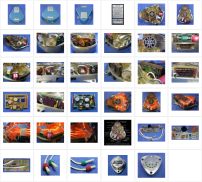
- View 01 - GG1342 exterior view 1.
- View 02 - GG1342 exterior view 2.
- View 03 - GG1342 exterior view 3.
- View 04 - GG1342 Closeup of labels.
- View 05 - GG1342 interior view 1.
- View 06 - GG1342 interior view 2.
- View 07 - GG1342 interior view 3.
- View 08 - Closeup of GG1342 mirror/PZT assembly 1 (left).
- View 09 - Closeup of GG1342 detector assembly. The 3-pin photodiode package is for the fringe signals. The other one is for monitoring the discharge intensity.
- View 10 - Closeup of GG1342 mirror/PZT assembly 2 (right). The two black laser connectors are also visible.
- View 11 - Closeup of area of GG1342 dither PZT motor. The silvery getter is also visible inside the block. It is nearly pristine.
- View 12 - Closeup of GG1342 power/signal connector. This would include the PZT drive signals, detector power and readout, and possibly laser power.
- View 13 - Closeup of GG1342 cathode-end of assembly. The pink object encloses the cathode. The pink may be a warning since unlike most HeNe lasers, the cathode here is at around -900 V.
- View 14 - Closeup of GG1342 anode 1. This one is just a spherical cap.
- View 15 - Closeup of GG1342 anode 2. This one has the vacuum tip-off.
- View 16 - Closeup of high voltage connectors and back of high voltage module.
- View 17 - Closeup of GG1342 front of potted high voltage module. This appears to be associated with starting only. The serpentine thin-film resistor appears to have a value of more than 20 Mohms.
- View 18 - Closeup of GG1342 Laser Regulator PCB in place.
- View 19 - Closeup of GG1342 Laser Regulator PCB removed.
- View 20 - Closeup of GG1342 Detector PCB in place.
- View 21 - Closeup of GG1342 Detector PCB removed.
- View 22 - GG1342 powered view 1. It's hot-wired directly from the HeNe laser power supply to the two anode ballast resistors.
- View 23 - GG1342 powered view 2. A tiny red dot from scatter on the output mirror can be seen near the top.
- View 24 - GG1342 powered view 3.
- View 25 - Closeup of GG1342 left bottom (area of mirror 1) powered.
- View 26 - Closeup of GG1342 bottom section powered.
- View 27 - Closeup of GG1342 right bottom (area of mirror 2) powered.
- View 28 - GG1342 with major parts labeled.
- View 29 - GG1342 triple HeNe laser power supply PCB with HV cables.
- View 30 - GG1342 triple HeNe laser power supply PCB top closeup. It is not known whether the input is DC or 400 Hz. The 2N5416s at the lower right are HV transistors, believed to be the current regulators for the three outputs.
- View 31 - GG1342 inertial platform triple HeNe laser power supply PCB bottom closeup. A close inspection will reveal that the center white wire at the top of the photo is not attached and may have been the original reason this was removed from service. ;-) This board is supposedly named "Mode HV PS" according to info obtained with it, but the marking appears to be invisible. ;)
- View 32 - GG1342 inertial platform triple HeNe laser power supply cables with HV connectors. Red is plus and green is minus.
- View 33 - GG1342 inertial platform accelerometer top view.
- View 34 - GG1342 inertial platform accelerometer bottom view.
- Honeywell GG1320 Ring Laser Gyro:
The Honeywell GG1320 RLG is used in numerous inertial navigation systems and the current version is still considered state-of-the-art. It has been in production in some form least back to the mid-1990s. And as of 2026 and Honeywell claims that over 500,000 units have been delivered.
There are two known versions of the GG1320 though each may have multiple revisions:
- GG1320AN: This is the model found on the Honeywell GG1320AN Digital Ring Laser Gyro Web Page and the only one returned via a Web search.
(That is, until the information here on the GG1320AF had been uploaded!)
The GG1320AN in the gallery is from 2001.
Honeywell calls it a "Digital Ring Laser Gyro" as all the control electronics are contained within the 3.45 inch diameter, 1 pound package. Input is +5 VDC and +15 VDC, a Reset pulse, and Sample Request pulses. The status and angle data are returned via RS422.
- GG1320AF: This is most likely an older and probably the origina version. All known samples are prior to around the year 2000. The only on-line reference with this part number was from the paper: "Qualification of the International Space Station rate gyro assembly, AIAA-98-4326", AIAA Guidance, Navigation, and Control Conference and Exhibit, 10-12 August 1998, Boston, MA. So it may have been special for the ISS. ;-) While believed to have functional specifications similar to those of the GG1320AN, the GG1320AF interface connector has external separate pins for the HeNe laser high voltage whereas the GG1320AN has an internal HV power supply that runs on 15 VDC. In fact, the GG1320AF shares much of its DNA with the GG1342: There is no internal microprocessor, only basic analog ICs, discrete transistors, and passives.
There used to be a color photo of a version of the GG1320AN innerds on the Honeywell Website though it differed from the one documented here and may be an earlier revision. This is a copy: Honeywell GG1320AN Photo. I'm hoping to find samples of that one. And it has been superseeded by a much more boring photo of the outside of the GG1320AN case. ;-(
Honeywell GG1320AN Ring Laser Gyro Web Album:
Honeywell GG1320AN Ring Laser Gyro Honeywell GG1320AN Ring Laser Gyro: Gallery.
Web Album: 36 Photos
-
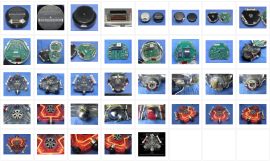
View 01 - GG1320AN top view of complete RLG.
-
View 02 - GG1320AN closeup of label. The first 4 digits
of the Serial Number (SERNO): 01121 for this unit. The year 2001, week
12. This info was actually in the publically available GG1320AN Interface Manual.
It is also hypothesized based on the two (2) IPs I've
seen the labels on ;-) that the 2 digits after the GG1320AN of the PART
NO. refer to the dither frequency range: AN11: Low, 518 or 519 Hz;
AN13: Medium, 567 or 578 Hz; AN15: High, 615 or 622 Hz. Whether there
are others is not known. Also unlike the GG1320AF where the dither drive
is external, for the GG1320 it is generated inside. I wonder if it is
programmable via a firmware upgrade. ;-)
- View 03 - GG1320AN bottom view of complete RLG.
- View 04 - GG1320AN main connector. This is a female 25 pin Micro-D. One possible mate is a Glenair MWDM2L-25P—4E7.
- View 05 - GG1320AN top with outer cover removed.
-
View 06 - GG1320AN bottom with outer cover removed.
-
View 07 - GG1320AN interior after separating case shows the
black mid-level plate on which laser block is mounted underneath and
the top of PCB 1 monted in top of case with ribbon to main connector.
Connections to the laser block are via the two long white connectors.
Separate Ground wires connect the black plate, PCB 1, and top cover.
-
View 08 - GG1320AN closeup of mid-level plate
secured by six screws around its perimeter with the laser block
between it and the rear of the case clamped via the three screws
in the center through the dither motor core.
- View 09 - GG1320AN PCB1 mounted in top of case.
- View 10 - GG1320AN PCBs shows PCB 1 (floating) with ribbon to main connector and PCB 2 still mounted inside top cover.
-
View 11 - GG1320AN PCB2 mounted in top of case.
- View 12 - Closeup of top of GG1320AN PCB 1.
- View 13 - Closeup of bottom of GG1320AN PCB 1.
- View 14 - Closeup of top of GG1320AN PCB 2.
- View 15 - Closeup of bottom of GG1320AN PCB 2.
- View 16 - GG1320AN laser block revealed! It is not actually attached to the black plate except by the (floating) white connectors.
- View 17 - GG1320AN laser block top view 1.
- View 18 - GG1320AN laser block top view 2.
-
View 19
- GG1320AN laser block bottom view. The black rubber webbing secures the various wires going to the white connectors. The dither motor (top and bottom) is the only point of rigid contact with the RLG structure. -
View 20 - Closeup of GG1320AN mirror/PZT assembly 1. Note the
3 wires soldered to the PZT. This could provide some fine alignment
in addition to adjusting the cavity perimeter to optimize the lasing
mode position.
-
View 21 - Closeup of GG1320AN AD590 temperature sensor.
-
View 22 - Closeup of GG1320AN mirror 2/detector assembly. The 3-pin
part has dual sensors for the fringe signals. The 2-pin part (under
the tan glob) is as single sensor for monitoring the discharge intensity.
They test like silicon diodes. The mirror substrate is shaped like a wedge
which may mean that no corner prism is required. Somewhere in the
vicinity there is a blue LED that is probably used to aid the HeNe
in starting.
- View 23 - Closeup of GG1320AN mirror/PZT assembly 3. Similar to PZT 1.
-
View 24 - Closeup of area of GG1320AN dither PZT motor. The silvery
getter is also visible inside the block. It is pristine.
-
View 25 - Closeup of GG1320AN cathode-end of assembly. This cathode cup
in this one is chrome, no hot pink, possibly because it really cannot be
powered by itself. Or at least it's not supposed to be powered except
when safely enclosed. Right....
- View 26 - Closeup of GG1320AN anode 1. This one is just a spherical cap.
-
View 27 - Closeup of GG1320AN anode 2. This one has the vacuum tip-off
and red cover.
-
View 28 - GG1320AN powered view 1. It's hot-wired directly from the
custom power supply box to the two anodes via 470K ohm ballast resistors.
There is also a 47K ohm resistor in series with the cathode as a
precaution.
- View 29 - GG1320AN powered view 2. And yes, there does appear to be a tiny red spot on the inside of the mirror at the top of the photo.
- View 30 - GG1320AN powered view 3.
- View 31 - GG1320AN powered view 4.
- View 32 - GG1320AN powered closeup area of mirror 1.
- View 33 - GG1320AN powered closeup area of cathode.
- View 34 - GG1320AN powered closeup area of mirror 3.
- View 35 - GG1320AN powered closeup of area of dither motor.
- View 36 - GG1320AN laser block with major parts labeled.
Honeywell GG1320AF Ring Laser Gyro Web Album (No Gallery photos):
Honeywell GG1320AF Ring Laser Gyro
Web Album: 45 Photos
Descriptons of the GG1320AF Web Album Photos:
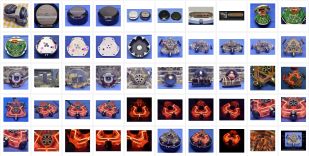
- Inertial-Platform-with_Triple_GG1320AF: This is the inertial platform similar
to the one from which these GG1320AFs originated. There has been some retouching
and Google AI kindly replaced the cluttered desktop background with a nice yellow
checkered tablecloth with not quite correct perspective. ;-) However, since the
free Google AI resolution sucks and every step further degrades it, a background
removal tool was applied to the original full resolution image and it was then
dropped onto the scaled AI version with the tablecloth and shadows, more or less. ;-)
Of the three GG1320AFs, #1 appears healthy based on the discharge color; #2 required a few hours of run time for the discharge color to recover and is what is used for most of these photos, and #3 is nearly up to air and thus very dead with no hope of recovery. #2 was used for most of these photos but the others may have had cameo roles in tight spots. ;-)
- GG1320AF-Closeup_of_Label1: This is similar to the one for the GG1320AN
but does not list the dither frequencies because unlike the GG1320AN,
the PZT motor drive is external so it can be selected as needed.
The first 2 digits of the SN specifies the year of manufacture and
the next 2 digits specifies the week of manufacture.
- GG1320AF-Angled_Top_View_of_Complete_RLG1 and
GG1320AF-Angled_Bottom_View_of_Complete_RLG1: This how the GG1320A looks
fully clothed.
- GG1320AF-Top_with_Outer_Cover_Removed1: The top cover is secured with 3 screws.
It's not clear what purpose the 2 screws on either side of the connector serve -
the GG1320AN does not have them.
- GG1320AF-Bottom_with_Outer_Cover_Removed1: The bottom cover is secured
with a single screw.
- GG1320AF-Main_Connector1: The contacts im the two large holes are for the
external high voltage power supply, + near the center. Regulation is internal.
- GG1320AF-First_Look_Inside1: Splitting the top and bottom using a
seperator tool reveals a single PCB with flying leads for the high voltage
to the laser.
- GG1320AF-PCB_Top_Closeup1: There are only a few SSI parts and chip
resistors and capacitors. The string of black SMT resistors on the left and
right of the PCB are associated with the High Voltage (HV).
- GG1320AF-PCB_Bottom_Closeup1: A few more small parts. The two sets
of three greenish chip resistors are the 600k ohm ballasts for the laser discharges.
The Omnetic connectors attach to the Laser Block. And yes, that is
an LED in a hermatic package for starting. Being so old - Mid-1990s,
it is green, not blue. Tested. ;-)
- GG1320AF-PCB_Removed_Revealing_Laser_Block_Mounting_Plate1: The
Laser Block attaches to the underside of the plate and bottom of the case
using 3 bolts. The dabs of pink nail pollsh (for want of a better term!)
are in the area where there would be high voltage - the end pins of the
Laser Block connectors and the top of the PCB in the vicinity of HV components.
- GG1320AF-Laser_Block_Mounting_Plate_Top1 and
GG1320AF-Laser_Block_Mounting_Plate_Bottom1: The smudges surrounding the
three bolt holes for the Laser Block had what looked like 5-Minute Epoxy;
Something like Loctite™ was used on the six bolts securing the plate to
the bottom of the case.
- GG1320AF-RLG_Case_Inside_Bottom1: The three threaded holes in the center
are for the Laser Block bolts.
- GG1320AF-Laser_Block_Top_View1 and GG1320AF-Laser_Block_Oblique_View1-2:
The Laser Block is actually upside-down when mounted normally but the top is more
photogenic. ;-)
- GG1320AF-Laser_Block_Bottom_View1: Note how the interface wires are
secured with an Epoxy-like material.
- GG1320AF-Mirror-PZT_ Assembly1_Closeup1:
- GG1320AF-Temperature_Sensor_Cloesup1:
- GG1320AF-Mirror_Detector_ Assembly2_Closeup1:
- GG1320AF-Mirror_PZT_ Assembly3_Closeup1:
- GG1320AF-Dither_PZT_Motor_Closeup1:
- GG1320AF-Cathode_End_of_Assembly_Closeup1:
- GG1320AF-Anode1_Closeup1:
- GG1320AF-Anode2_Closeup1:
- GG1320AF-Powered_with_Weak_Discharge_Color1: This was how the discharge
appears when first powered - weak and purple. It rquired around four hours to
return to a more-or-less normal HeNe complexion.
- GG1320AF-Powered_with_Healthy_Discharge_Color1:
- GG1320AF-Powered_Top_View 1 and Oblique_Views 1-3: This is in normal
room lighting and the redition is reasonably faithful.
- GG1320AF-Dark_Powered_Top_View 1 and Oblique_Views 1-3: More impressive
with the lights out. ;-)
- GG1320AF-Powered_Area_of_Mirror1, Cathode, Mirror 3 Closeup1:
- GG1320AF-Powered_Area_of_Dither_Motor_Closeup1:
- GG1320AF-Dark_Powered_Area_of_Mirror1, Cathode, Mirror 3 Closeup1:
- GG1320AF-Display_Mounted1, Powered_Display_Mounted1,
Dark_Powered_Display_Mounted1: The Laser Block is attached to the *top*
of the Mounting Plate and secured to the *bottom* of the case for a nifty RLG
display piece. Power is provded by a remote Laser Drive 103-23 HeNe laser power
supply brick running at reduced voltage. 2M ohn ballasts are mounted inside
the case. By controlling the DC input voltage to the brick, the discharge current
can be varied from around 0.25 to around 1 mA.
- GG1320AF-Powered_Lasing_Dot1: Closeup of red 633 nm dot due to scatter from
Mirror 2 surface. The starburst pattern is an artifact of the camera. The
lasing dot is, well, a dot. ;-)
- GG1320AF-Laser_Block_with_Major_Parts_Labeled1: Most parts are very similar
to the GG1320AN except for the connectors.
- GG1320AN: This is the model found on the Honeywell GG1320AN Digital Ring Laser Gyro Web Page and the only one returned via a Web search.
(That is, until the information here on the GG1320AF had been uploaded!)
The GG1320AN in the gallery is from 2001.

- Honeywell HG1700 IMU with Triple GG1308 Ring Laser Gyro:
The Honeywell HG1700 IMG (Inertial Measurement Unit) is used in a variety of applications like missiles, UAVs, UUVs, and and other drones where the lower performance and life expectancy of the very small GG1308 RLGs (leg length of 0.8 inches) is adequate.
The HG1700 consists of three GG1308 RLGs, three vibrating beam quartz accelerometers, and the integrated power supplies and communications and control PCB, all in a package under 4x4x4 inches overall weighing less than 2 pounds.
The first few photos are similar to those of the HG1700 found on the Web; many of the others are of various stages of disassembly and its guts, and are not available elsewhere anywhere. :-)
Since I've yet to find specs on the external connector to be able to power the entire HG1700, the photos of the RLGs lit in all their glory were taken using an adjustable output HeNe laser power supply with an external 3.3M ohm ballast resistor for each of the three anodes and six cathodes. The power supply voltage is around 1.5 kV for all the photos which includes the voltage drop across the external ballasts, internal ballasts and other circuitry which is part of the potted VMI module, and the discharges themselves. The starting voltage is between 1.5 and 2.0 kV. The operating current is under 0.105 mA for each discharge with a discharge voltage of around 0.5 kV. The dropout current is under 0.067 mA at a total operating voltage less than 1 kV. Note that much of the total voltage is made up of the drops across the external ballasts, which would not be present for actual operation, though there is probably some amount of active current regulation for at least half the discharge paths to fine tune lasing gain. So the high voltage inside the HG1700 under normal conditions isn't that high. :)
If anyone has access to documentation, please contact me via the links at the top or bottom of this page.
Honeywell HG1700AG59 IMU with Triple Ring Laser Gyro Web Album:
This one has a manufacturing data of 2013. The case at least is very sliglty different than the one in the Web Album below from 2005.
Honeywell HG1700AG59 IMU with Triple GG1308 Ring Laser Gyro 1 Honeywell HG1700AG59 IMU with Triple Ring Laser Gyro: Gallery.
Web Album: 45 Photos
-
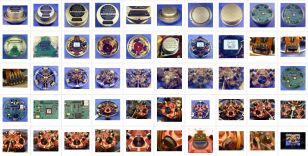
View 01 - HG1700 IMU side with resilient mount. The mount around the equator also is what holds the top and bottom together via a lock
ring having 12 holes for a matching unobtanium spanner wrench. The
yellow portion is an elastomer so the HG1700 body is not rigidly
attached to the mount.
- View 02 - HG1700AG59 IMU top with resilient mount.
-
View 03 - HG1700AG59 IMU top with resilient mount removed. The top and
bottom parts of the case are a snug fit sealed with an O-ring.
-
View 04 - HG1700AG59 IMU top label closeup. A Web search for the model
"HG1700AG59" shows that it is a version with mid-level precision, which
may just mean a manufacturing sort. The "59" also specifies the type
of communications protocol, among other things.
-
View 05 - HG1700AG59 IMU control main connector. This looks like a naked
DB-style connector but the pin spacing is larger.
- View 06 - HG1700AG59 IMU bottom side.
- View 07 - HG1700AG59 IMU bottom straight on.
-
View 08 - HG1700AG59 IMU bottom with resilient mount removed.
-
View 09 - HG1700AG59 IMU top interior revealing control PCB. This is
believed to have the only active electronics in the HG1700. It is secured
with four screws.
- View 10 - HG1700AG59 IMU top interior straight in.
- View 11 - HG1700AG59 IMU top interior with control PCB removed. The only other part is a breakout PCB for the main connector.
- View 12 - HG1700AG59 IMU breakout PCB closeup.
-
View 13 - HG1700AG59 IMU bottom interior revealing the top of triple GG1308
RLG assembly. The RLG assembly is secured with six screws and
a peg for orientation.
-
View 14 - HG1700AG59 IMU bottom interior with RLG assembly removed
revealing triple accelerometers secured with screws and attached
via a thick flex cable.
-
View 15 - HG1700AG59 IMU bottom interior straight in.
-
View 16 - HG1700AG59 IMU accelerometer closeup. These look like tall TO5
transistor cans with 6 pins. They are labeled ACCELERX P/N 976-0513-004.
The "CAGE CODE" refers to the manufacturer's Governemt contractor ID.
-
View 17 - HG1700AG59 IMU triple GG1308 RLG assembly top. This shows the
potted VMI module, ribbon cables and connectors, an just a hint of the
GG1308 RLG blocks.
-
View 18 - HG1700AG59 IMU VMI potted module closeup. It is not entirely
known what is inside.
manufacturer of, among other things, HeNe laser power supplies. But
it may only have only passive components. There are diode/resistor paths
through it from each cathode of the GG1308 to the connector at the
3-o'clock position in the photo. The resistance is between 200K and 300K
and provides most of the ballast for the laser "tube" cathodes.
-
View 19 - HG1700AG59 IMU RLG anode/PZT/power sensor/fringe detector
connector closeup. The pin at the top of the triad goes directly to
the HeNe laser anode for its RLB laser block; the two below it are for
the cavity length tuning PZT. The others are for the power sensor and
fringe detector.
-
View 20 - HG1700AG59 IMU RLG cathode connector closeup. Six of
the ten pins go through the VMI module (via at least a resistor and diode
for each) to the six RLG block cathodes.
The function of the other pins is not known but they may be for the PZT
dither motor and/or control signals.
-
View 21 - HG1700AG59 IMU triple GG1308 RLG assembly bottom 1. This shows
the three RLG blocks, just over one inch across. :) Each has an associated
connector for the laser anode, mirror PZT, power sensor, and detector, but
not the two cathodes, which go to the potted VMI module.
- View 22 - HG1700AG59 IMU triple GG1308 RLG assembly bottom 2.
- View 23 - HG1700AG59 IMU triple GG1308 RLG assembly bottom 3.
-
View 24 - HG1700AG59 IMU triple GG1308 RLG assembly bottom closeup.
-
View 25 - HG1700AG59 IMU GG1308 RLG block 3. The detector
assembly is at the lower right.
-
View 26 - HG1700AG59 IMU GG1308 RLG block 2. The two hemispherical
(more or less) cathodes attach via the ribbon cables to the potted VMI
module.
-
View 27 - HG1700AG59 IMU GG1308 RLG block 1. The lasing cavity
legs inside the block are 0.8 inches in length, thus the "08" in GG1308.
These are made of common BK7 to reduce cost (compared exotic materials
like Cervit or Zerodur for high precision RLGs). The power detector
assembly is at the top. Only one of the pair of solder bumps tests like
a silicon diode.
- View 28 - HG1700AG59 IMU GG1308 RLG block closeup.
- View 29 - HG1700AG59 IMU control PCB top.
- View 30 - HG1700AG59 IMU control PCB bottom. The module with the white label is the high voltage transformer for either the HeNe laser power supplies, the dither motor PZT power supply, or both.
- View 31 - HG1700AG59 IMU control PCB top closeup showing large chip. ;-)
-
View 32 - HG1700AG59 IMU control PCB bottom closeup showing large chip. ;-)
This has the ARM designation but also "ASIC" so probably custom.
-
View 33 - GG1308 ring laser gyro assembly glowing 1. These show the
good stuff. The appearance isn't quite as impressive in "person"
but is still very illuminating. ;-)
- View 34 - GG1308 ring laser gyro assembly glowing 2.
- View 35 - GG1308 ring laser gyro assembly glowing 3.
-
View 36 - GG1308 ring laser gyro assembly glowing 4.
- View 37 - GG1308 laser block glowing 5.
- View 38 - GG1308 laser block glowing 6.
- View 39 - GG1308 laser block glowing 7.
-
View 40 - GG1308 laser block closeup glowing 8. It's possible
to make that interior etching of the block.
- View 41 - GG1308 laser block glowing - PZT closeup.
- View 42 - GG1308 laser block glowing - power sensor closeup.
- View 43 - GG1308 laser block glowing - detector closeup.
-
View 44 - GG1308 laser block glowing - cathodes closeup.
- View 45 - GG1308 laser block with major parts labeled.
Honeywell HG1700AG13 IMU with Triple Ring Laser Gyro Web Album:
This one has a manufacturing data of 2004. The case at least is very sliglty different than the one above.
Honeywell HG1700AG13 IMU with Triple GG1308 Ring Laser Gyro 1
Web Album: -- Photos
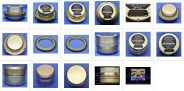
Descriptons of the HG1700AG13 Web Album Photos:
- HG1700AG13-IMU_*_with_Resilient_Mount1: Overall views before removal of the
resilient mount.
- HG1700AG13-IMU_Connector_Closeup1: All power and signals use this funny 30 pin
connector.
- HG1700AG13-IMU_*_without_Resilient_Mount1: Overall views after removal of the
resilient mount.
- HG1700AG13-IMU_Straight_without_Mount_Closeup_Labeled1: This is the area
of the seam. Details of the joint TBD.
- HG1700-GG1308_Laser_Block_with_Major_Parts_Labeled1: GG1308 laser block with major parts labeled.
-
View 01 - HG1700 IMU side with resilient mount. The mount around the equator also is what holds the top and bottom together via a lock
ring having 12 holes for a matching unobtanium spanner wrench. The
yellow portion is an elastomer so the HG1700 body is not rigidly
attached to the mount.
Honeywell GG1342 HeNe Ring Laser Gyro
Honeywell GG1320AN HeNe Ring Laser Gyro
-
View 01
View 02 View 03 View 04 View 08
View 09 View 10 View 11 View 12
View 13 View 14 View 15 View 16
View 17 View 18 View 19 View 20
View 21 View 22 View 23 View 24
View 25 View 26 View 27 View 28
View 29 View 30 View 31
Honeywell HG1700AG59 IMU with Triple GG1308 HeNe Ring Laser Gyro
-
View 01
View 02 View 03 View 04 View 05
View 06 View 07 View 08 View 09
View 10 View 11 View 12 View 13
View 14 View 15 View 16 View 17
View 18 View 19 View 20 View 21
View 22 View 23 View 24 View 25
View 26 View 27 View 28 View 29
View 30 View 31 View 32 View 33
View 34 View 35 View 36 View 37
View 38 View 39 View 40