One area that is often overlooked but which adds significantly to the professionalism and impressive appearance of home-built lasers - not to mention user and visitor safety - are the safety labels. See the section: Laser Safety Labels and Signs for examples of those for common lasers. You may need to modify them for the particular laser you decide to construct.
Much more detailed information on each type of home-built laser can be found in the chapter for that specific laser.
Forget about most wood - it is too flexible, absorbs moisture and warps or at least changes size all too readily. It may be possible to totally seal some high quality wood or wood-based composite products but it probably isn't worth the effort.
Start with a solid metal base. Short of something milled from a big heavy casting or the use of a real optical bench or table or a converted lathe bed, the best is an extruded aluminum box shape since this is very strong for its weight and will resist bending and twisting. A C-channel extrusion will be nearly as good if it is braced at multiple points along its open side - and this is more accessible for attaching screws and whatever from underneath. Or, a thin removable cover plate can be screwed to the open side.
Buying a big enough piece of this new - say 4" x 2" x 4 feet, more or less depending on the size of your laser - will set you back a few bucks but will save a lot of time in the long run.
Drill and tap holes for mounting the laser tube, mirror mounts, and whatever else you need. With tapped holes, there is less opportunity to spend your time fishing for lost screws! Add keying holes for assemblies that may need to be removed and replaced without changing their position - like the mirror mounts. Attach some non-slip material on the bottom to force the entire affair to stay put!
The advice has been given to avoid wood as a structural material, but for experimental use there are times when wood might be the material of choice. If you need a certain shape that can be made of wood and you don't have a milling machine handy to make it of steel or brass you might prefer to have it in wood tonight rather than wait until next Tuesday to have it made of metal. Threaded holes are easily made in wood. You just drive the screw into an undersize hole and it makes its own thread! You might have the objection that wood is not dimensionally stable. Quite so in the case of bringing in a board that has been out on the woodpile on a rainy day, but for plywood that has been stored indoors for several weeks in an air conditioned house there will be very little change. The main need is for rigidity, and wood can be made rigid. You don't want the mirror to shift the minute you touch the mirror mount. You need to turn the adjusting screw on a mirror mount without imparting much translational force. Torque without Push. What I found helpful was to drill one or two holes transversely through the screw knob. Then I made a little tool consisting of a 7 inch long 1/4 inch dowel into the end of which I inserted a straight, half-inch long wire (from a paper clip). It is used as a capstan wrench to make tiny adjustments of a screw.
Getting back to wood... If you want something that you expect to keep its adjustment on the shelf until Christmas then wood is not called for. But for experimental work, something that's here today and something else tomorrow, why not use wood?
An example of how simple and crude you can be and still get away with it was shown in our 1965 paper by Vander Sluis et. al. in Figure 1. (I don't have the photo but a description of the paper and reference can be found in the section: K. L. Vander Sluis et. al. HeNe Laser --- Sam.) It is a photograph of the world's simplest HeNe laser. On a sheet of half inch plywood there are four chemist's ring-stands in a line. Mounted on them are four burette clamps. The two on the ends are holding concave dielectric mirrors. The other two are holding a sealed-off laser tube about 75 cm long. Lying on the table and serving as power supply is a Cenco Tesla-type leak tester with a wire leading up to a band on the tube. With about a half hour of testing and adjusting this contraption was actually lasing! It may have been going when the photo was made - I don't remember and the picture doesn't show it.
Another time, just to see if we could do it, a laser was run with no mechanical support to either mirror. Dr. VanderSluis and I each had an alignment card in one hand and a mirror in the other at opposite ends of the laser, both of us trying to hold his mirror in alignment. Every once in a while we would both be in alignment at the same time and it would flash. Not a very practical way to go.
High quality microscope slides (not the kind that are 100 for $1.00 at your local hobby store) are actually quite good. To check a microscope slide or real optical flat:
Where the angle of a Brewster window is not adjustable (e.g., no bellows or ball-and-socket joint connection), the index of refraction should be determined (experimentally or from a reference book or the manufacturer) so that the it (the Brewster angle) can be set quite precisely (within +/1 1/2 degree if possible). Assuming an air/glass interface, the Brewster angle = arctan(n) where n is the index of refraction.
Keep in mind that the light intensity *inside* the resonator is going to be many many times greater than the actual power in the output beam. This ratio will be approximately 1/(1-R) where R is the reflectivity of the Output Coupler (mirror reflectivity specified between 0 and 1).
For example, with a HeNe laser, a typical R is .99. So, the power level between the mirrors will be roughly 100 times greater than the actual power in the output beam - or 1 WATT for a 10 mW laser!
Thus, absorption->heat losses can be significant and need to be minimized. (And no, you cannot stick a mirror in at an angle to extract a high power beam but think about zig-zag paths through laser gain media if you have trouble sleeping some night!)
See the section: Sources of Special Parts and Supplies for low cost suppliers of high quality optical windows.
Brewster angle = arctan(index of refraction)
For a quartz window - desirable for an HeNe laser due its lower heat losses at
632.8 nm, the index of refraction is 1.54 resulting in a Brewster angle of
57 degrees.
So, this is a piece of cake even if you weren't a stellar performer in high school trig. However, suppose you don't know the index of refraction of the material you are using? Ah, no problem if you have a light source (like a laser) of the SAME wavelength since it can be determined experimentally. For the construction of the HeNe laser this should be no problem since you likely already have some sort of HeNe laser! And, we already warned you that you shouldn't be building the HeNe laser if your goal is just to have a working HeNe laser anyhow. :-)
The light source has to be polarized. This either means a laser outputting a polarized beam (by design or see the section: Unrandomizing the Polarization of a Randomly Polarized HeNe Tube) or the use of a polarizing filter on its output. However, for the latter, common HeNe tubes produce a beam with random polarization - it varies as the tube heats up and just because it feels like it! This means that the intensity will be varying at the output of the polarizer so this will have to be taken into account as you view the reflected beam.
The ideal mirror would have a coefficient of reflectivity of 1 (100%) for all wavelengths of interest (no transmission and no absorption), no scatter, and introduce no (unwanted) distortion. (However, specific reflectivities of less than 1 over a range of wavelengths are required for laser work as noted below.)
Mirrors are used in two sorts of places: as part of the laser resonator and everywhere else. :)
Planar mirrors result in higher efficiency in the lasing process since more of the lasing medium can participate (think of the shape of the reflected beam inside the tube). However, diffraction losses are higher. You can't win on all counts! :) A true spherical resonator (L = r) would be easiest to align but would use even less of the lasing medium.
The use of planar mirrors have a couple of other advantages as well: Putting a planar mirror at one end allows additional optics to be introduced into the cavity near that end without requiring much, if any, realignment of the mirror. A 'folded confocal cavity' with one planar mirror and the other having r = 2 * L is a good choice in this regard and will also have the beam waist located at the OC. Planar mirrors are also generally much less expensive than curved ones (and it may be desirable to experiment with OCs having different wavelength characteristics and reflectivities so cost savings here could be important)!
The OC will typically be designed to transmit anywhere from a fraction of 1 percent to more than 50 percent depending on resonator gain. Some types, like the copper vapor or nitrogen laser have so much gain that the OC needs to have little or no reflectance.
Needless to say, you aren't going to find resonator-qualified mirrors at the local variety store! Unlike aluminized telescope mirrors which are possible to coat in your basement (at least in principle), this is not an option for dicroic types. They can be obtained from optical supply companies and in the case of the HeNe laser, dead or sacrificial HeNe tubes. (Argon or krypton ion also, but you aren't likely to have any!)
Note that for testing a resonator, a pair of totally reflecting (HR) mirrors can be used. This will result in the lowest possible lasing threshold because very little light escapes through either mirror. Of course, you won't get much of a beam either! However, as an indication that your laser is working, there will be some coherent light reflected off of the not quite perfect Brewster windows and some will leak through the typical HR as long as it isn't covered with tape or paint or a solid metal back plate as noted above! If you can get your laser working in this manner, substituting the proper OC mirror that transmits a small percentage of the incident light should be a piece of cake!
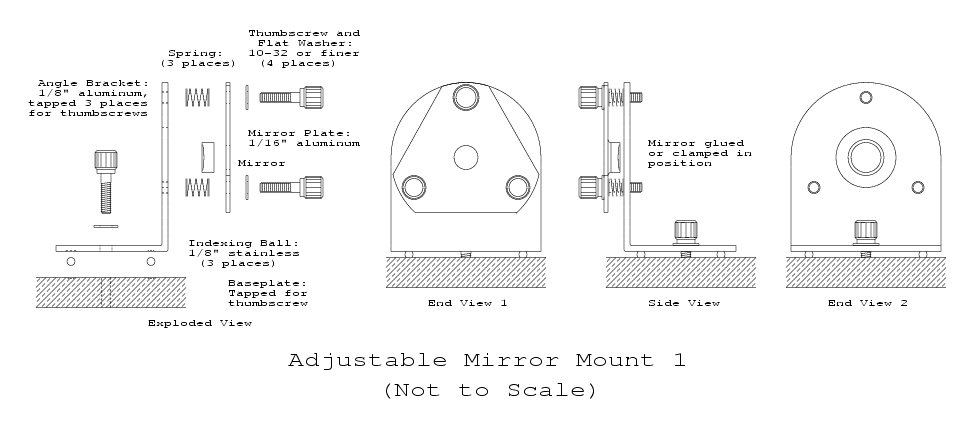
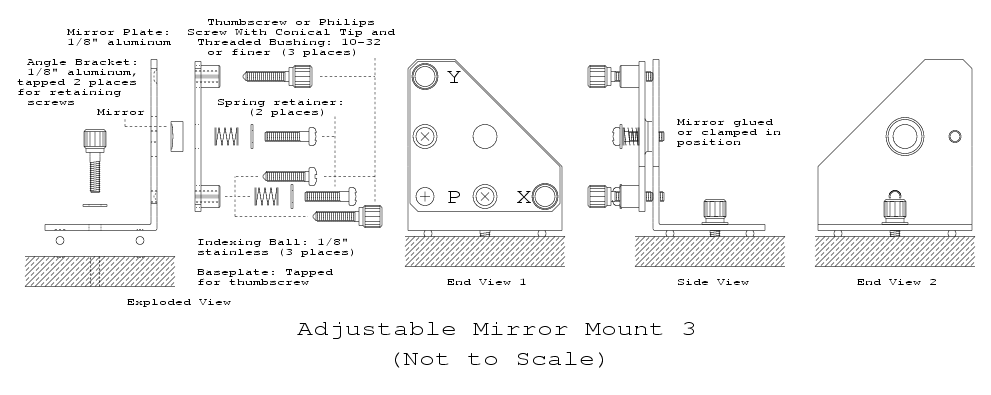
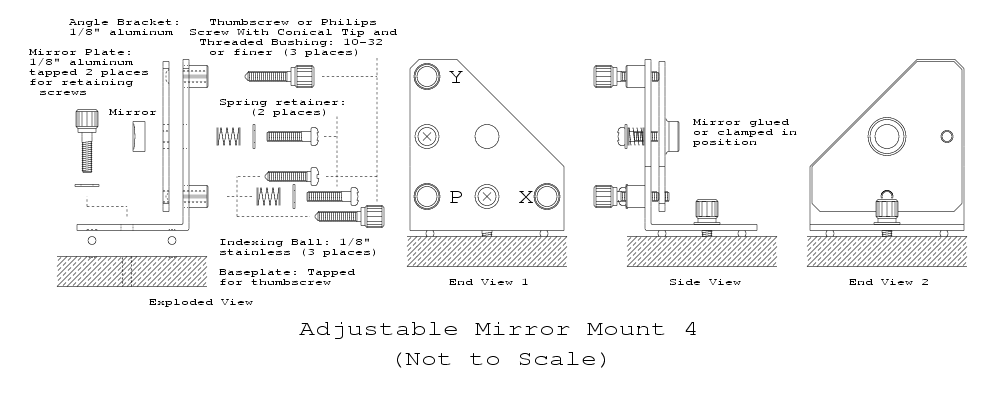
All of the following designs should be adequate for use with home-built lasers. These mounts consist of a right angle aluminum bracket, an aluminum plate to which the mirror is attached with glue (around the edge), screws, or clips, and two or three spring loaded thumb-screw adjusters. Indexing balls between the base and the mounting surface and an adjustment screw allow it to be removed and replaced with virtually no change in alignment should this ever be required. Both designs can be constructed using common hand tools though a drill-press would be nice and high quality drill bits and taps are a must!
While the drawings show the mirrors themselves glued to the mounts, a better approach is to construct something to hold the optic that can be easily removed and replaced without risk of damage. See the section: Mounting Laser Mirrors for one such design that constructed easily without the services of a fully equipped machine chop.
The dimensions given below are just suggestions. Modify them depending on your particular needs. Using the smallest height which provides the desired baseline for the (Y) adjustment and then adding a block underneath the entire assembly to raise the mirror position to center it within the tube bore will maximize stiffness.
Note that while all the mirror mounts described below show coil springs, I have found that these can generally be replaced with 1 or 2 split (lock) washers (which are what I now use for all my home-built mirror mounts). While the adjustment range is reduced to a few mR, this is still quite adequate for most laser resonators as long as care is taken in fabricating the mirror mounts and pre-aligning them on the baseplate and mounting the optic squarely on its plate or in its holder. However, if your machining skills are somewhat rusty, go for the springs. :)
The Adjustable Mirror Mount 2 is very similar as far as construction is concerned but moves the thumbscrew locations to the corners of an isosceles right triangle. And, although three thumbscrews are shown, the center one (marked P) can be left alone or replaced with normal screw, a point contact, ball joint, or something similar, since all adjustments are made with the thumbscrews marked X and Y. With this arrangement, the side and top thumbscrews produce nearly independent changes to mirror orientation in the X and Y axes respectively.
Parts list (typical for Mirror Mounts 1 and 2):
Parts list (typical for Mirror Mounts 3 and 4):
The adjustment and pivot screws in commercial mirror mounts of this type may have a steel ball glued into a recess at their end to form a highly stable symmetric tip. If you have access to a lathe, you can do this as well. Or, just mount an ordianry blunt-end screw tip-out (I'll let you figure out how to do this!) in an electric drill or drill press and use a file followed by fine sandpaper or emery cloth to form it into a smooth blunt conical shape.
The conical tips of the thumbscrews and pivot screw press against matching depressions in the fixed plate. To align everything, first drill holes for the three adjustment bushings (slightly undersize if neceesary for a press fit) and secure them in place (press fit or threaded nut as appropriate, or glue as a last resort). Then, drill one of the holes for the spring retainers. Use a snug fitting nut and bolt to clamp the two pieces of metal together and then drill the other retainer hole and add a nut and bolt there. Make sure they are tight!. Now, using the holes in the threaded bushings as guides, drill the depressions for the tips of the thumbscrew but make sure you only go about halfway through the fixed plate - set your drill stop to this depth. Also take care to avoid damaging the threads on the bushings in the process.
For the assembly to be stable, all three screws (X, Y, and P) must seat in the bottoms of their matching depressions. If the slight 'give' between the screws and bushings isn't enough to assure this, it will be necessary to elongate the depression at X ONLY in a direction parallel with a line passing through X and P and widen the one at Y in the appropriate direction to allow the screw at Y to seat properly (X and P will fix the position of the plate; the depression at Y can be widened in all directions or left out entirely).
Some examples:
In addition to the thread pitch (see below), the length of the bushing, the quality of the match of its threads with those of the thumbscrew, as well as the size of the adjusting knob or length of the adjusting wrench will determine the precision of these mounts. Up to a point, a longer bushing and larger knob is better but almost anything beats a simple nut and tiny headed screw!
The addition of a locknut or setscrew, and/or removal of the knob (without disturbing anything), will reduce the possibility of adjustments changing on their own.
While the ALC-60X has rather mediocre per-turn sensitivity, its adjusters are tight 5/8 inch nuts requiring a wrench for adjustment so they actually end up being much better than might appear based simply on thread pitch and the size of the baselines.
For higher quality components than available at the corner hardware store, go to Thorlabs and search for 'taps' (or get a Thorlabs catalog). They have the 80 pitch screws, taps, and other tools and parts that you need to make your own more precise mounts. Prices aren't that terrible either considering what you get. For example, 1/4-80 thumbscrews and nuts (actually tapped bushings) are $6 to $9 and $6 to $7.90 respectively (depending on length in each case). The 1/4-80 tap is $12.60 if you want to make your own threads. Then, the incremental cost of an adjustment will be only $6 (assuming the 1 inch thumbscrew - which should be adequate for these lasers). However, the bushings may be less hassle since getting these fine threads to mate smoothly over any length may be difficult. Other possible sources this sort of hardware may include Melles Griot and New Focus.
(From: Steve Roberts.)
Buy an MM1 from Newport or a KM1 from Thorlabs and then see if you really want to try to clone it. There is a reason for the traditional kinematic design of the mirror holder. The ball shaped pivot, the cone and the flat, and the specially milled groove, are there to eliminate crosstalk between the X and Y axis. Buy one, look at it and you'll see what I'm talking about. Then you'll see why they get $40 to 80 each for the 2-3/8ths thick one inch square blocks of aluminum. If you have a milling machine or access to one, or don't mind crosstalk, then making your own fine mounts is child's play, otherwise, for long distance applications, you'll find yourself willing to pay for the quality units once you've used them. If you need really large mounts, then making them yourself becomes a viable option.
However, one or both mirrors may not be planar. A curved mirror can be used in a *shorter* laser but not in one that is much longer than where it came from. In addition, the mirror reflectivities will have been optimized for the particular tube length, gas fill, and configuration (internal mirrors or external mirror(s) with Brewster windows - and may not be adequate for an external mirror resonator. Of course, if you found a laser of the same type as you inteded to build that was dead because of a leaky tube, there may be nearly no remaining challenges!
There *are* nice first surface mirrors in laser printers. They are going to be coated for the IR laser diodes used (around 800 nm unless you have a really old one using an HeNe laser). Or, if you happen on a high performance graphics arts copier/whatever using an argon ion laser, the mirrors will be optimized for that blue/green wavelengths (but you did remove the laser and its power supply as well, right?).
The planar dielectric mirrors found in an older HeNe laser based laser printer may be of very high quality and suitable for one of the mirrors of a HeNe or krypton ion laser. However, since these are generally planar, using them for both the HR and OC would make alignment more difficult. Even the aluminized mirrors might be useful in a pinch - I've gotten a commercial one-Brewster HeNe laser head to lase using one of these. They would certainly be fine for several of the higher gain home-built lasers.
The ones I've ripped out of IR laser diode based laser printers do appear to be decently reflective at all visible wavelengths though they do have a slight orange tint in reflection. They are excellent at the 632.8 nm wavelength of a HeNe laser. Most of the printers I have seen appear to use metal coated mirrors - not dielectric. So they won't be as good as proper dielectric types and are probably unsuitable for use inside a laser resonator unless it has a very high gain. I've seen dielectric type mirrors in older HeNe based printers. But even there, the polygonal scanner mirror was the metal coated type.
Note that some of the fixed mirrors may NOT be planar though they might appear to be so at first - even that long narrow mirror next to the output aperture may have a slight curvature in the cross-wise direction.
However, the mirrors at least tend to be dielectric coated for the particular wavelength being used - 780 nm for CDs, 650 nm for DVDs, etc. (Mirrors for the 780 nm wavelength in particular usually appear nearly transparent to visible light.) Again, these mirrors are not likely suitable for use inside the resonator but fine for redirecting the beam.
(From: Steve Roberts.)
Here are some possibilities for laser quality specific wavelength or broad-band mirrors:
(From: Ran (ran@netgate.net).)
Another potential source is high-tech surplus stores: I've gotten some really good deals on Newport mounts that were built into equipment that was being scrapped. I've also picked up some mounts that were custom-made for the equipment, but can be adapted for other purposes. And all but 1 or 2 of the support rods on my optics bench started life as shafts or ways in machinery. Most of 'em were even already tapped for 1/4-20 screws on the ends and cost $1 or $2 instead of $10.
The best deals are usually found when you're at the store and they have some subassembly that they're vacillating about tearing down into components, but one surplus place I know of with an on-line presence that sometimes has some optical bench bits are:
And, finally, there's me. ;-) Maybe. I have some extra odds-n-ends that I probably ought to sell off. If you drop me an email with more details about what you need, I'll see if I have anything excess that matches.
The most convenient light source to use is a HeNe laser which has a 5X to 10X beam expander telescope mounted on its output. Some inexpensive "educational" lasers come with one and they can often be purchased as an option. Someone gave me such a laser that was being thrown out! Or with care, a small spotting or finder scope or monocular (half a binocular!) can be mounted in front of a HeNe laser (eyepiece first) to expand the beam. The expander should be adjusted for as parallel a beam as possible. This is one good hobbyist use for an HP 5501 or HP 5517 laser head as they have superb beam expanding/collimating optics! Other types of lasers can of course be used, even a laser pointer. If a laser and/or beam expander isn't available, any bright light source will also work if it is at least 10 to 20 times the distance of the expected focal length of the mirror since this will be close enough to parallel to get an accurate measurement. The Sun is also suitable and is safe to use for small (e.g., 6 mm diameter) mirrors but realize that the focused reflected light from a large mirror will tend to set things on fire!
Orient the mirror to be tested slightly off axis at the laser or other light source so that the reflected beam is easily accessible. Place a white card in the reflected beam and move it along the beam axis locating the position of smallest spot size or sharpest focus. The distance from this point to the mirror its focal length, f. If the beam expands faster than without the mirror, the optic is convex (convex laser mirrors aren't that common but see below) and the location where the size doubles will be -f. In either case, the RoC is 2*f. If the beam size/divergence stays about the same (compared to the unreflected beam), the optic is planar.
Here's basically the same procedure in different words:
(From: Steve Roberts.)
Take a working HeNe laser, upcollimate it to at least 10X the size of its normal beam, and make sure it has 1/10 the normal divergence, in other words just expanding it with a lens wont work, it must have all the rays in it parallel. Or, take a large diameter source of projected light focused at infinity, and aim it at a slight angle from the normal to the optic. (Normal means at exactly right angles to the surface.) The optic should be many feet away from the light source. Then you should have the beam coming back toward the source but not hitting it. If it's a flat or convex mirror, the beam will continue to expand. But, if it was figured with a concave radius during polishing, by sweeping a card through the reflected beam you can sometimes find a focal point. Measure the distance from the focal point to the surface of the optic, this is 1/2 of the radius so double the measurement to get the radius. This isn't that accurate, but it will give a measurement within 10 percent. You are probably never going to find a convex ion or HeNe optic, but you might find them in CO2 or YAG lasers.
For ion laser optics, standard radii are flat, then 60, 100, 200, 300, 400, 800 cm. Generally, for a TEM00 beam, the focal length of the output mirror is at least twice the length of the plasma tube if the rear mirror is flat.
(From: Sam.)
Actually, I have seen slightly convex (-1 to -2 meter RoC) HeNe output mirrors. :)
I recently went hunting for laser optics. A pair of standard coated 12.5 mm diameter mirrors for an ion or HeNe laser would set you back $1,200-2,000 a set, you might get a suitable rear mirror for a Hg, CuBr, or CO2 for much less, but the price of optics for any gas laser will be prohibitive. Large frame argon laser optics, if you could find a used set, are going to be $250 for optics if the coatings are still anywhere near useful, and much more if they are in good shape. Costs seem to stay the same regardless of the substrate material or diameter - buying a smaller optic won't be that much less expensive if at all.
If you are thinking about going direct to a supplier of laser optics, off the shelf optics similar to what they coat for other laser companies are generally not available as the contract prohibits the optics company from selling them. Thus yours will be a 1 off custom run. The low cost Chinese optics companies do not do ion or HeNe coatings with the needed levels of reflectivity or quality. I tried that too, and I have especially good relations with one of them.
You have to rip them out of a dead laser of similar size and power, and for HeNe this is a problem as modern sealed HeNe tubes may use at least one mirror that is concave and is only good at the same working distance between the mirrors used in that given tube.
I know, I just spent two months hunting down an ion set, $750 an optic new, so $1,500 for a full cavity for a 1 meter-class laser. That was a relatively inexpensive optics set too. It was for krypton - I could have bought a whole used 1.7 W argon ion laser for not much more.
Using the short radius semi-confocal cavity optics of an ALC-60X or Omni-532 (their radius of curvature is around 60 cm) for the Scientific American tube will not work even though the mirrors are only $300 a set for cheapies. Mirrors are coated to a specific transmission based on tube length, a small air-cooled might be .6 percent transmission, where a 2 meter long large frame 25 to 30 watt would be around 8%, but that percentage would be tailered across the range of lasing wavelengths for a specific balance. So if you tried using a 2 watt pair of optics for a 10 mW homemade laser, you would be very sadly disappointed in the output and/or it probably won't lase at all, or if it did you would only see the ultra high gain 488 line lasing. However mirrors for a shorter low power laser might work if you scale up the tube. The problem will be the radius of the mirrors, not the transmission. For example, a 1 meter radius ALC-60X OC might work for Scientific American ion laser, but the usual standard 60 cm radius would not. Plus aligning a non optimized cavity would be a bear, and with a low gain amateur tube, highly unlikely. Funny how the author left the optics specs out entirely!!!!
For a recent project we put two 45 cm radius optics from a laser with a 1.5 inch longer resonator then a 60X into a 60X, alignment time approached 1 hour instead of the usual 5 minutes, and did not get any quicker. There was exactly one path with respect to the bore that worked, including the offsets in length caused by the X-Y adjustment screws on the end plates, talk about critical!! Only reason we did it was we needed gain on a line not supported by the 60X optics for a experiment.
So what I'm trying to say, is, unless you have the right optics, you are better off investing in a working laser if you are trying HeNe, or Ar or Kr ion.
There are only 3 companies in the US who produce hene mirrors, and the one of them that was hobbyist friendly just told me, "no more" as they are tired of coating optics that get returned with the claim "well my tube is good, so it must be your mirrors that aren't working, or for argon, I don't like the green-blue-red balance or transmission of these optics."
(Portions from: Anthony Paolini (apaolini@cros.net).)
I have 2 sets of mirrors to be used for my home-built argon ion laser.
One is a newer hard-coated set from a commercial large-frame argon ion laser I got from MWK Laser Products spec'd as 100 cm radius coated for 450 nm to 530 nm reflectivity. It is an HR/OC pair and is in excellent condition but actual reflectivity is unknown. The reflectivity of the OC is probably under 95 percent and way too low for the SciAm ion laser. Testing would require a laser with a wavelength in this range (preferably at 488 nm or 514.5 nm) and a laser power meter of some sort. Almost any would do as long as relative readings could be taken of the laser beam before and after it passes through the mirror. Then, percent reflectance is equal to:
                       (Beam Power) - (Transmitted Power)
        Reflectance = ------------------------------------ * 100
                                (Beam Power)
The second set is a soft-coated flat/120 cm centered at 488 nm from North
Country Scientific. These were in fact manufactured specifically for the
SciAm argon ion laser. North Country is going out of business and just
selling its remaining stock. (They may have mirrors for the other SciAm
lasers as well.) The mirrors I have would likely have been fine
20 years ago when they were manufactured. But, with the naked eye, pits and
scratches are obvious. I am convinced they are useless. However, other
samples might be in better condition since with proper storage, they can
survive for a long time.
As far as new ones, Esco Products has "off the shelf" laser mirrors, angle 0, coated for 488/514 nm. (They also have 633 nm (HeNe red) and 532 nm (doubled YAG green) mirrors. These mirrors available from stock for $58.00 (January, 2000) which is not bad, but rear surface is described as "fine ground" making them unsuitable for the OC even if the reflectance is acceptable as well as complicating alignment. Also note that they are all planar. Custom mirrors are available but of course likely at much greater cost.
I've made adapters to allow 7 to 8 mm diameter mirrors intended for, or salvaged from HeNe laser tubes to be used with standard 1/2" Newport mirror mounts (e.g., U50-A). A piece of 1/2" aluminum threaded spacer (or rod stock) was sliced into 1/2" sections with a hacksaw and miter box. After smoothing, a 5/16" (7.93 mm) hole was drilled through the center of each section. A 2-56 tapped hole was added on the side for a Nylon set screw. These also allow for easier handling of the small easily damaged mirrors.
These include: crystals such as BaB2O4, BaF2, CaF2, LiF, MgF2, KBr, KCl, NaCl, CsI, CaCO3, GaAs, Ge, KRS-5, KRS-6, KDP, KTP, PbMoO4, LiIO3, LiNbO3, quartz, sapphire, silicon, scintillators, TeO2, TiO2, ZnSe; and amorphous materials such as fused silica (UV grade, IR grade), fused quartz, astrosital, bullet proof glass, and special glasses for aircraft.
This is a commercial site but includes this general information with minimal fluff.
The most likely parts useful for home-built lasers or laser experiments are likely to be the mirrors, capillary, and possible other glass work.
Either the mirror itself or some portion of the mirror mount assembly can be removed from the tube. It is generally better to keep the mount intact unless you intend to build a new mount for it (see below). This is more convenient for attaching to your laser and minimizes the possibility of contamination or damage to the delicate inner surface of the mirror. However, cleaning of the mirror inside the mount using any of the approved laser mirror cleaning techniques discussed elsewhere in this document is virtually impossible so should cleaning be needed, the glass will almost certainly have to be removed. There is one option that might work though. See the section: Cleaning Mounted Laser Mirrors.
Another technique that may be successful is careful heating of the metal part of the mirror mount using a small butane torch with a needle point flame that avoids the glass directly. The glue should melt at a lower temperature than the mirror glass or its coating - hopefully!
This technique may be harder for Melles Griot, Siemens, and other tubes with a fat frit line. I'm told that squeezing the mirror mount in a pair of Vice-Grips(tm) (locking pliers) or a vice will cause the mirror to pop off intact about 50% of the time. The other 50% of the time it will probably break in half or worse. This may be worth the risk for those tubes with a fat frit line though.
However, I consider such treatments to be cruel and unusual punishment. Thus, salvaging the mount intact may be preferred. In any case, take special care that no damage occurs to the mirror (or what's left of it) when it finally comes free. It may be best to work with the tube or head upside-down over a soft cloth so that the mirror will fall away rather than toward the sharp edges of the mount. If I had $1 for every mirror I've ruined because the fragile coating came in contact with something just as it popped off.... Dropping it on a concrete floor would also be bad news.
On one HeNe tube that used an Epoxy sealed mirror to a glass stem, I scraped away as much of the Epoxy as I could. But when the mirror was cracked loose, most of it remained stuck in the Epoxy, which was apparently stronger than the optical glass. Only a 1 or 2 mm area in the center survived. It does lase though using my one-Brewster HeNe tube. Next time I salvage a mirror from one of these tubes, I think I'll leave the Epoxy intact but cut the glass stem a half inch or so away from the mirror.
However, some of these adhesives may yield to other approaches - see the section: Disassembling Cemented Optics.
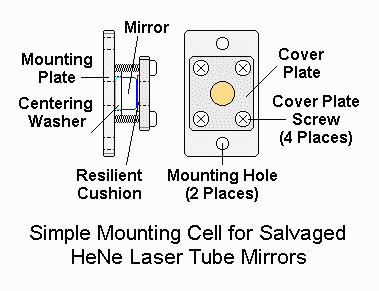
For subsequent handling and mounting, I would recommend constructing some sort of mirror cell to house the mirror and prevent damage to its coated surfaces. One possible design that can be built easily without a fully equipped machine shop is shown in Simple Mounting Cell for Salvaged HeNe Laser Tube Mirrors. See the section: Mounting Laser Mirrors for details.
The main advantage of keeping part of the mount is that it protects the delicate coated inner surface of the mirror from damage. However, it is virtually impossible to clean in there should the need arise in the future. If your tube used Melles Griot style locking collars, these can be reused and clamped or glued to a plate to securely hold the mirror mounts in your experimental laser permitting easy installation and removal. I store these assemblies with a piece of tape over the hole to keep out dirt and dust. The exposed sticky surface will also tend to capture any dust floating around inside. (There is some risk of outgassing from the adhesive contaminating the surface in the long term but I have never detected any problems.)
However, for polarized tubes which have internal Brewster plates behind one of the mirrors, removing the mirror glass itself may be the only viable option as it may be impossible to extract the Brewster plate and it's holder from the tube-end. A very few will just slide out but most are installed in a larger size region of the mount just before the mirror glass is put in place. If there is no desire to salvage the Brewster plate, it might be possible to carefully destroy it so the pieces just fall out without damaging the mirror but that's risky since they are usually almost touching the mirror.
WARNING: Do not file, grind, or saw any ceramic parts of an ion laser tube They may be made of beryllia, a nasty biohazardous material. See the additional comments on this topic in the chapters on argon and krypton ion lasers.
In all cases, DO NOT saw, file, or sand anything once the inside is exposed - use a glass cutter and then crack the tube or chip away at it, at least not without plugging the hole with a wad of tissue or a ball of cotton (but don't let anything touch the mirror, it's just there to block contamination). Any dust would result in tiny particles getting on the mirrors which could cause damage and be difficult to remove if the mirrors are kept on the mounts. Filing before the vacuum is breached is fine. As soon as you have access to the inside of the mirror mount tube, put a piece of masking or electrical tape over it to prevent contaminants from reaching the mirror. Ideally, no cleaning of the mirror should be needed if it was in a the tube's sealed sterile environment.
The capillary of a HeNe tube can usually removed mostly intact using a triangular to score it at the desired location and then snapping it. Other glass parts may require more creative techniques to avoid breakage.
Electrodes, filaments, getters, and the like may be salvageable as well.
The only approach I've found for cleaning mirrors inside mounts that has any chance of working is to use fast evaporating solvent in a spray can such as electronic degreaser or tape head cleaner. These will not damage the mirror coatings and evaporate within a few seconds which minimizes the chance of picking up any contaminants from the air. Give the mirror a good squirt so it's obviously drowning in solvent, swirl it around a bit, then shake out the mirror mount and let it evaporate completely. A visual inspection with a bright light or laser pointer should show if there is any serious contamination still remaining. Repeat if necessary, Obviously, whatever solvent is used must be as pure as possible. Not all common electronics cleaning chemicals meet this requirement. Probably few actually do and even may differ from one container to the next since absolute purity isn't necessary for their intended applications.
Do not attempt this cleaning approach unless you are absolutely sure the mirror needs cleaning! It could make the problem worse. And, since there's no easy way to really know that the cleaning has been fully successful without testing in a laser, unless this is convenient without cracking the vacuum or requiring extensive realignment, it still may be best to remove the mirror from the mount and clean it properly.
The solvents I've tried so far that appear to work reasonably well are Chemtronics Freon TF, Chemtronics Electronics Cleaner/Degreaser 2000, and GC Tape Head Cleaner. I still suspect they are leaving something behind though so no guarantees! Perhaps there is a special optical spray cleaner intended for this purpose.
I did do a test using the degreaser on a mirror mounted in a mirror cell that (1) I could install easily in my one-Brewster rig to test performance and and compare before and after and (2) I could clean properly if it wasn't successful. The result was encouraging. Two shots were needed but the the already fairly clean mirror behaved slightly better after treatment. So the chemical probably didn't leave any significant residue.
My arsenal of optical cement removal approaches/solvents include:
CAUTION: Even water may damage soft-coated optics (which thankfully are not common today). Water will definitely ruin many of the materials used for carbon dioxide optics though.
Sometimes, simple physical abuse will work as in the case of glass optics glued to a plastic substrate. However, where glass-to-glass joints are involved, one of the glass elements is quite likely to fracture if too much force is used. That glue is tough! Therefore, try the other suggestions, above, before dusting off the 12 pound hammer. :)
Here are some suggestions specifically for the case of an HeNe tube with a cemented lens. The acetone worked for me. After failing to loosen the lens with alcohol and lacquer thinner, I let the end of the tube soak in nail polish remover for about 10 hours at which point the lens just popped off. The only damage was some slight mottling of the AR coating around the edge of the HeNe tube's mirror but this didn't effect the performance in any way. The lens survived in pristine condition.
(From: Equinox (esoteric@pacifier.com).)
The mirrors are probably glued on with optics glue. We used it a lot at my last employer. It stays liquid until it is exposed to UV light. Acetone is what we used to dissolve that stuff. You probably already know that nail polish remover is diluted acetone. If you want to go the route of using acetone, go to a hardware store and purchase some stronger stuff. Nasty fumes. You can get a small can for around $8.00.
But there is a far simpler way to get the lens off. It has worked every time for me, in fact while writing this I saw a tube on my shelf with a lens, and I decided to try it again to see if it would work. And yes it worked again.
Get either a lighter or a small propane torch, or maybe a match? Expose the lens where the glue is to the flame while rotating the tube (to evenly distribute the heat) Do this for about 3 - 6 seconds, then just slide the lens off. (the lens may become black from soot from the lighter or match) Once you have done this, you can try to soak the lens in acetone to remove the glue. Also with a soft cloth, use some acetone to wipe the end of the laser tube off. From the ones that I have done, it always seems that the glue stays on the lens and not the tube. Make sure the acetone is nowhere around if you use the flame - heating method. Use it once all sources of flame have been extinguished.
If you want to go the route of soaking the lens, try heating the Acetone on a small coffee warmer and cover it as it will evaporate very quickly, and it is extremely flammable, so not to hot. My experience with solvents is that they work much better when heated.
You can also try to heat the entire tube in a small oven or toaster oven and see if that will work. Just don't go from a hot environment to a cool or cold one or the tube may crack.
This really isn't directly laser related but II couldn't think of another more suitable place to put it and perhaps it could be useful in a laser application! :)
Getting the actual glass prism out intact is pretty easy assuming all you care about is the prism (not the case):
This leaves the (probably) silver coating. I soaked the prism in photographic film or paper bleach to dissolve the metal of the mirror. I think it is potassium chromate in dilute sulfuric acid? - it's been about 20 years since I mixed the stuff. Sorry, I don't have the formula. Check an antique photography book. It took about a half hour.
If the mirrors are to be mounted in commercial adjustable mounts (e.g., Newport MM1s) but are too small, machining an adapter should be straightforward: Cut a disk somewhat thicker than the mirror from aluminum or plastic cylinder stock of suitable diameter, drill a hole sized to the mirror just fits, and drill and tap a side hole for a nylon setscrew. Such adapters can also be purchased at exorbitant cost.
If you have a Southbend lathe and Bridgeport milling machine and know how to use them, there should be no problem in machining whatever mounts are desired to house your new or recycled mirrors.
For the rest of us, here is a simple mirror cell design that can be put together in about an hour (less if you don't care about aesthetics!) using a drill press and common hand tools. The drill press isn't even essential but does simplify things quite a bit. This mirror cell can be easily removed and replaced without upsetting alignment very much though for curved optics, a pair of indexing pins would be needed (not shown) since any change in X or Y position will also affect alignment (but this may be useful for fine tuning your mirror's 'hot spot').
The design is shown in Simple Mounting Cell for Salvaged HeNe Laser Tube Mirrors. It basically clamps the optics itself between a pair of plates. Aluminum is what I use but Plexiglas or some other rigid material would also be acceptable. A metal or fiber washer glued to the mounting plate centers the mirror while a cushion on the cover plate provides some resilience as its screws are tightened (just snug!). These fastening screws may also allow some mirror adjustment if the bottom plate is aluminum or Plexiglas (which is fairly soft), or if a compliant washer is placed between the optic and the bottom plate. But, again, don't push you luck when tightening the screws!
The dimensions in the parts list below are for the mirrors from the Spectra-Physics 084-1 barcode scanner HeNe laser tube. The size of the mirrors from other internal mirror laser tubes and external mirror lasers may differ. Mirrors purchased new or obtained from other types of lasers may be larger requiring everything to be scaled up to handle them.
In keeping with my "never buy anything unless absolutely necessary" philosophy, I used a VME Bus card cage cover plate for the aluminum stock and hardware from various obsolete hard drives for the screws and washer. The resilient cushion was a 3 ring binder paper reinforcement (trimmed to fit). :)
Don't be tempted to use a flat bottom reamer to machine a shoulder in place of the centering washer unless you are using that lathe or a very well aligned drill-press (but see the next paragraph) because the mirror will likely end up being tilted slightly when clamped in place. Using the mounting plate's surface guarantees that this won't happen. Drilling the proper size hole in an existing washer (if needed) and gluing it in place is no big deal. :) And, don't chamfer the edges of the center holes in contact with the mirror - it must seat on the flat surface of the mounting plate and be held in place (via the resilient cushion) by the flat surface of the cover plate.
As noted above, the mirror must be free of any glue or frit that could prevent proper seating. The adhesive on soft-seal mirrors can generally be removed with a sharp Xacto knife or similar blade taking great care not to damage the coating(s). However, with hard-seal mirrors, this may not be possible since bits of frit may remain firmly attached to the glass and are essentially part of the glass. A slight modification to the design that will work with either type - and actually provide some additional adjustments would be to add a flexible rubber cushion under the mirror and only a protective cushion (like one of those paper reinforcements) between the cover plate and mirror. Then, the 4 cover plate screws can be used for coarse mirror alignment. The outer surface will seat square on the cover plate and the entire mirror can then be moved on the rubber cushion. In fact, I've found that this scheme using 4-40 screws which form a square only 1/2" on a side is sufficient for fine alignment of a 12 inch resonator using a one Brewster Melles Griot 05-LHB-570 HeNe tube! This approach could also be used with the machined shoulder instead of a centering washer since the coarse adjustments can be used to compensate for an imperfectly aligned reamer. The only disadvantages of the added flexibility (in more ways than one!) are that more things can change over time - and, of course, that you will be tempted to constantly tweak everything to perfection! Where fine alignment is performed elsewhere, once the mirror is roughly aligned, put a dab of Locktite(tm) or nail polish on each of the screw heads to secure it.
For compatibility with all of my home-built mirror mounts, the distance between the mounting holes is exactly 1 inch. This allows mirrors up to about 3/4" to be accomodated (with suitable adjustments in washer size and cover plate screw locations). (With the benefit of 20/20 hindsight, 1-1/8" for all the mirror mounts would have been a better choice as it would permit the end-caps of a typical small barcode scanner HeNe tube or those from the SP-184-1 to be mounted using a pair of screws without the trimming required to fit 1 inch diameter objects between screws on 1 inch centers.)
I have now mounted 4 SP-084-1 OCs, 2 SP-084-1 HRs, the OC from a 20 mW Aerotech HeNe laser tube, and the OC from an AO-3100 external mirror HeNe laser in this manner. The Aerotech mirror was a frit seal type with a bumpy bottom so I used the rubber cushion under the mirror approach for that one.
The mirror cell can easily be removed and replaced requiring only about 5 or 10 seconds to re-optimize the alignment on my Mirror/Optics Test Jig Using a One-Brewster HeNe Laser Tube.
The only disadvantage of this design is that the surface of the mirror is recessed and difficult to clean in-place - but real mirror cells often have this same characteristic. Perhaps, it will discourage unnecessary optics cleaning - all cleaning, no matter how carefully done, degrades the surface. Of course, the plates can be made from thinner material and/or the holes can be beveled to improve access.
(From: Laserlover (laserlover@my-deja.com).)
I've been doing stained glass for over 15 years aside from all my other interests and have cut front surface mirrors for several Newtonian telescopes I've built and here's my 2 cents worth.
There are several approaches:
Better practice a lot on glass microscope slides before tackling the expensive mirrors.
Some adhesives are extremely strong and also shrink ever so slightly while curing. The result may be that bits of glass can actually be ripped from your valuable optic. Even if this doesn't happen, the position and orientation you so carefully set up may change on its own. I've heard horror stories about SuperGlue(tm) doing both of these. The solvent in SuperGlue can also end up depositing a film on all nearby optics. So I'd avoid it like the plague. For that matter, has anyone ever found a truly justifiable use for this stuff? :) The formulation of many optical adhesives have been designed to address these issues.
RTV Silicone adhesive - clear, white (e.g., "bathtub caulk"), or black, your choice (though clear probably looks best) is good for optics that may need to be removed and don't require position stability to a fraction of a wavelength of light (since it is quite flexible). Again, 3 dabs around the periphery, not over the entire optic.
Double-sided adhesive ("sticky") tape is another option. In fact, it has nearly all of the qualities one would want - excellent holding strength, minimal thickness, no curing time, possibility of removal (or correction of screwups). However, not all sticky tape is created equal. The high strength types from 3M are recommended. Some companies use this approach to mount all their optics (and as you may have discovered, nearly everything else!).
When I do use adhesive to mount optics, it's usually 5 minute Epoxy. It's relatively rigid but not rock hard like most long time curing Epoxies. The work time is short enough to even allow for manually holding the optic in place until it will stay on its own. And, when used in modest size dabs, can be removed relatively easily.
UV-cure adhesives are another option - often used by the "BIG BOYS" to mount all sorts of optical and mechanical parts. These require exposure to long wave UV and will then begin to set up in a few seconds to a couple minutes, though complete curing may take much longer. There are a semi-infinite variety of UV-cure adhesives, each supposedly optimized for a particular characteristic like adhesion to metals or plastics, rigid or resilient, transparent or opaque, etc. Normally, a special very expensive curing lamp is required to perform the magic. The most popular one retails for about $1,000 from places like Thorlabs and Edmunds Optics but is just a halogen lamp with a filter to block most visible light and light guide to direct the UV at the area to be cured. It's also essentially the same rig used by your dentist to cure the bonding material and many other adhesives he/she uses on your teeth. But they pay something like 3 or 4 times that exorbitant price from their dental supply house! It should be possible to build your own for much much less.
(From: Elliot Burke (elliot@hitide.com).)
Designing an adhesive mount for optics is nontrivial. The biggest problem is the differential expansion between the optic and its mount. If there is no compliance in either optic or mount, the difference in thermal expansion can cause stresses large enough to shear the adhesive, if the adhesive is on the back of the optic. If the adhesive is on the edge of the optic, the resulting stresses can warp the optic. So, either:
It isn't hard to calculate the stresses due to thermal expansion - this should be done as a matter of course with all optical mounts. There are probably other good solutions too. The solutions involving compliance will also help if the system is dropped or otherwise shocked.
(From: Bob.)
Glue should only be placed on the periphery of an optic, and only in a few spots. I normally use three dabs, one at noon, one at 4 and one at 7 O'clock, or there abouts. As to what glue to use, in theory, you can use just about anything. I have seen superglue used with success, but I would tend to steer clear from such adhesives, particularly on high power optics, as cyanacrylate has a fairly high vapor pressure, and you don't want an film that will absorb/scatter light on your optics. I use Norland UV curable optical adhesive. You can get the stuff from Edmund Scientific or "Thor Labs. It's really great for any sort of optical work, and it's very strong. Sometimes even too strong. After it is fully set up, I know of no way to remove it. So whatever you glue with it sure is going to be permanent. The stuff is fairly inexpensive, but requires UV light to cure. The UV 'cure-ers' that these companies sell are outrageously priced. I use a normal novelty store black-light. The cure time is a lot longer, but $3 sure as hell beast $300!
(From: Sam.)
As far as UV lamps, I'm not sure that the long wave UV types for making minerals glow and so forth are suitable but perhaps those for erasing EPROMs? Some of the UV curable optical adhesives do dissolve (or at least soften) in acetone (nail polish remover) or lacquer thinner.
(From: Bob May (bobmay@nethere.com).)
You want to use a flexible glue to attach a mirror to a backing plate. The reason for this is that a very rigid connection between the two will stress the mirror to an incorrect shape before the problems of separation due to overstressing the joint. For larger mirrors, 3 dots of silicone adhesive at about the 50% radius (the old theory was about 70% of the radius) is about the right place to put the adhesive. For smaller mirrors, a single dab is usually sufficient if it's a significant part of the back.
(From: L. Michael Roberts.)
I use standard 'transparent' bathroom silicone from Home Depot. I have found that 'superglue' becomes brittle over time and 5 minute Epoxy is almost impossible to remove. A thin layer of silicone allows thermal expansion and can be removed with a razor blade when the optic needs changing [although this usually breaks thin mirrors]. This is not an expert opinion - your needs may differ depending on the nature of the application.
(From: Louis Boyd (boyd@apt0.sao.arizona.edu).)
Silicon RTV adhesive is reasonable for many uses. Beside that, making a mirror cell out of a material with as similar of thermal expansion to the mirror substrate helps maintain stabilty and reduce the stress on the adhesive (which also gets applied to mirror). Invar or a low expansion ceramic is usually the best choice for a mirror mount though they're expensive. Cast iron has one of the lowest thermal expansion coefficients of common inexpensive metals and it's easy to machine. Aluminum is about 2.5 times worse.
A mirror doesn't have to be glued at all. It can can be accurately held in alignment with as few as three hard points. For a small disk mirror standing "on edge" a three point mount on the mirrors circumference, centered on the edges (none on the back) will provide minimum distortion if the pressure on the points is moderate.
Even the strongest metals and low expansion glass aren't infinitely rigid. In fact they are quite elastic over a small range of motion. A thin layer of adhesive can work as a dampener to reduce vibration. Whether glue is used or not you have to deal with flexibility in the system. Mirrors will only vibrate if subject to variable force, such as shaking the table or air currents.
(From: Joe Gwinn (joegwinn@mediaone.net).)
I would add that it's a bad idea to make the silicone rubber too thin, because the thinner the rubber layer the higher the strain in the rubber as the temperature changes and the glass moves relative to the mount (made of aluminium?). Even the difference between daytime and nightime inside a building can do it. If the strain is too high, the rubber will soon fail, and the mirror will be able to move around, or even to fall off. The larger the mirror diameter, the thicker the silicone layer must be. That said, silicon rubber will tolerate 200% strain (pull to double the length) acutely, and perhaps 20% for long periods and/or many reversing stress cycles, if memory serves. See the datasheet and application notes for the details.
I found this out the hard way fifteen or twenty years ago, when we had polycarbonate tops just popping off of an instrument with an aluminium chassis, despite the fact that to pull the top off at first took hundreds of pounds of applied force. The low-tech solution was little pieces of toothpick embedded in the wet rubber before pushing the top down into place, maintaining a minimum rubber thickness.
On the other hand, if the rubber is too thick, then the mirror will be able to flop around too much, so there is an optimum thickness, but the optimum will be quite broad.
I don't know the properties of the 3M tape, but I would guess that it too can handle lots of strain.
Definitions:
Stress -- The force applied to a material. Units are pounds per square inch or the like.
Strain -- The resulting physical distortion of the material subjected to stress. Unitless, expressed as a fraction. For example, if the strain is 1% (0.01), the length changed by 1%.
Reversing stress -- Where the force on the material alternates between compression and tension. If one bends a beam back and forth, the material near the top and bottom of the beam will suffer reversing stress. Likewise, the rubber between a glass mirror and an aluminium back as the temperature cycles. This matters because reversing stress causes much more material fatigue than non-reversing stress (where the sign does not change), causing material failure that much sooner.
(From: Zane (zanekurz@sansnetcom.com).)
If you go the flexible epoxy route, you can use soft brass shim stock as spacers between the mirror and plate to get the glue pads the same thickness. As mentioned, a number of small pads spaced around is a good way to go.
You can practice getting the glue pads to look the way you want by using a piece of plate glass on a metal plate similar to your mount. You can then get a measure of exactly how much glue to put down per pad, as well as check the strength of your bond.
One very common method is to use what's known as a rotary solenoid. This device looks like a small motor but its shaft only rotates through a fixed angle (usually 90 degrees) when power is applied. By attaching a "flag" to the shaft, activating the solenoid can be set up to open or close the beam port within a fraction of a second. A spring returns it to the deactivated position when power is removed. Limiting the motion externally to less than the full angle will improve response time and reduce vibration. The most widely known manufacturer of rotary solenoids is probably Ledex.
A small DC motor can also be used like a rotary solenoid if it's rotation is limited by stops and a spring or reverse polarity is used for return motion.
Another method is to use the guts of an electromagnetic relay. A "flag" can be attached to its moving armature to act as a shutter. The advantage of this approach is potentially higher speed and lower vibration. However, the amount of motion is generally smaller so beam size may be a consideration.
A company that specializes in laser shutters in particular is NM Laser Products. However, if you're an even minimal scrounger, suitable devices can be found in all sorts of surplus optical equipment, or as noted above, built from junk parts.
Note that in this document and the associated laser power supply schematics, voltages between 110 and 120 VAC Hot to Neutral (220 to 240 VAC between Hots on opposite sides of the line) may be shown for power in the USA and other parts of North America. Likewise, 220 to 240 VAC may be shown for power in Europe and elsewhere. Where some other voltage is used (such as 100 VAC in parts of Japan), it will be ideentified explicitly.
Several types of power supplies are used for these lasers (more than one type may actually be applicable):
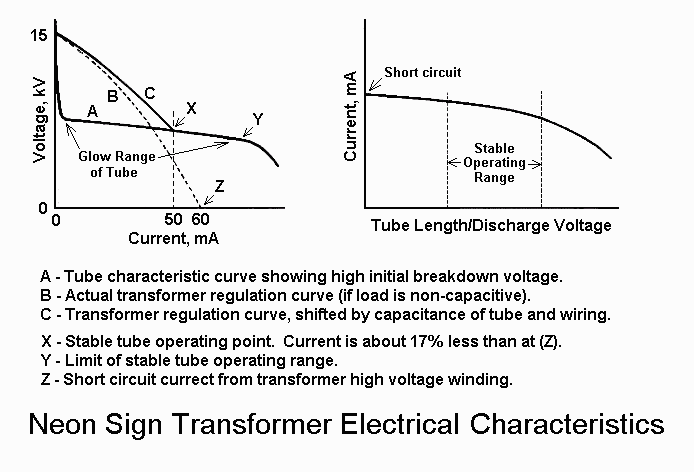
Luminous tube (neon sign) and oil burner ignition transformers are the most common types, are simple to use, and relatively easy and inexpensive to obtain. These typically produce between 5 and 15 kV at 10 to 60 mA and are internally current limited. The implementation uses a loose coupling with a magnetic shunt to provide current limiting. For some types like the oil burner ignition transformer I tested, the behavior is similar to that of a series resistor that limits current to the maximum specification when the output is shorted. So, you don't get both the rated voltage AND the rated current at the same time. Larger neon sign transformers may be constructed to act more like constant current sources up to nearly their rated voltage. The input VA rating will probably be roughly equal to the OUTPUT open circuit voltage times the OUTPUT short circuit current. Unless corrected (usually with a parallel motor run type capacitor), their power factor when the output is open circuit will be very low (e.g., .2). Check the transformer's nameplate - The VA rating divided by your line voltage is the current your electrical outlet will have to provide (though actual wattage used depends on output current).
The following applies only to conventional "iron" transformers, not the electronic type - no funny connection arrangements are possible with those.
Check demolition companies, salvage yards, neon sign shops, etc. They sell old transformers at low prices since a guarantee for long term reliability cannot be provided - but you really don't care unless your laser is to be run for years on end. Oil burner types will be totally free from HVAC contractors - but you will probably have to take the entire smelly, oily, icky oil burner away as well!
And, no, you don't want to build your own even if you own a wire factory. :) For a 12 kV transformer, I figure about 400 turns for the primary and over 40,000 (!!) turns of really really fine wire for the secondary. This is all carefully wound in multiple insulated layers on the special core and then the entire affair is fully potted to prevent corona, arcing, and all those other undesirable things that high voltages would do if undisciplined.
Also see the section: Comments on Neon Sign and Other Frankenstein-Class Transformers.
The output of luminous tube and oil burner ignition transformers can be rectified and used to charge high voltage capacitors. However, both the rectifiers and capacitors must be rated for the voltages involved.
See the section: Standard and Custom HV Rectifiers for more information and suppliers.
Timing may also be provided by mechanical means - a rotating switch or commutator arrangement feeding the outputs of multiple high voltage capacitors to the laser tube in sequence like an automobile engine distributor.
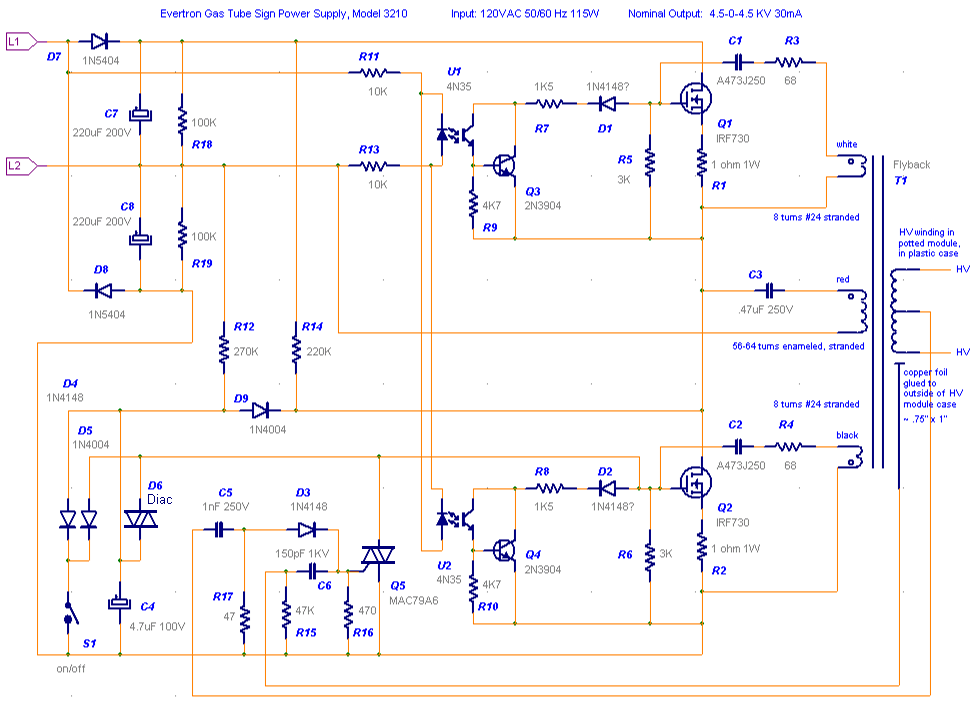
High frequency inverters may also be used as the power source for any of these approaches. See the section: SwitchMode Power Supply (SMPS) for Home-Built Lasers? for altnernatives to basic "iron" transformer designs.
For additional suppliers (both commercial and private) of the parts needed to construct these sorts of high voltage power supplies, see the chapter: Laser and Parts Sources.
                  Load   Output Voltage   Output Current
               -------------------------------------------
                  Open     1,000 VAC         0.00 mA
                  R          560 VAC         1.43 mA
                  R/2        350 VAC         1.79 mA
                  R/3        250 VAC         1.91 mA
                  R/4        195 VAC         1.99 mA
                  R/5        160 VAC         2.04 mA
                  Short        0 VAC         2.10 mA
R was equal to 392K ohms (I have a bunch of them). So, for loads resulting
in between about 1/2 and rated output voltage, the current changes by less
than 30 percent - which isn't bad for something without any silicon! The
Thevenin equivalent for this transformer over the range of 0 to 350 V or 2.1
to 1.8 mA would be 1.129M ohms fed from a 2.45 kV source (remember, this was
done at reduced voltage. At nominal input this would be equivalent to almost
30 kV). These measurements were very approximate. I expect that behavior at
full voltage (and its associated current) won't be quite the same (actually,
it will probably be better) but this demonstrates the general idea.
You can estimate the voltage rating of an unlabeled NST by running it as above on a Variac at say, 5 percent of line voltage, and measuring its output voltage. Then, multiply by 20. To determine the current rating, connect the output directly to an AC current meter. To be cautious, start at low input voltage and go up to full line voltage (since the NST should be current limited).
WARNING: The current test assumes a current limited neon sign or oil burner ignition type transformer. Doing this on a normal power transformer will probably result in a blown fuse/popped circuit breaker, blown meter, or both!
Here is some additional information on the electrical characteristics of neon sign transformers (NSTs) including power factor issues and correction. A 15 kV, 60 mA unit is assumed - adjust the numbers for whatever size you have.
(From: John De Armond (johngd@bellsouth.net).)
Let me answer several questions at once. First, a 15 kV, 60 mA transformer will produce 60 ma almost up to its rated voltage. The transformer is designed to be a constant current device, to supply whatever compliance voltage is needed to push the 60 ma through the load. The 60 ma is nominal short-circuit. All magnetic transformers made for use in the US are designed for continuous use at no more than 80% of the short-circuit current.
I never actually sat down and plotted it out but I do know this: With 1 foot of neon tubing on a transformer (about 500 volt drop), it drives 60 mA. With over 60 feet of tubing on the tranny (more than specified), it still outputs about 50 to 53 mA. That's fairly constant current.
That said, a NST will NOT survive long if asked to supply full voltage at full current. It is designed to drive a gas discharge tube. The characteristic of a gas discharge tube is that it takes a large amount of voltage to ignite the discharge and then the voltage falls to a fraction of the starting voltage to sustain the discharge. Thus the high dissipation occurs only for a short period of time in each half cycle. On a scope, this looks like a sharp spike followed by a level, square wave form for the rest of the half cycle. This sequence occurs 120 times per second.
Regarding volt-amps and watts. You left off the critical part of the equation. While for DC and 100% resistive AC loads, the formula is W = E * I, for typical loads that include some capacitive or inductive reactance, the equation for power is W = E * I * cos(theta) where theta is the phase angle between the voltage and the current waveform. Volt-amps is simply E * I and includes both the real component and the reactive or out-of-phase component. The term "power factor" is simply cos(theta). In a pure inductor or capacitor, the current is 90 degrees out of phase with the voltage, cos(theta) = 0 and so no real power is dissipated. This even though the cap or inductor is drawing amps that can be measured. For an inductor, the current lags the voltage by 90 degrees and for a cap, the current leads the voltage by 90 degrees. If one measures the current to a reactive device (cap or inductor), the measured current will be the quadratic sum of the real (in phase) and imaginary (out of phase) current.
An AC wattmeter measures real power. In other words, it compensates for cos(theta) Wattmeter test instruments are available in a form that uses a clamp-on current probe to measure the current and a physical connection to measure the voltage. These will typically display volts, amps, watts, VARs (volt-amps reactive) and PF. They are also expensive. For the experimenter, an ordinary utility power meter is an accurate, if less convenient alternative. Widely available surplus (C&H Sales and others), the meter is accurate typically to better than 2% over a 10:1 range. the numbers on the front register watt-hours while the RPM of the meter wheel measures watts. The Kh factor printed on the meter face is how many watt-hours each revolution represents. Typically 7.2 for residential meters. Simply count the turns over a measured period of time, multiply by Kh and divide by the measured interval in hours to get watts. I have a recording watt-hour meter that was equipped with a photo-interruptor to count revolutions. One can easily add one to any meter using a reflective photo-interruptor to look at the black flag on the meter wheel. (Do NOT attempt to drill a hole in the dial for counting - that will destroy the calibration.)
The PF of a standard neon transformer is very low, typically in the range of 0.2 to 0.4 lagging. This is why the VA ratting is much higher than the watts that can be supplied. That means that the transformer draws more than twice the current required to supply the output wattage. This reactive current, called "wattless current" in the slang, can be countered by supplying an equal amount of leading phase angle wattless current. A capacitor does that. A motor run capacitor is the proper type which can handle the continuous duty. To compensate a tranny, simply start adding capacitance while watching the amperage draw from the line. When the draw is at the minimum, the capacitive reactance is equal to the inductive reactance, the PF to the line is 1 and all is well in paradise! A 15 kV, 60 mA tranny will need about 160 uF of parallel capacitance. This varies with secondary load so one must measure but that's a starting point.
Note that the full current (wattless + real) is still flowing in the circuit between the cap and the tranny.
This technique is widely used in neon sign work. It will allow twice as many transformers to run on a given branch ampacity or else it will allow lighter wire to be run to a given load. For fully enclosed transformers (HV terminals are inside the box), there is enough room for the cap inside.
(Portions from: Mark Dinsmore (dinsmore@ma.ultranet.com).)
There is a very good analysis of the design of neon sign transformers in:
I don't know if the following is a newer edition of the same book, but it might be an alternative source of a lot of additional information on these topics:
(From: Jason Freeburg (egraffiti@iname.com).)
A used neon sign transformer should not cost more than $20 or so. Find a neon shop in your area. They usually have the used ones stacked up somewhere and will sell cheap. The 60 mA models are usually somewhat cheaper than the 30 mA type if you buy them used from a neon shop because they are really too hot (e.g., provide too much current) for running neon and they cause staining and premature burnouts. It all depends on the particular shop you go to. I don't suggest buying new for something like this, the performance will be the same but the price much higher. A new 15 kV, 60 mA transformer lists for about $80.
BTW, the best name to look for in neon sign transformers is France. These things are ruggedly built and will take a lot of abuse without dying. The name to avoid is Actown - their transformers are wimpy and usually don't deliver the rated current.
(From: John De Armond (johngd@bellsouth.net).)
Testing of a used neon sign transformer is pretty easy even without test equipment. These normally fail with a secondary short and all that does is (slowly) cause them to overheat and let all the magic black goo run out.
Wire the transformer primary up with a 3 wire grounded cord (green to the case!), plug it in, and see if you can use a plastic-handled screwdriver to draw an arc from each insulator to the case. If that works and they don't make any funny noises, they're probably OK. The grounded cord will also weed out any trannys with a primary short to ground.
(From: Sam.)
While some of the discussion above might suggest that you should run right out and corner the market on old neon sign transformers because newer ones won't work properly for home-built lasers, you can relax. The nice simple iron current limited type aren't going to disappear overnight - there will be plenty of piles of used transformers in neon sign shops for years, if not decades, to come!
(From: John De Armond (johngd@bellsouth.net).)
The glory days of neon transformers for experimenting are coming to an end. UL and the NEC have conspired to rewrite the code to require secondary ground fault protection to built into new transformers. These protectors trip the transformer if the secondary current is unbalanced or goes to ground. My testing of the units on the market show them to be very sensitive to spurious currents, particularly RF (as will exist in a gas discharge tube at higher pressure). It must be built in and be inaccessible to the installer. This means potted in tar. I've X-rayed a couple to try and figure out where that "special place" would be to drill a hole to disable the devices but since most of these are still at least partially hand-assembled, the parts placement isn't accurate enough to make a template. Used transformers will still be available from sign shops as they are replaced with SGFI (Secondary Ground Fault Interrupter) transformers but then the supply of unprotected ones will go away. Therefore basing plans on neon transformers could be shortsighted.
As for more power than the conventional 15 kV, 60 mA neon sign transformer:
The highest power leakage-flux limited (neon) transformer that is available is actually called a cold cathode transformer with a maximum rating of 15 kV, 120 mA. These are available from neon suppliers but are not common and will usually have to be ordered.
Beyond that is the common domestic pole pig. That is, a pole-mounted utility transformer. For my neon bombarder, I have a 25 kVA, 15 kV pole pig driven in reverse from the 240 volt main. A modified Miller welding machine hooked in series with one leg is the current limiting choke. As configured it will produce 2 amps at 15,000 volts!! The pig itself will produce over 10 amps before it saturates if you can drive it. :-) Utility transformers have a service factor of at least 2.5 so it can do that all day.
(From: Sam.)
And, before you ask, while microwave oven transformers might seem to be useful for home-built CO2 (or other) lasers, I have three problems with recommending them:
As for ballast resistance, the discharge characteristic of small commercial CO2 laser tubes is supposed to be something like -200K ohms. So, you need at least 200K (actually figure 30 to 50 percent more to be on the safe side) of positive resistance to maintain stability - this is automatic with the neon sign transformers whose internal equivalent series resistance is typically 250K or more. It may be possible to use a high voltage capacitor (like the one in that microwave oven) to limit current - yet another object to zap the careless! Home-built CO2 lasers with wide bore tubes probably have a negative resistance that is a lot lower but you will still need some external ballast resistance since there is essentially none provided by the transformer itself. In addition (as if this isn't enough?) the relatively 'low' voltage of these units compared to neon sign transformers means either (1) that starting of some laser tubes may be a problem even if the voltage is adequate for operation and (2) you may be tempted (shiver!) to put 2 or more microwave oven transformers in series. Two *could* be used with their returns tied together and driven out of phase to create a centertapped arrangement like that of the typical neon sign transformer.
Please don't consider any of this unless you have lots of experience working around high voltage high power equipment! Microwave oven transformers significantly exceed the lethality factor of pole pigs if for no other reason than the physical setup is likely to be closer to something out of a bad Sci-Fi movie than a well designed, safe, protected (in a relative sense, at least) system! At least the pole pig *looks* suitably dangerous due to its size and impressively large porcelain insulators! And, no, I don't recommend CT scanner X-ray generator transformers either. :)
WARNING! EXTREME DANGER: The HV winding is deadly and one end is grounded to the core. If you aren't going to be using the high voltage winding (which is the desired state of affairs!), it is best to remove it entirely by a combination of hack saw, chisel, pry bar, and explosives. :) Do make sure your health insurance is paid up and you know the directions to the nearest emergency room and/or the number of the your local ambulance service - some of these techniques can result in personal injury. :(
If you don't remove the high voltage winding, make sure adequate insulation (e.g., electrical tape, Plexiglas shields) is added to absolutely prevent contact.
To drive an argon/krypton ion tube (2.5 to 3 VAC) or thyratron filament (5 to 6.3 VAC) will require only a few turns of heavy wire. Use a wire size of at least #12 for a current of 15 to 25 A, #15 for 10 to 15 A, and #16 for 5 to 10 A. The specific number of turns is best determined by experiment (dependent on the actual number of turns in the primary winding, the voltage drop in the wiring, and your exact line voltage) but will be between 1 to 2 turns per volt RMS of output (for 115 VAC nominal line voltage). Where a centertap is needed (i.e., for an ion tube filament supply), it is probably best to bring out each half separately and connect them externally.
Whatever you do, make sure there is no possibility of this filament winding coming anywhere near the high voltage winding if you haven't removed it! Also, note that some applications like a HV pulser require that the filament winding be insulated to withstand the full output voltage to ground - maybe 15 or 20 kV or MORE!
WARNING: A Variac is NOT an isolation transformer and provides NONE of its safety benefits! Due to the power requirements of many of these lasers, it is not really practical to use a small isolation transformer for testing. However, make sure you understand and follow the information provided in: Safety Guidelines for High Voltage and/or Line Powered Equipment.
The most common variety (at least that you are likely to use) connects to the 115 VAC line and outputs either 0 to 115 VAC or 0 to 140 VAC depending on how it is wired. There are both open frame 'bare bones' and fully cased units. The latter may include a line cord, on/off and possibly low/high range switch, power indicator, and a 3 prong grounded outlet. If you have an older unit with only a 2 prong cordset and outlet, I would recommend replacing them with a heavy duty grounded cordset and 3 prong grounded outlet.
There are also models that will accept 115 VAC and output upt to 0 to 280 VAC - useful for powering or testing 220 VAC (e.g., European or high power laser) equipment. There are three-phase models as well (but you need a three-phase power feed for them to be of much value!).
To determine what size you need, check the full load input requirements of the equipment you will be powering. Neon sign transformers provide this information on the nameplate; regular transformers may not; in this case, estimate the input volt-amp (VA) requirements by adding up the full load secondary VA ratings and multiply by 1.10 to 1.15 to account for transformer losses.
See the next section for Variac wiring.
For adjusting the power to a transformer or other inductive load over a possibly slightly restricted range, there may be an alternative to an expensive, heavy, Variac. Some relatively simple modifications to a common light dimmer will permit it to substitute for a Variac for some applications. This is detailed at: A Two-Into-One Homemade Neon Dimmer. The idea is to get around the inductive lag in current flow that confuses a normal dimmer and may cause it to blow up. However, the voltage and current waveforms are going to be nasty with this approach - which may not matter but is something to keep in mind. If you do this, make sure there is a fuse for this circuit alone - some failures of the triac or its trigger circuit can result high current DC through the primary of your transformer which is not something you want to experience.
Another option, more applicable to lower power equipment, is the use of a fixed or variable power resistor (rheostat) in the primary circuit. The problem with this is that all three of the following conditions must be satisfied:
However, for a small fixed reduction in current/voltage, a power resistor may be a good idea as the dissipation will be modest and it can be mounted inside the equipment case out of harm's way (as long as it is adequately cooled).
                         _        1
          H o-----/ ----- _----->o--+     Tap 1: 0 to 115 VAC
                Power   Fuse      2  )||
                Switch           o--+ ||  Tap 2: 0 to 140 VAC
                                     )||
                                     )||      _
      Tied together at               )<------- _--------o Adjustable output
      service panel           Power  )||     Fuse 2
      |              220       LED   )||
      |          +--/\/\--|>|--|>|--+ ||
      |          |                   )||
      +-> N o----+------------------+-|-----------------o Return
      |                               |
      +-> G o-------------------------+-----------------o Ground
WARNING: Direct connection between input and output - no isolation since the
power line Neutral and Ground are tied together at the main service panel
(fuse or circuit breaker box)!
CAUTION: Keep any large transformer of this type well away from your monitor or TV. The magnetic field it produces may cause the picture to wiggle or the colors to become messed up - and you to think there is an additional problem!
Note: the 'Power LED' circuit is soldered directly to a winding location determined to produce about 6 VAC.
Wiring is straightforward if you have acquired a bare unit (the following assumes a 115 VAC line, the extension to 230 VAC should be obvious):
(From: Steve Hardy (hardy@sweng.stortek.com).)
The usual solution to this problem is to connect more than one device in series. Unfortunately, in the real world, components are not matched closely enough for this simple trick to work. The purpose of this article is to explain how to design series-connected rectifier strings, which will operate reliably in spite of component mismatches and tolerances.
Although the emphasis is on rectifiers, the principles are also applicable to switching elements such as thyristors, bipolar transistors and mosfets.
A set of rectifiers connected in series will be referred to as a 'string'.
The following examples assume that the transformer output is 1 volt RMS. Simply multiply everything by the appropriate factor for other voltages.
    o-----|>|-----+
                  |
                  /
  AC In           \ Resistive Load
                  /
                  \
                  |
    o-------------+
Peak reverse voltage across diode (Vd) = 1.414.
    o-----|>|-----+
                +_|_
  AC In          --- Capacitive Load
                  |
    o-------------+
Vd = 2.828.
    Bridge rectifier
          +---+
    o-----|~ +|----+
          |   |    |
  AC In   |   |   |X| Capacitive or Resistive Load
          |   |    |
    o-----|~ -|----+
          +---+
Vd = 1.414 for each of the 4 diodes in the bridge.
    o----+--|>|-----+----o +
         |        +_|_
  AC In  |         ---
         |          |
    o---------------+    To resistive or capacitive load
         |        +_|_
         |         ---
         |          |
         +---|<|----+----o -
Vd = 2.828 for both diodes
For example, for a full-bridge rectifier used with a 15 kV transformer, each of the 4 diodes in the bridge will need to withstand 15 kV * 1.414 = 21.2 kV. This is a minimum value. An additional safety factor of 15% should be provided to account for mains overvoltage, giving a design point of 24.4kV, or say 25 kV.
Commonly available rectifier diodes, such as the 1N4007, are rated for 1kV, thus (in theory) at least 25 of these will be required for each of the four strings to make up the full bridge rectifier. This is not as bad as it sounds, since packs of 100 1N4007's can be obtained for under $5. It is tedious to perform all that soldering, but the alternative of buying ready-made rectifiers of the required voltage will be much more expensive.
The time honoured way of dealing with this is to add resistors in parallel with each diode in the string. This will increase the 'leakage' current, swamping out the variation between the diodes. The price to pay for this is wasted power, and obviously the cost of the resistors. To mitigate the former, the highest value resistance should be used which affords the proper voltage sharing.
It is impossible to completely balance the voltage in this way, since resistors have their own tolerance. Thus the only alternative is to add extra diodes in the string, to allow for the imbalance. There is a tradeoff to be made: increasing the string number will reduce the wasted power, but increase the total cost.
To compute the string number and the parallel resistance values, the following information must be known:
                  Vd(n - 1) * (1 - a) - (Vs - Vd) * (1 + a)
            R <= -------------------------------------------
                           (n - 1) * (1 - a2) Imax
Then the worst-case power dissipated by any of the resistors is:
                                      Vd2
                            Pd = -------------
                                  R * (1 - a)
And the total power dissipated by the entire string of diodes and
resistors is:
                                     Vs * Vd
                           Ptot = -------------
                                   R * (1 - a)
These values may be reduced somewhat, since the string will not be
continuously blocking the maximum reverse voltage. For sinewave
rectification, the above figures may be divided by 2 to 4.
Note that resistors have a voltage rating as well as a power rating. Typically, the voltage rating is 300 or 600 V (600 V for 1 W types, 300 V for 1/4 W). Values above 1M are hard to obtain in tolerances under 5%.
Since 1N4007s are rated for 1 kV, each parallel 'resistor' should actually be a series combination of two resistors, unless you can locate special high-voltage resistors.
Using an initial guess of n = 30 (i.e., 20% more than the theoretical 25 required):
             1000 * (30 - 1) * (1 - 0.1) - (25000 - 1000) * (1 + 0.1)
       R <= ----------------------------------------------------------
                        (30 - 1) * (1 - 0.01) * 5x10-6

          = -2.09M
Negative values for R mean that the initial guess for n was too low. As it
turns out, the culprit here is the loose tolerance of the resistance. We can
either tighten the resistance tolerance, or increase n. Trying for 2%
resistors, the result becomes: R <= 27M.
This is a high resistance, which is good, but practically unobtainable in 2% tolerance. This is the point at which a decision needs to be made. We can either
                                .5 * 10002
                      Pd = --------------------
                            2x106 * (1 - 0.02)

                         = 0.256 W
Each resistor will only see half of this, which is very small. This is good
for long life and stability. We can't use 1/4 W metal films, unless they are
rated for at least 500 V. 1/2 W metal films would normally be OK.
Having worked all of this out, the complete bill of materials for the bridge rectifier is:
Special high-voltage resistors are available, which cuts down on the inconvenience (if not cost) of series combinations. For example, Philips has the VR25 series of 1/4 W 5% metal glazed in the range of 1.2M to 10M, and the VR37 series of 1/2 W 5% in the range 1.2M to 33M. The VR25's are rated for 1,600 VDC and the VR37's for 3,500 VDC.
If you are thinking of 'cheating' by hand-selecting matched resistors, then be aware that this is not good for long term reliability. Even if you select two resistors that are matched within 1% on day one, then after time they will more than likely drift apart. This is because they are stressed by high voltage, which is a well-known cause of long-term drift.
When higher frequencies are involved, it is also necessary to account for transient phenomena such as diode reverse recovery charge. You can ignore this section if you are only concerned with low frequency sinewave circuits (<200 Hz). Note: a low frequency square wave actually has high frequency components, so this section may still be relevant.
When a current is flowing through a diode in the normal (forward) direction, then the voltage is suddenly reversed, the forward current will rapidly decrease, go through zero, then actually reverse before finally snapping back to the leakage level. The rate of change of current will depend on external circuit inductance.
In effect, the diode conducts current in the reverse (normally blocking) direction for a short period after voltage reversal. The peak magnitude of the reverse current may actually be greater than the forward current that was initially flowing.
This phenomenon is known as reverse recovery charge (Qrr), and is common to all PN junction rectifiers. Rectifiers used in high frequency circuits are designed for rapid reverse recovery (i.e low Qrr), and are designated as 'high-speed', 'ultrafast', 'soft recovery' etc. Ordinary 60Hz rectifiers are not optimised for this, and thus are unsuitable for use above a few hundred Hz. (Note that fast rectifiers have higher on-state losses and much higher reverse leakage -- there's always a down-side.)
When using series connection of high-speed rectifiers, Qrr is another variable quantity which needs to be 'soaked up' by some auxiliary sharing circuit, in a similar manner to reverse leakage current in the low frequency case. This sharing is accomplished by means of capacitors which are connected in parallel with each diode in the string.
To compute the capacitance value, the following values need to be determined:
                                  (n - 1) * Qmax
                        C >= -------------------------
                              (n * Vd - Vs) * (1 - a)
                                 (15 - 1) * 12x10-6
                    C >= ---------------------------------
                          (15 * 1200 - 12000) * (1 - 0.1)

                       = 31nF
Use 33 nF, 3 kV HV ceramic. Not cheap but, hey, we're talking about a 300 kW
SMPS rectifier here!
To minimise problems, all exposed wiring should be encased in neutral cure silicone. Don't put silicone over the resistor bodies since it may cause them to overheat.
Make sure there is an air gap of at least 2 mm per kV between two conductors. For solid surfaces, the gap should be at least 5 mm/kV since a humid atmosphere will increase surface leakage.
(From: Mark Dinsmore (dinsmore@ma.ultranet.com).)
Here are a couple of comments that might be pertinent, based on my own experience.
First, use of carbon composition resistors is highly recommended for HV use. They are orders of magnitude more robust in the presence of hv transients. I have put 10kV transients across a 1 watt resistor repeatedly(in Fluorinert dielectric fluid) with no failure and very minimal changes in resistance. Allen Bradley makes the devices I am using. However, I don't know if they can be obtained in the appropriate tolerance.
Second, if the entire rectifer assembly is potted in silicone, mineral, etc. oil, the issues of HV breakdown, corona, and thermal dissipation are almost completely eliminated. The oils have a very high breakdown voltage, making the issues of spacing much easier. The oil also acts as a convective cooler for the devices, and is very effective in removing the heat generated in the diodes and resistors.
It is unlikely that you will have or can find exactly the types of meter needed for each of these lasers. However, any sort of mA or uA meter cn be turned into a DC or AC voltage or current meter of almost any full range sensitivity quite easily. This can be a moving coil (D'Arsonval) type or digital panel meter module. For historical reasons, we call these 'movements' whether they have moving parts or not. :-)
Note: Where the use of a panel meter is suggested below, if you salvaged the meter movement from some other equipment or your junk, box, double check the actual sensitivity. There should be a rating printed at the bottom of the meter face or the back of the unit like "fs=1mA", "fs=10A", or something similar. Even though the scale may be labeled with a particular set of units and values, a series or shunt resistor may actually be needed to adapt the basic movement to read at that sensitivity. An AC meter may actually use a DC movement with an external rectifier! It's also a good idea to test the meter to confirm that it hasn't been damaged due to an overload or just age.
In the discussion below, Im is the full scale sensitivity of the meter movement and Rm is the resistance of the meter movement.
For centertapped HV transformers (e.g., luminous tube, oil burner ignition), make R1 and R3 approximately equal.
Example: 10 kV full scale using 50 uA movement (negative grounded):
                            +--+                M1
                    R1      |  v R2       + +---------+ -
           + o-----/\/\-----+-/\/\----------| 0-50 uA |----------+
                   190M       20M           +---------+         _|_
                            Calibrate     10 kV Full Scale     ////
Example: 1 A full scale using 1 mA movement:
                                  Rs  1  5 W
         + o------+------------------/\/\-----------------+------o -
                  |                                       |
                  |          +--+              M1         |
                  |    R1    |  v R2     + +--------+ -   |
                  +---/\/\---+-/\/\--------| 0-1 mA |-----+
                      910      100         +--------+
                            Calibrate   10 A Full Scale
However, while making average measurements of voltage and current in AC powered circuits is relatively easy and useful setting the operating point and monitoring overall system behavior, the readings can be quite deceiving when driving gas discharge tubes. In particular, it isn't possible to just multiply the I and V values together to compute power input (as would be desirable when estimating laser efficiency - assuming you have some means of measuring optical beam power). The AC waveforms are likely to be quite nasty (it is a gas discharge after all, not a resistor) and will result in significant errors when computing power using the simple equation: P = I * V.
(From: Terry Greene (xray@cstel.net).)
"Folks should keep in mind that a gas discharge as viewed on a scope looks sort of like the noise at a rock concert. The only relevant data is the peak voltage required for breakdown. This is not what you will measure with a meter. What you will see is a perverted version of RMS voltage which will not be accurate. It won't even be an accurate RMS reading. It should serve as an interesting bench mark, but the numbers won't be real. The only way I know of that you will gather usable info on voltage is to assemble a resistor network and scope it. Interesting data for design purposes, but not really relevant to function. I'm not saying you shouldn't put a meter on, just don't misinterpret the readings."Precise measurements of power can be performed by integrating I * V over a complete cycle and multiplying by the number of cycles per second (60 or 50 as appropriate). As you might expect, this is well beyond the capabilities of the average multimeter but a piece of cake if you have an instrument designed for this purpose. :)
The following circuits for AC voltage and current measurements will actually read the average, not RMS if components values are calculated using the same equations as for the DC case. For sinusoids, a simple correction can be made with the calibrate pot. True RMS readings are left as an exercise for the student!
Example: 500 V (AC) full scale using 100 uA movement:
                           +--+                  M1
           D1       R1     |  v R2        + +----------+ -     R3
   AC o----|>|-----/\/\----+-/\/\-----------| 0-100 uA |------/\/\----o AC
         1N4007    1.2M      200K           +----------+      1.2M
                          Calibrate   500 V (AC) Full Scale
Note that since a half wave rectifier is used, the total series resistance
must be half of what it was for the DC measurements.
For high voltages where finding diodes with sufficient ratings is a problem, use a bridge rectifier - almost any type will do since it doesn't need to block more than a volt or so. Why? Consider the following:
Example: 10 kV (AC) full scale using 100 uA movement (centertapped HV transformer):
                      +--+            D1                M1
               R1     |  v R2     +--------+     + +----------+ -
      AC o----/\/\----+-/\/\------|~      +|-------| 0-100 uA |------+
              47M        1M       | Little |       +----------+      |
               R3     Calibrate   | Bridge |  10 kV (AC) Full Scale  |
      AC o----/\/\----------------|~      -|-------------------------+
              47M                 +--------+
Since the voltage across the meter movement itself is probably no more than
a fraction of a volt, this is all the bridge has to worry about! There will
be a dead-zone between +/1 1.5 V or so but who cares on a meter that reads
10 kV full scale. Ignoring this voltage drop, the required current limiting
resistor will be equal to: (Vfs/Ifs - Rm).
A blocking capacitor can be put in series with the input to this circuit if there is a DC offset but it must withstand the full voltage (AC peak + DC) and have a low impedance at the frequency range of interest compared to the sum R1+R2+R3.
Example: 100 mA (AC) full scale using 1 mA movement:
                                            +--+            M1
                                       R1   |  v R2   + +--------+ -
                                  +---/\/\--+-/\/\------| 0-1 mA |---+
                                  |   940     100       +--------+   |
                                  |        Calibrate   100 mA (AC)   |
                         D1       |                    Full Scale    |
                     +--------+   |    Rs                            |
        AC o---------|~      +|---+---/\/\---+-----------------------+
                     |   LV   |        10    |
                     | Bridge |              |
        AC o---------|~      -|--------------+
                     +--------+
If you have a clamp-on AC ammeter, here is another alternative:
(From: John De Armond (johngd@bellsouth.net).)
This approach multiplies the sensitivity of any clamp-on ammeter. I call it a "reverse current transformer" because it expands the sensitivity of the meter instead of reducing it, as does a range expander. I've made several of these and given them out to area neon people and they all love 'em.
The thing consists of an empty Teflon pipe tape spool and shell. 100 turns of magnet wire are placed on the spool and led out via TV anode wire (rated 40 kVDC). The whole assembly is vacuum-potted in thin clear 2-part Epoxy.
Vacuum potting is easy to do with an old pressure cooker. Remove and plug all the safeties and install a Schraeder valve in place of the steam regulator. Mix up the Epoxy in a cup, place the device in it with the tip of the device exposed to air (to allow air to escape), place the whole thing in the pressure cooker and draw as good a vacuum as you can. Don't use your high vacuum equipment - the Epoxy vapors will contaminate it. I use an air-driven venturi vacuum pump.) After a few minutes of evacuation, slowly release the vacuum. Air pressure will drive the Epoxy back into the coil. Fully submerge the coil and repeat. Allow to cure. Attach alligator clips to the leads and the project is finished.
(From: Sam.)
This same technique can also be used for all those other modules that need to be potted like custom HV capacitor and diode arrays. However, I is the vacuum potting really essential for this gadget? While it DOES make for a really cool looking assembly AND most excellent HV insulation to the outside world IS needed, there shouldn't be any voltage differences of any consequence inside the device. However, the additional insurance won't hurt.
(From: John.)
It IS the high voltage to ground you worry about. All high voltage neon transformers are grounded at the center tap. That means that the current to be metered can be as much as 7.5 kV above ground, more if there is resonance in the circuit. I've managed to pull 6" long arcs from a 15 kV tranny with just the right (wrong?) amount of capacitive loading - right before the blue smoke leaks out! I'm allergic to electrons and so I take such measures seriously.
To use, simply hook the leads in series with the load and clamp the clamp-on meter through the hole. The meter will read 100X the actual current. Thus 30 mA will read 3 amps on the clamp-on.
There are two barriers to the high voltage involved. One is the epoxy potting which is an excellent dielectric. The second is the insulation on the clamp-on meter itself.
Protecting various subsystems separately is also a good idea since the fuse or breaker current ratings can more closely match the actual operating values and thus will be more likely to blow or trip with a fault that the large main fuse would happily ignore.
Note that it is not necessary to separately fuse the high voltage secondaries of these systems. For normal transformers, primary protection is adequate. For neon sign transformers, the output can be shorted all day without harm to the transformer.
Once can also consider the use of thermal fuses or thermal protectors where something like a transformer or possibly even the laser tube itself could overheat.
There are two types of bleeders (these are my terms):
Vf = Vi * e-(t/(R * C))
Or, solving for t given final voltage, Vf; or R given Vf and t:
                                 Vi                    t
                 t = R * C * ln(----)        R = --------------
                                 Vf                       Vi
                                                  C * ln(----)
                                                          Vf
The last equation is probably the easiest to use - just determine what the
safe voltage is and how long you want to wait for it!
If you don't like equations, just figure how many time constants are needed to discharge to a safe voltage: t = RC: .37 * Vi; 2RC: .14 * Vi; 5RC: .007 * Vi; 10RC: .00005 * Vi.
Note that with respect to shock hazard, 30 V is considered safe but accidently discharging a cap charged to 30 V suddenly to some other circuit element may cause damage, especially in systems with solid state components. Thus, it may be desirable to choose a lower voltage when selecting your bleeder.
After the safety concerns - which are significantly more serious than for simple transformer based designs - there is a major problem with using SMPSs to powering experimental apparatus: They like to turn into slag instantly under conditions which neon sign transformers on Variacs would be perfectly happy tolerating for hours. :( Unless you spend the time and money to design in very good protection schemes - not present on something you're likely to rip out of another piece of equipment where the supply ran under relatively controlled conditions - you will be doing more repair and rework than playing with lasers!
SMPSs generally require a minimum load, protection for open circuit and short circuit/over current faults, they are difficult to design, custom magnetic components need to be bought or built, they are generally line connected with large primary side filter caps which makes troubleshooting dangerous, etc.
If you are still thinking about just using a commercial SMPS:
(From: John De Armond (johngd@bellsouth.net).)
Having both tried to repair 'em and modify them for other projects, hacking commercially produced SMPSs can be done but here are some considerations:
(From: Sam.)
Or buy one:
(From Jeff Zurkow (jeff@atrox.com).)
In the course of looking for an NST, I discovered the following line of flyback-type HV power supplies:
For example: the Evertron 2610 is rated at 10 kVAC, 10 mA for $45.50. The model 2610D has dimming for $56.50. There are also 3.5 kVAC and 6 kVAC models that are somewhat less expensive. The 3.5 kV unit runs on 12 VDC, the others on 115 VAC.
The neon bender I visited was kind enough to give me a couple of older units - one made by Evertron (Everbrite Electronics, the model 3210) and the other by Transfotek international. One of these (the Evertron) works, but he had a whole pile of dead ones from various makers. He considers all of the electronic ones unreliable (compared to conventional NSTs), but that's probably in 24/7 service. They ought to be OK for intermittent use in laser and HV projects if the output voltage and current are sufficient.
Evertron Model 3210 Gas Tube Power Supply shows the schematic of this unit. It has a pair of power MOSFETs driving a flyback style high voltage transformer, with a whole bunch of open-wound primaries and a potted secondary. A pair of MOSFETs (Q1, Q2, IRF730s) in a half bridge configuration drive the primary of a high frequency ferrite transformer via the coupling capacitor, C3. Oscillation is sustained via a pair of feedback windings, one for each gate circuit. The pulse width of the drive to the MOSFETs alternates on the half-cycles of the AC line waveform via a pair of opto-isolators (U1, U2). Presumably, this creates an effect similar to the 60 Hz AC of an iron neon sign transformer. Upon power-on, C4 and D6 form a relaxation oscillator with a frequency of about 1 Hz to "tickle" Q2 into starting. This also activates Q1 via its feedback winding and the system then comes up (or blows up). :) We (Sam and myself) have are not sure what the triac circuit does - perhaps it is to detect a broken or shorted tube condition and inhibit full operation, or perhaps it is there just to confuse us attempting to reverse engineer the circuit! Or, more likely, it is a sort of HV GFCI (Ground Fault Circuit Interrupter) - The triac would be triggered only if there were an unbalanced condition resulting from a short to ground in (one side of) the HV circuit.
I did plug the thing in and was rewarded with an impressive arc at about 1 cm electrode spacing (bare wires).
The Transfotek unit is completely potted, except for the AC input and on-off switch. And completely dead.
It may be possible to feed the output of one of these units to a HV multiplier (home-built or one from a TV) to boost it to 20 or 30 kV. The only problem with using a commercial TV tripler would be that their design current is a couple of mA - I don't know how well it would hold up with much higher output current.
(From: Sam.)
The only problem with using a a TV tripler may be its rated current is only a couple of mA and I don't know how well a typical unit it would hold up with much higher output current. Attempting to power a higher current laser may result in mediocre performance or early failure.
(From: Jonathon Caywood (sarlock@twcny.rr.com).)
So far I have turned up several triggered spark gap (SG) designs as listed below.
(From: Mark Kinsler (kinsler@frognet.net).)
I horsed with these in my high-voltage days and found that there's a bit more art than science in getting them to work. I don't think that the UV is that big an issue, though there's still some debate about it. Dr. Michael Mazzola of Mississippi State University did some research on the role of UV in spark gap triggering fairly recently.
I think that methods 1 and 2 are essentially the same, actually. You can also think of the xenon photoflash circuit in a camera as being about the same thing: there's a little wire wrapped around the strobe tube about halfway between the main terminals. This wire is supplied with a 4kV pulse from the shutter circuit.
The triggered spark gap on our old Marx generator at MSU consisted of two toilet-tank-sorts of copper spheres. A 1" or so hole was cut into one of the spheres. In the middle of this hole you could see a long needle electrode: it looked sort of like the sphere had a tongue. This needle was contained inside but insulated from the the sphere. A high-voltage pulse (20kV?) was used to make a spark from the needle to the sphere that surrounded it. This would initiate the discharge between the two spheres quite reliably.
All of which is to say that you'll have to do some experimentation.